Among the subtle treasures of the Caribbean’s birdlife is La Sagra’s Flycatcher (Myiarchus sagrae), a modest but endearing species known for its soft vocalizations and understated plumage. Though not as flashy as some tropical birds, this flycatcher holds a special place in the avian tapestry of the Caribbean islands, particularly Cuba, the Bahamas, and the Turks and Caicos Islands. Birders who appreciate the quieter beauty of forest-dwelling birds will find La Sagra’s Flycatcher both charming and ecologically significant.
Identification and Description
La Sagra’s Flycatcher is a small to medium-sized passerine, measuring approximately 18–20 cm (7–8 inches) in length. It belongs to the Myiarchus genus, which includes several similarly plain-looking flycatchers throughout the Americas.
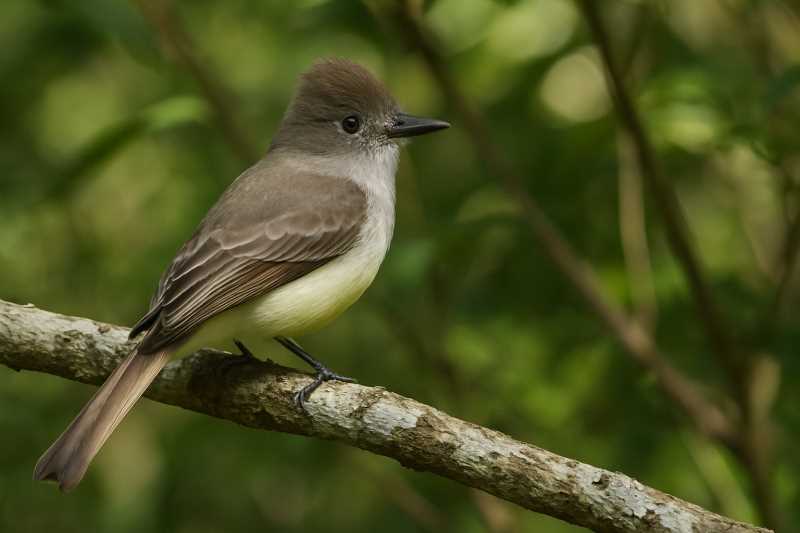
The bird has a rather drab appearance, dominated by gray and brown tones. Its upperparts are olive-brown, while the underparts are pale gray with a wash of yellow on the belly and undertail. The wings are darker with subtle pale edging. A faint crest is sometimes visible on the head, and the bill is dark and slightly broad-based—typical of insectivorous flycatchers. Despite its modest appearance, this subtle color palette provides excellent camouflage in the dappled light of forest understories.
Males and females are alike in plumage, and juveniles resemble adults but may show paler edges on their flight feathers. Identifying this species can be a challenge due to its similarity to other Myiarchus flycatchers in overlapping regions. Vocalizations are often the most reliable method for distinguishing it.
Vocalizations and Behavior
The voice of La Sagra’s Flycatcher is one of its most distinctive traits. It utters a soft, rising “whee-eep” or “wheeu,” often repeated with short pauses. Its calls are less sharp and less insistent than those of other Myiarchus flycatchers, which aids in field identification.
Like many flycatchers, La Sagra’s feeds by sallying from a perch to snatch insects in midair or gleaning them from leaves and branches. It shows a deliberate, patient hunting style, often remaining motionless before darting out after prey. It consumes a diet primarily of flying insects, including beetles, wasps, flies, and caterpillars, but occasionally supplements with small fruits and berries.
This species is generally solitary or seen in pairs. It is shy and often goes unnoticed unless actively sought out by patient observers.
Habitat and Distribution
La Sagra’s Flycatcher is endemic to the Caribbean and favors subtropical or tropical dry forests, moist lowland forests, and secondary growth. It is commonly found in wooded habitats with tall trees and open midstory, especially where perches are abundant.
Its primary range includes Cuba, where it is fairly common, as well as the Bahamas and the Turks and Caicos Islands. It is largely non-migratory, though there may be some local movements in response to food availability or seasonal weather changes.
On rare occasions, vagrants have been spotted in southern Florida, especially in winter, making it a prized sighting for North American birders.
Breeding and Nesting
The breeding season generally coincides with the onset of the rainy season, which increases insect abundance. Nests are typically built in tree cavities or old woodpecker holes, though the species will also use artificial nest boxes when available.
The female lays a clutch of 3–5 eggs, which are creamy white with reddish speckles concentrated at the larger end. Incubation is performed solely by the female, lasting about two weeks. Both parents participate in feeding the nestlings, which fledge after another two weeks or so.
Conservation Status
La Sagra’s Flycatcher is currently listed as a species of Least Concern by the IUCN. It maintains a relatively stable population across its range, largely due to its ability to adapt to secondary growth and modified habitats.
However, deforestation, urbanization, and the destruction of native forests continue to pose localized threats. Protecting native habitats in the Caribbean remains vital not only for this flycatcher but for the myriad endemic species that share its environment.
Observation Tips
To spot La Sagra’s Flycatcher, birders should venture into mature forests or wooded reserves in Cuba or the Bahamas. Early mornings, when the birds are most active and vocal, offer the best chance of detection. Listening for their soft, rising calls and watching for quiet perching behavior can help distinguish them from other flycatchers.
A pair of binoculars and a recorded playback of the call may assist in locating this elusive bird, but ethical birding practices—especially regarding playback—should always be observed to avoid disturbing breeding individuals.
La Sagra’s Flycatcher may not dazzle with color, but it offers a rewarding challenge to birdwatchers seeking a more nuanced and contemplative birding experience. Its delicate voice and graceful foraging are quiet reminders of the diversity and richness of the Caribbean’s avifauna.
Related posts