Introduction
The Freckled Duck (Stictonetta naevosa) is an endemic Australian waterfowl species and the only member of the genus Stictonetta. It is a cryptic, wetland-dependent duck recognised by its dark, finely spotted plumage, peaked head and narrow, slightly upturned bill. Its movements and breeding success are closely linked to rainfall, flooding and the availability of suitable freshwater wetlands.
Physical Description
The Freckled Duck is a medium-sized, heavy-bodied duck measuring approximately 48–59 cm in length. Adult males generally weigh about 747–1,130 g, while females weigh approximately 691–985 g, although individual measurements overlap between the sexes.
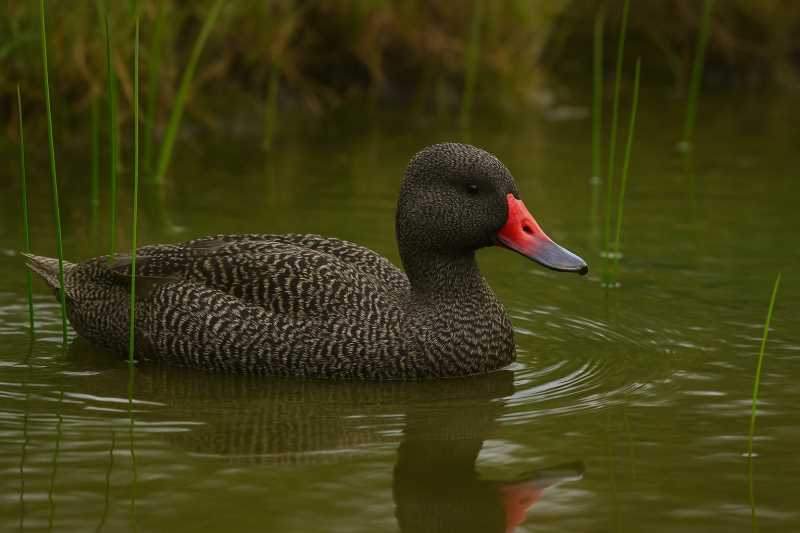
Adults are dark greyish-brown to nearly black, with numerous fine white or buff markings that create a freckled or scaly appearance. The head is large and peaked towards the rear, producing a distinctive angular profile. The bill is narrow, slate-grey and slightly upturned at the tip. The legs and feet are also generally slate-grey.
Males and females are similar outside the breeding season. During the breeding period, the base of the male’s upper bill develops a conspicuous crimson colour. This colour varies in intensity and may fade outside the breeding period, so it is not always visible. Juveniles are paler than adults and may become difficult to distinguish from non-breeding adults as they mature.
Range and Habitat
The Freckled Duck is endemic to Australia. Its main range is in south-eastern and south-western Australia, with records extending across inland wetland systems and occasional occurrences elsewhere. Important breeding areas include temporary freshwater swamps and floodplain wetlands in the Murray–Darling, Bulloo and Lake Eyre drainage systems.
Breeding habitat usually consists of large, densely vegetated freshwater swamps formed or replenished by flooding. Lignum, cumbungi or bulrushes, tea-tree and other dense wetland vegetation provide cover for nests and young.
When inland wetlands dry, Freckled Ducks disperse to more permanent waters, including freshwater lakes, reservoirs, farm dams, sewage ponds, coastal lagoons and other floodplain wetlands. Their distribution can therefore change markedly between wet and dry years. During prolonged drought, birds may move towards coastal wetlands in New South Wales and Victoria and other reliable water sources.
Behaviour and Diet
Freckled Ducks are generally quiet and secretive. They often rest during the day in dense vegetation and feed mainly at dawn, dusk and during the night. They may occur in small groups, but large concentrations can form at reliable refuges during dry conditions.
The species feeds on algae, seeds, the vegetative parts of aquatic grasses and sedges, and small aquatic invertebrates. It may filter-feed or forage at the water’s surface and among submerged or emergent vegetation. Although its structure and behaviour differ from those of many dabbling ducks, it can feed using a combination of surface feeding, dabbling and other shallow-water foraging techniques.
Freckled Ducks are capable of travelling considerable distances in response to changing water levels and rainfall. Their movements are best understood as rainfall-driven dispersal rather than regular seasonal migration.
Breeding
Breeding usually occurs from late winter or spring into early summer, commonly between September and December, although nesting can take place at other times when rainfall and wetland conditions are favourable. Nests are built in dense vegetation at or close to water level, often in lignum or other well-compacted wetland plants. They are shallow structures made from twigs and plant material and lined with down.
The usual clutch is about five to seven eggs, although larger clutches can result from more than one female laying in the same nest. Incubation lasts approximately 28 days and is performed by the female. The ducklings are covered in down, leave the nest soon after hatching and remain under the protection of the adults while developing.
Identification Tips
Look for the following combination of features:
- Dark greyish-brown plumage covered with fine white or buff flecks.
- A large head with a noticeable peak towards the rear.
- A narrow, slate-grey bill that curves slightly upwards at the tip.
- A relatively heavy body and high-floating appearance on the water.
- A crimson base to the upper bill in breeding males.
- A quiet, secretive behaviour and a preference for resting in dense wetland cover.
The Freckled Duck can be confused with other dark or brown Australian ducks, especially at a distance. Its fine all-over freckling, peaked head and narrow upturned bill are useful distinguishing features. The breeding male’s red bill base is particularly helpful, but it should not be expected on females or non-breeding males.
Conservation Status
The Freckled Duck is listed globally as Least Concern on the IUCN Red List, but it is considered threatened in parts of Australia, including Vulnerable in New South Wales. Global status and state or territory listings address different assessment frameworks, so a species can be globally Least Concern while remaining a conservation priority within particular jurisdictions.
The principal threats are the drainage and clearing of wetlands, changes to natural flooding and river flows caused by dams, weirs and irrigation, grazing and trampling by livestock, and illegal or accidental shooting. The species’ dependence on temporary inland wetlands also makes it vulnerable to prolonged drought and altered rainfall patterns.
Important conservation measures include protecting breeding swamps and permanent drought refuges, maintaining environmental water flows, retaining dense wetland vegetation, reducing livestock damage, improving wetland connectivity and preventing illegal shooting. Conservation breeding has also been used as a supplementary safeguard in Australia, although protection and restoration of wild wetland habitat remain central to the species’ long-term security.
Frequently Asked Questions
Where does the Freckled Duck live?
The Freckled Duck lives only in Australia. It breeds mainly in densely vegetated inland freshwater swamps and floodplain wetlands, then disperses to more permanent lakes, reservoirs, dams, sewage ponds and coastal wetlands when inland waters dry.
Is the Freckled Duck rare?
The Freckled Duck is uncommon and locally threatened, although its global IUCN category is Least Concern. Its numbers and distribution can fluctuate substantially because breeding depends on suitable flooding and rainfall conditions.
What does the Freckled Duck eat?
Its diet includes algae, seeds, aquatic grasses and sedges, other plant material and small aquatic invertebrates. It usually feeds at dawn, dusk and during the night.
How can a Freckled Duck be identified?
Identify it by its dark, finely flecked plumage, peaked rear crown, narrow upturned bill and heavy body. In breeding males, the base of the upper bill becomes crimson.
When does the Freckled Duck breed?
Breeding commonly occurs from September to December, but the timing varies with rainfall and flooding. Nesting can occur outside this period when wetland conditions are favourable.
What threatens the Freckled Duck?
Major threats include wetland drainage and clearing, altered river flows and flooding, drought, livestock damage to wetland vegetation, and illegal or accidental shooting.
References
- Australian Museum. 2024. “Freckled Duck.” The Australian Museum, updated 18 July 2024. https://australian.museum/learn/animals/birds/freckled-duck/ Accessed 8 September 2026.
- Australian Bird Study Association. 2020. Freckled Duck Stictonetta naevosa: Bird in the Hand, Second Edition. Australian Bird Study Association, with measurements and ageing information reproduced from BirdLife Australia’s HANZAB material. https://absa.asn.au/wp-content/uploads/2020/05/Freckled-Duck.pdf Accessed 8 September 2026.
- BirdLife Australia. n.d. “HANZAB Taxonomy: Freckled Duck Stictonetta naevosa.” Handbook of Australian, New Zealand and Antarctic Birds. https://hanzab.birdlife.org.au/hanzab-taxonomy/hanzab-taxonomy-top/ Accessed 8 September 2026.
- IUCN. 2026. The IUCN Red List of Threatened Species. Version 2026-1. International Union for Conservation of Nature. https://www.iucnredlist.org/species/22679836 Accessed 8 September 2026.
- International Ornithologists’ Union. 2026. “Freckled Duck, Stictonetta naevosa.” IOC World Bird List, version 15.2. https://www.worldbirdnames.org/bow/anatidae/ Accessed 8 September 2026.
- Marchant, S., and P. J. Higgins, eds. 1990. Handbook of Australian, New Zealand and Antarctic Birds. Volume 1: Ratites to Ducks, Part B: Australian Pelican to Ducks. Oxford University Press, Melbourne.
- New South Wales Government. 2023. “Native biodiversity: Freckled duck.” Environment and Heritage. https://www.environment.nsw.gov.au/about-us/get-involved/sydney-nature/native-biodiversity Accessed 8 September 2026.
- New South Wales Government. n.d. “Freckled Duck, Stictonetta naevosa.” Threatened Species of the Central West. Local Land Services NSW. https://www.lls.nsw.gov.au/__data/assets/pdf_file/0006/1252437/Threatened-species-of-the-Central-West_web.pdf Accessed 8 September 2026.
Related posts