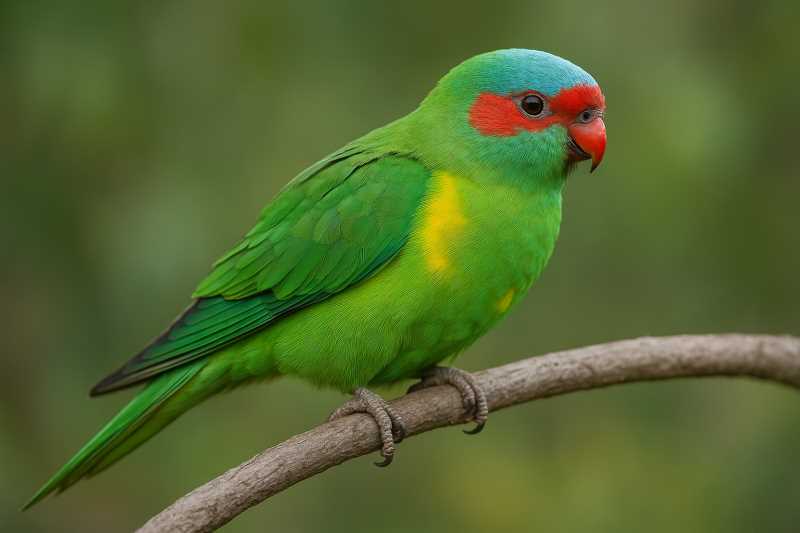
The Musk Lorikeet (Glossopsitta concinna) is one of Australia’s lesser-known but strikingly beautiful parrots. Smaller and less flamboyant than some of its rainbow-colored relatives, this lorikeet stands out with its sleek green plumage, contrasting crimson facial markings, and swift, darting flight. Endemic to south-eastern Australia, it is a species well-adapted to the temperate woodlands, urban parks, and flowering gardens of the region.
Physical Description
Measuring approximately 22 to 24 cm in length, the Musk Lorikeet has a slim build and a relatively long, pointed tail. Its primary color is a bright, leafy green, which provides excellent camouflage among the eucalypt canopy. The face is marked with a distinct patch of red that extends across the forehead and around the eyes, while a small blue area is visible near the crown and nape. The underparts are slightly paler green, and the flight feathers are tinged with yellowish hues. The beak is orange-red, and the legs and feet are grey.
Juveniles are duller in appearance, lacking the intensity of the red facial markings and possessing a brownish beak that turns orange as they mature.
Distribution and Habitat
Musk Lorikeets are found predominantly in south-eastern Australia, including eastern South Australia, most of Victoria, and parts of southern New South Wales. They are nomadic, moving in response to the flowering of eucalyptus and other native trees that provide their food. These lorikeets thrive in open eucalypt forests, woodlands, and areas with abundant flowering vegetation. In recent decades, they have adapted well to urban areas, particularly in cities like Melbourne and Adelaide, where they are frequently seen in suburban parks and gardens.
Diet and Feeding Behavior
Like other lorikeets, Musk Lorikeets have brush-tipped tongues specially adapted for feeding on nectar and pollen. They primarily feed from flowering eucalypts, bottlebrushes (Callistemon spp.), and grevilleas, playing a crucial role as pollinators in their ecosystem. Their diet also includes soft fruits and, occasionally, small insects.
Feeding often occurs in small, fast-moving flocks. Their rapid, agile flight and incessant chattering make them noticeable even when high in the treetops. While feeding, Musk Lorikeets can be quite vocal and animated, often hanging upside-down to access blooms.
Breeding and Life Cycle
The breeding season of the Musk Lorikeet typically runs from August to January, though this can vary depending on food availability. They nest in tree hollows—preferably in older, mature eucalyptus trees—where the female lays two white eggs. Both parents share incubation duties and care for the chicks after hatching.
Chicks fledge approximately 6 to 8 weeks after hatching but remain dependent on their parents for food for several weeks afterward. Suitable nesting sites are becoming increasingly scarce in many areas, which may limit population growth despite their adaptability.
Behavior and Social Structure
Musk Lorikeets are social birds and are usually seen in small flocks. Outside of the breeding season, these flocks can grow larger, especially when food is abundant. They are diurnal and most active in the early morning and late afternoon, when feeding activity is at its peak.
Though generally tolerant of other lorikeet species such as the Rainbow and Little Lorikeet, competition for food resources can occur, particularly in urban gardens. Despite their noisy behavior during feeding, Musk Lorikeets are often overshadowed by the more brightly colored Rainbow Lorikeet, leading them to be less recognized by the general public.
Conservation Status
The Musk Lorikeet is currently classified as a species of Least Concern by the IUCN. However, habitat loss—especially the reduction of mature eucalypt forests and nesting hollows—poses a growing threat. Urban expansion and agricultural clearing have fragmented many natural habitats, though the species’ ability to adapt to city environments has somewhat mitigated the impacts.
Continued monitoring of populations and the protection of mature trees with nesting hollows will be essential for ensuring their long-term survival. Additionally, encouraging the planting of native flowering species in urban areas supports these important pollinators.
Final Thoughts
The Musk Lorikeet may not have the flamboyance of some of its cousins, but its subtle beauty, ecological importance, and adaptability make it a valuable and cherished part of Australia’s avian fauna. Birdwatchers and gardeners alike can contribute to its conservation by recognizing its presence and supporting the native vegetation it depends on.
Related posts