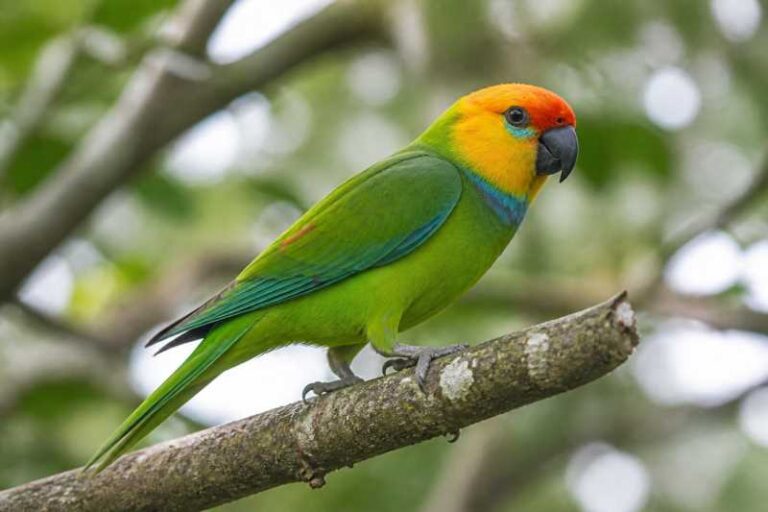
Among the most vivid and charismatic birds of the African bush, the Crested Barbet (Trachyphonus vaillantii) stands out with its riot of colours, distinctive call, and fearless behaviour. Found across a wide swath of sub-Saharan Africa, particularly in woodland and savanna habitats, this chunky barbet species is a favourite among birders, photographers, and nature enthusiasts.
Description and Identification
The Crested Barbet is a medium-sized bird, approximately 23–25 cm long, with a stout body and a prominent, bushy crest. Its plumage is nothing short of spectacular—a patchwork of yellow, red, black, and white that gives the bird a speckled, almost mosaic appearance. The yellow belly is flecked with black, while the head and throat are often tinged with red. Black and white streaking on the wings adds contrast, and the bird’s short, thick bill is adapted for pecking into wood and fruit.
Both sexes are similar in appearance, although males typically have slightly more intense red on the face and throat. Juveniles are duller, with less defined markings and a less pronounced crest.
Distribution and Habitat
Crested Barbets are widely distributed across the southern and eastern parts of Africa. Their range extends through South Africa, Botswana, Zimbabwe, Namibia, Zambia, and into southern Angola and Mozambique. They are particularly common in woodland, thornveld, gardens, and suburban areas where mature trees provide nesting and feeding opportunities.
These birds are resident year-round and are often seen perched conspicuously on tree branches or foraging along the ground for fallen fruit, insects, and other small invertebrates.
Behaviour and Diet
Despite their flamboyant appearance, Crested Barbets are remarkably territorial and aggressive. They will readily chase off other birds, even those much larger than themselves. Their territorial calls—a loud, trilling, vibrating series of notes—can carry over great distances and are often repeated for long periods, especially in the early morning. This call plays a critical role in marking their territory and attracting mates.
Diet-wise, Crested Barbets are omnivorous. They feed on a mix of fruits, insects, and larvae, as well as seeds and even the occasional small vertebrate. They are known to raid nests of other birds, eating eggs or chicks, which is relatively unusual for a bird of this type.
Their robust, chisel-like bills allow them to excavate cavities in dead wood or soft tree trunks, which they use for nesting. These holes are also frequently reused or taken over by other species such as hornbills or woodpeckers once the barbet has vacated.
Breeding and Nesting
Crested Barbets breed from September to December in most of their range, coinciding with the warmer, wetter season. They excavate nest cavities in dead tree trunks or large branches, typically 1–4 metres above ground. The female lays 2 to 5 eggs, which are incubated for about 13 to 17 days. Both parents share in the incubation and feeding of the chicks.
Nesting pairs are fiercely defensive of their nest sites, attacking potential predators or intruders that venture too close. The chicks fledge after approximately 31 days but may remain in the territory for a while before dispersing.
Conservation Status
The Crested Barbet is listed as Least Concern by the IUCN Red List due to its wide range and stable population. Urbanisation and habitat fragmentation have had relatively little negative impact on the species, and they have adapted well to gardens and suburban parks, often benefiting from artificial water sources and fruiting trees.
Nonetheless, large-scale deforestation and the removal of deadwood—which they rely on for nesting—can pose localized threats. Retaining snags and mature trees in both rural and urban landscapes can help sustain their populations.
Cultural Significance and Ecotourism
In African folklore, the Crested Barbet’s unusual call and striking plumage have led to various cultural interpretations. Some tribes consider it a bird of luck or omen, while others associate it with protection of the home due to its loud, watchful nature.
For birders and wildlife photographers, the Crested Barbet provides an irresistible subject. Its bold colours, charismatic behaviour, and frequent visibility in accessible habitats make it a favourite among visitors to southern Africa’s game reserves and national parks.
Conclusion
The Crested Barbet is a true gem of the African landscape—a bird as bold in behaviour as it is in colour. Its success in adapting to both wild and urban environments demonstrates the resilience of certain species in a changing world. For anyone with an eye on the treetops in southern Africa, the sight (and sound) of a Crested Barbet is an unforgettable highlight.
Related posts