Introduction
The Small Sun Squirrel, scientifically known as Heliosciurus punctatus, is a captivating species of rodent belonging to the Sciuridae family. This small mammal, with its unique characteristics and behaviors, inhabits specific regions of Africa, contributing significantly to the ecological balance of its habitat. As we delve into the fascinating world of the Small Sun Squirrel, we aim to uncover the intricacies of its existence, from its physical description to its behavior, diet, and conservation status.
Physical Description
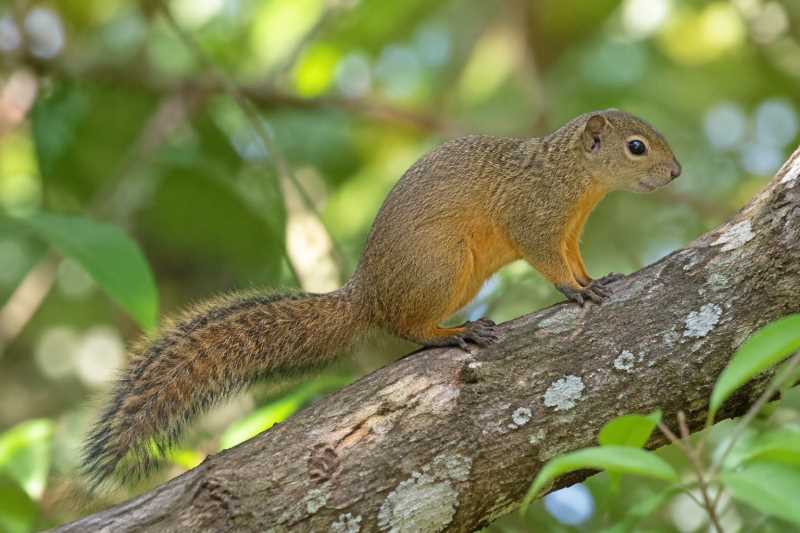
The Small Sun Squirrel is a relatively small rodent, with adult specimens typically measuring between 18 to 23 centimeters in body length, excluding the tail. The tail itself adds an additional 15 to 20 centimeters, providing balance and agility as the squirrel navigates through its arboreal environment. This species is adorned with a soft, dense fur coat, predominantly a greyish-brown color with subtle yellowish or reddish hues—a characteristic that aids in camouflage within its natural habitat.
One of the distinguishing features of Heliosciurus punctatus is its pointed snout and large, expressive eyes, which facilitate excellent vision. The ears are small and rounded, enhancing its auditory capabilities, crucial for detecting predators and communicating with conspecifics. The limbs are strong and well-suited for climbing, with sharp claws that provide a firm grip on tree bark.
Range and Habitat
The Small Sun Squirrel is native to the forested regions of Central and West Africa. Its range extends across countries such as Nigeria, Cameroon, Gabon, and the Democratic Republic of the Congo. Preferring tropical and subtropical moist broadleaf forests, this species thrives in dense canopies where it can find ample food sources and shelter from predators.
This squirrel is highly arboreal, spending most of its life in the trees. It exhibits a preference for primary forests but can also be found in secondary forests and occasionally in plantations. The availability of fruiting trees, which are crucial for its diet, often dictates its choice of habitat.
Behavior and Diet
The Small Sun Squirrel is primarily diurnal, meaning it is most active during the day. Its behavior is characterized by agile movements through the forest canopy, where it forages for food. This species is omnivorous, with a diet consisting mostly of fruits, seeds, nuts, and occasionally insects and small vertebrates. Its feeding habits play a significant role in seed dispersal, contributing to forest regeneration.
Socially, Heliosciurus punctatus is known to be solitary or found in small family groups. Communication among individuals includes a variety of vocalizations and physical gestures, which are used to establish territory and alert others to the presence of predators.
Identification Tips (Field Recognition Cues)
Identifying the Small Sun Squirrel in the wild requires attention to several key characteristics:
- Size and Shape: Look for a small rodent with a body length of 18 to 23 centimeters and a tail of similar length.
- Coloration: Notice the greyish-brown fur with yellowish or reddish hues, which blends well with the forest environment.
- Movement: Observe the agile and quick movements through the canopy, a testament to its arboreal lifestyle.
- Vocalizations: Listen for the distinct calls used for communication and alerting others of potential danger.
Conservation Status (With Threats and Protections)
The conservation status of the Small Sun Squirrel is currently listed as Least Concern by the International Union for Conservation of Nature (IUCN). Despite this classification, the species faces several threats that could impact its population in the future.
Threats
- Habitat Destruction: Deforestation for agriculture, logging, and urban development poses a significant threat to its habitat.
- Hunting: In some regions, the Small Sun Squirrel is hunted for bushmeat, although this is not a widespread practice.
Protections
Efforts to conserve this species include the establishment of protected areas and national parks within its range. Conservationists advocate for sustainable forestry practices and the protection of primary forests to ensure the survival of the Small Sun Squirrel and other forest-dwelling species.
Frequently Asked Questions
Why is this species unique?
The Small Sun Squirrel is unique due to its arboreal lifestyle and role in seed dispersal, which helps maintain forest ecosystems. Its physical adaptations, such as sharp claws and excellent vision, enhance its survival in dense forest habitats.
What role does this squirrel play in its ecosystem?
As a seed disperser, the Small Sun Squirrel contributes to forest regeneration. By consuming fruits and dispersing seeds across its habitat, it aids in the propagation of various plant species.
How can we help conserve the Small Sun Squirrel?
Supporting conservation initiatives that focus on habitat protection and sustainable forestry practices can help safeguard the future of the Small Sun Squirrel. Advocacy for the preservation of primary forests is crucial.
Is the Small Sun Squirrel endangered?
Currently, the Small Sun Squirrel is not endangered and is classified as Least Concern. However, ongoing habitat destruction could pose future risks, emphasizing the need for continued conservation efforts.
Related posts