The Orange-throated Tanager: A Jewel of the Peruvian Forests
The Orange-throated Tanager (Wetmorethraupis sterrhopteron) is a remarkable avian species that has captured the attention of ornithologists and bird enthusiasts alike. Endemic to the lush, humid forests of northern Peru, this species is not only noted for its vibrant plumage but also for its unique behavioral and ecological characteristics. In this article, we explore the various facets of the Orange-throated Tanager, from its habitat and distribution to its conservation status and ecological significance.
Habitat and Distribution
The Orange-throated Tanager is primarily found in the lowland and foothill forests of the Peruvian Andes. These regions are characterized by their high humidity, dense vegetation, and rich biodiversity. The species’ range is relatively restricted, occurring predominantly in the departments of Amazonas and San Martín. Within these areas, the tanager inhabits subtropical or tropical moist lowland forests, where it prefers the canopy layer.
These forests play a crucial role in supporting the tanager’s life cycle, offering abundant food resources and suitable nesting sites. The complexity of the canopy provides ample opportunities for foraging, as well as protection from predators. However, habitat loss due to deforestation and agricultural expansion poses a significant threat to these birds, making the conservation of their natural environment critical for their survival.
Physical Characteristics
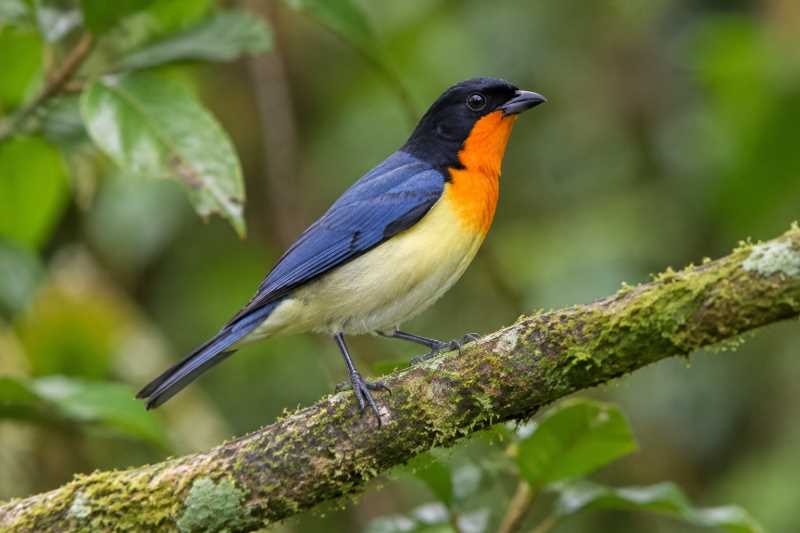
The Orange-throated Tanager is a striking bird, easily recognizable by its bright orange throat and chest, which contrast vividly with its predominantly blue and green body. The wings and tail display a rich combination of olive and blue hues, adding to the bird’s visual appeal. Adult tanagers typically measure around 19 cm in length and weigh approximately 42-48 grams.
Their robust bills are adapted for a varied diet, which includes fruits, insects, and small invertebrates. The vibrant plumage not only plays a role in mating displays but also aids in camouflage among the colorful foliage of their forest habitat.
Behavior and Diet
Orange-throated Tanagers are social birds, often found in pairs or small family groups. They are known for their lively and energetic behavior, frequently engaging in acrobatic foraging techniques to locate food. Their diet is diverse, consisting mainly of fruits, but they also consume insects and small arthropods, which they skillfully extract from tree bark and foliage.
These tanagers are also known to participate in mixed-species foraging flocks, a behavior that increases foraging efficiency and offers protection from predators through the ‘safety in numbers’ effect. The cooperative nature of these flocks allows the tanagers to exploit a wider range of food resources and habitats.
Reproduction and Lifespan
The breeding season for the Orange-throated Tanager typically coincides with the onset of the rainy season, when food resources are abundant. They are believed to be monogamous, with both parents participating in nest building, incubation, and feeding of the young. Nests are usually constructed high in the canopy, concealed among dense foliage to protect against predators.
Clutch sizes generally range from two to three eggs, which are incubated for approximately 14 days. Once hatched, the chicks are altricial, meaning they are born relatively undeveloped and require significant parental care. The fledging period lasts about 18-20 days, after which the young birds gradually become independent.
Conservation Status
The conservation status of the Orange-throated Tanager is currently listed as "Near Threatened" by the International Union for Conservation of Nature (IUCN). The primary threats to their survival include habitat loss due to deforestation and fragmentation, driven by logging, agriculture, and infrastructure development.
Conservation efforts are focused on preserving the remaining tracts of lowland and foothill forests in northern Peru, which are crucial for the survival of this and many other endemic species. Establishing protected areas and promoting sustainable land-use practices are key strategies in mitigating the impact of human activities on these delicate ecosystems.
Ecological Significance
The Orange-throated Tanager plays a vital role in the ecosystem as both a seed disperser and an insect predator. By consuming a variety of fruits, these birds aid in the distribution of seeds throughout the forest, facilitating plant regeneration and maintaining biodiversity. Their insectivorous habits contribute to controlling pest populations, thus helping to maintain ecological balance.
Additionally, as a member of mixed-species flocks, the Orange-throated Tanager contributes to the complex social dynamics of the forest avifauna, promoting interspecies interactions that enhance biodiversity and ecosystem resilience.
Conclusion
The Orange-throated Tanager is an exquisite example of the rich biodiversity found in Peru’s tropical forests. Its striking appearance, combined with its ecological role, underscores the importance of conserving its habitat. As scientists and conservationists continue to study and protect this species, it serves as a reminder of the intricate web of life that thrives in these vibrant ecosystems.
Efforts to preserve the Orange-throated Tanager and its habitat not only benefit this particular species but also the multitude of other organisms that share its environment. Continued research and conservation initiatives are essential to ensuring that future generations can enjoy the beauty and ecological contributions of the Orange-throated Tanager.
Related posts