Introduction
The Sula Pitta, Erythropitta dohertyi, is a little-known forest bird endemic to Indonesia’s Banggai and Sula island groups, east of Sulawesi. It belongs to the pitta family, Pittidae, a group known for compact bodies, vivid plumage and ground-foraging habits. The species is currently recognised as distinct by the IOC World Bird List and BirdLife International, although it was formerly treated as a subspecies of the Red-bellied Pitta complex under the name Pitta erythrogaster dohertyi. (worldbirdnames.org)
Sula Pitta is a resident rather than a migrant. It occupies moist lowland forest and some less intensively disturbed secondary habitats, usually below about 800 metres. Although its known range is geographically restricted and the population is considered to be declining, the current global assessment is Least Concern because the species is not thought to have a very small population or to be declining rapidly enough to meet a threatened-category threshold. The number of mature individuals has not been quantified. (datazone.birdlife.org)
This is a secretive bird, and reliable information about its behaviour, breeding biology and population density remains limited. Much of what is known comes from field observations on Peleng and the Sula Islands, recent conservation assessments, museum material and comparison with closely related pittas. Consequently, some aspects of its natural history should be regarded as provisional rather than fully established.
Physical Description
The Sula Pitta is a compact, short-tailed forest bird measuring approximately 16–18 centimetres in length in commonly used field references. It has the characteristic pitta shape: a relatively large head, sturdy bill, short tail, rounded wings and strong legs suited to moving through leaf litter. Its body appears stocky when perched or walking, but the bird can make quick, low flights between patches of cover. (birdforum.net)
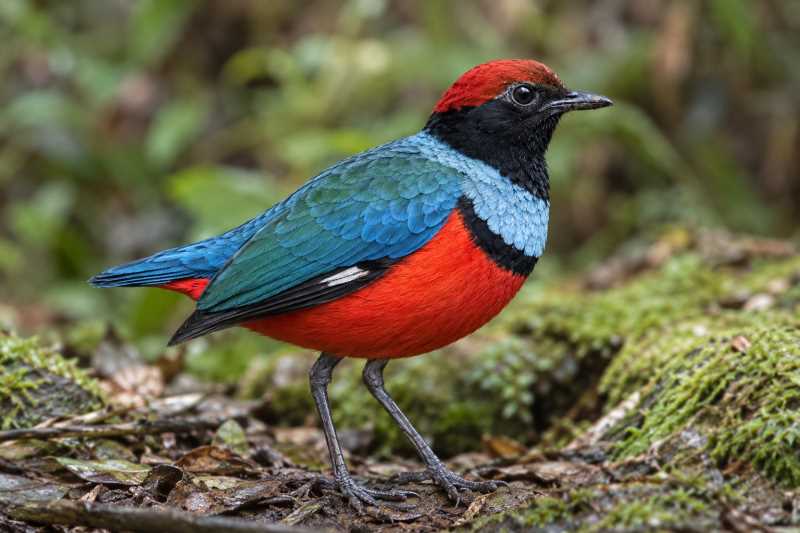
Adult plumage is striking but can be difficult to see in the dim understorey. The upperparts are predominantly glossy green, with a blue or blue-green area on the wings and shoulder. The head, face and throat are largely dark, contrasting with a rich chestnut to red-orange crown and hindcrown. A narrow pale blue band or stripe across the upper breast separates the dark throat and chest from the darker lower underparts. The belly and vent are vivid red, providing the most obvious flash of colour when the bird moves through vegetation.
Detailed descriptions of museum specimens and taxonomic studies identify a prominent sky-blue central crown stripe, dark lateral crown markings extending towards the nape, a ferruginous-red area on the hindneck and a dark band across the lower hindneck. A blue band across the upper mantle can separate this dark collar from the green back. The mantle and upper scapular feathers may show a subtle scaled effect because of their darker centres and paler green edges, especially when the plumage is worn. (researchgate.net)
The sexes are broadly similar in plumage, which means that sexing a bird in the field is usually difficult. Some field descriptions report a difference in iris colour, with females having a pale or whitish iris, while males may show a darker iris. This feature should be treated as supportive rather than decisive because viewing conditions in dense forest can make eye colour difficult to assess. (birdforum.net)
Age-related plumage is poorly documented. Juveniles are not as well described as those of more frequently studied pittas, and there is no dependable field guide account that allows every immature stage to be separated with confidence. Young birds should therefore be identified from their overall structure, habitat, colour pattern and any visible development of the adult crown, breast and belly markings rather than from a single assumed juvenile character.
The bill is relatively short and slender compared with some other members of the Red-bellied Pitta group. The legs are strong and adapted for walking and hopping on the forest floor. Like other pittas, the Sula Pitta often remains low, where its green back blends with foliage and its bright colours are visible only briefly when it turns or moves into an opening.
Range and Habitat
Sula Pitta is endemic to Indonesia. Its accepted range includes the Banggai Islands, particularly Peleng and Banggai, and the Sula Islands, including Taliabu, Seho and Mangole. The distribution is therefore spread across several islands rather than being confined to the island called Sula. It is a breeding endemic and is considered resident throughout its range. (datazone.birdlife.org)
The species is associated mainly with tropical moist lowland forest. BirdLife International gives an elevational range of approximately sea level to 800 metres, while older field accounts have tended to emphasise lowland evergreen forest and sites below about 200 metres. These figures are not necessarily contradictory: the pitta may occur across a broad lowland belt, with local records extending upwards where suitable forest remains. The available evidence does not justify treating it as a high-elevation specialist. (datazone.birdlife.org)
Habitat use includes primary forest, secondary forest and selectively logged forest, as well as areas containing bamboo. However, tolerance of disturbance appears limited. During recent surveys on Peleng, the species was recorded at only five of eleven surveyed sites and was absent from heavily disturbed agricultural and scrubby landscapes. The occupied sites generally retained well-developed trees and canopy cover. This suggests that Sula Pitta may use modified forest, but not open farmland or severely degraded vegetation on a regular basis. (datazone.birdlife.org)
The bird’s preference for forest with intact canopy and ground cover is ecologically significant. Pittas forage close to the ground, but the quality of the forest floor is influenced by the surrounding vegetation. Leaf litter, shade, humidity, fallen branches and dense understorey can provide both feeding opportunities and protection from predators. Clearing for crops or repeated burning removes this structure and may also reduce the invertebrates on which the species depends.
There is little published evidence for consistent geographic variation within the species. Sula Pitta is generally treated as monotypic in modern species accounts, although the populations on separate islands may deserve further study. The islands of the Banggai and Sula groups have distinctive biogeographic histories, and additional surveys, vocal analysis and genetic work could clarify whether geographically separated populations differ in measurable ways.
Where to See This Species
Sula Pitta is not an easy species to see. Most of its range lacks developed birdwatching infrastructure, formal visitor trails or regular wildlife tourism. The locations below are included because the species has been documented or specifically identified as likely to occur there. Travel to these islands should be arranged with local guides, and access conditions may change.
Peleng Island forests, Banggai Islands, Central Sulawesi, Indonesia
Peleng is one of the most realistic places to search for Sula Pitta because the species has been recorded during field surveys and has also been encountered by organised birding groups. Forested areas on the island support several restricted-range birds, and Sula Pitta has been observed in wooded sites where canopy cover remains well developed. Recent survey work found it at five of eleven sites, while highly disturbed agricultural and scrub-dominated areas produced no records. (forums.birdlife.org)
The best strategy is to work slowly along forest edges, shaded tracks and quiet interior paths, paying attention to movement on the ground and to brief flashes of blue, green or red. The species is likely to be missed if observers concentrate only on the canopy. Peleng is not a conventional national park with extensive visitor facilities, so birders should use a local guide and confirm access, transport and permission before travelling.
Nearby accommodation: Tataba and other local villages can serve as basic homestay or guest-house bases, while Luwuk on Sulawesi provides a wider choice of hotels and guest houses and is the main practical gateway for travel to the Banggai Islands.
Taliabu Nature Reserve, Taliabu Island, North Maluku, Indonesia
BirdLife International identifies Taliabu Nature Reserve as a protected area where Sula Pitta is likely to occur. The reserve contains the type of forest habitat used by the species, but the assessment also makes clear that direct information from within the reserve is limited. It should therefore be regarded as a plausible conservation site and a serious survey location, not as a guaranteed birding destination. (datazone.birdlife.org)
The most suitable habitat is likely to be moist, relatively intact forest at low and middle elevations, especially where the understorey and leaf litter remain undisturbed. Because Taliabu is remote and visitor information is limited, a visit requires careful logistical planning, local assistance and confirmation of regulations with the relevant Indonesian conservation authorities. The absence of a developed tourist trail should be expected.
Nearby accommodation: Bobong is the principal settlement and practical gateway on Taliabu, with basic local guest-house accommodation and simple lodging options. Field teams may also need to arrange village-based stays or expedition-style camping, depending on the survey area and access conditions.
Behaviour and Diet
Sula Pitta is diurnal and terrestrial. It spends much of its active time on or close to the forest floor, where it moves through leaf litter and low vegetation in short hops and quick steps. Its compact shape and short tail are well suited to this environment. When disturbed, it may remain motionless in cover before making a short, low flight rather than immediately flying into the canopy.
The species is regarded as secretive and uncommon. It is often encountered alone or in pairs, although the limited number of observations makes it difficult to define its normal social system. Pittas commonly maintain contact through calls while moving through dense vegetation, but the vocal repertoire and territorial behaviour of Sula Pitta have not been studied in detail. Observers should not assume that a silent bird is absent, because its unobtrusive movements and preference for shaded cover make it easy to overlook.
Available ecological information places the species in the ground-foraging invertivore guild. Its diet is expected to consist mainly of invertebrates, including insects and other small soil or leaf-litter animals. Earthworms and similar prey are plausible components of the diet, as they are important foods for many related pittas, but the exact proportions of prey types in Sula Pitta have not been quantified. It may also take small amounts of other animal or plant material, but firm species-specific evidence is limited. (oiseaux.net)
Foraging birds may pause, tilt the head and probe or flick through leaf litter while searching for prey. They are most likely to be encountered in shaded, humid areas with a continuous layer of fallen leaves and some low cover. Forest tracks can be useful because they provide a clearer view of the ground, but birds may avoid exposed stretches and retreat quickly into vegetation.
Breeding biology remains poorly known. Historical observations from Mangole have been interpreted as suggesting breeding activity late in the year, possibly around October and November, but the evidence is old and should not be treated as a confirmed island-wide breeding season. The nest, eggs and incubation behaviour have not been adequately documented for the species. Information from related pittas suggests that nests may be domed structures placed close to the ground or in dense low vegetation, but this is an inference from relatives and not a securely established description for Sula Pitta. (oiseaux.net)
There is no evidence that Sula Pitta undertakes regular seasonal migration. BirdLife International classifies it as not a migrant, which is consistent with its island-restricted distribution and resident forest ecology. Local movements may still occur in response to breeding, food availability or habitat disturbance, but these have not been documented sufficiently to describe a normal movement pattern.
Identification Tips
When trying to identify Sula Pitta, concentrate on the combination of structure, habitat and colour rather than on a single mark. The most useful field characters are:
- A compact, short-tailed pitta shape, usually seen walking or hopping on the forest floor.
- Glossy green upperparts and blue on the wings or shoulder.
- A dark face, throat and upper chest.
- A chestnut or red-orange crown, often contrasted with dark crown markings.
- A narrow pale blue breast band or upper-breast marking.
- A strong red belly and vent, often visible only briefly when the bird turns.
- A preference for shaded moist forest, dense understorey and leaf litter.
The Sula Pitta can be confused with other members of the former Red-bellied Pitta complex, especially where range maps, older literature or historical labels use the name Pitta erythrogaster. The Sula form is distinguished by its combination of a prominent blue central crown stripe, dark lateral crown and nape markings, a dark hindneck band, green mantle and vivid red underparts. Detailed comparison may require a good view or a photograph because many of the relevant characters are small and difficult to assess in poor light. (researchgate.net)
It should not be identified solely from a red belly. Several pittas have red or orange underparts, and brief views can produce misleading impressions. The blue crown and breast markings, dark throat, green back and island location together provide a much safer identification framework.
A bird seen in open farmland, dry scrub or heavily disturbed grassland is less likely to be Sula Pitta than a bird in mature or recovering forest. Habitat is particularly useful on Peleng, where recent surveys found the species in sites retaining canopy and did not find it in the most severely altered landscapes. Calls may help locate a bird, but the species’ vocal behaviour is insufficiently documented for a detailed call-based identification guide.
Conservation Status
The current IUCN Red List category for Sula Pitta is Least Concern. This assessment was reviewed in 2023. BirdLife International reports that the number of mature individuals is unknown, the population trend is decreasing and the species is described as uncommon, but the available evidence does not indicate a population small enough or a decline rapid enough for a threatened category. (datazone.birdlife.org)
The principal threat is loss and degradation of lowland forest. Commercial logging, small-scale agriculture and slash-and-burn cultivation are identified as important pressures across the species’ range. Forest clearance removes feeding habitat and canopy cover, while repeated burning and grazing can simplify the understorey and degrade the leaf-litter environment on which ground-foraging pittas depend. (datazone.birdlife.org)
The species’ restricted island distribution increases its vulnerability to local habitat loss. A decline on one island may not immediately place the entire species in a threatened category, but isolated island populations can be difficult to monitor and may have limited opportunities for recolonisation. Recent survey results from Peleng, where the pitta occurred at only some sites and was absent from highly disturbed areas, reinforce the importance of retaining connected forest patches.
BirdLife International indicates that the species is likely to occur in Taliabu Nature Reserve, but also notes that there is no other protected area within its range. Conservation work by Burung Indonesia includes community engagement, awareness and education on the islands. Recommended actions include repeated surveys, studies of habitat requirements and disturbance tolerance, and effective protection of important forest areas through both formal reserves and community-led land management. (datazone.birdlife.org)
The Least Concern category should not be interpreted as evidence that the species is secure in every part of its range. Population estimates are unavailable, the trend is inferred rather than measured directly, and several islands remain poorly surveyed. Better information on abundance, breeding success, island-by-island distribution and responses to secondary forest would improve future assessments.
Frequently Asked Questions
What is the scientific name of the Sula Pitta?
The accepted scientific name is Erythropitta dohertyi. The species was formerly placed within the Red-bellied Pitta complex as Pitta erythrogaster dohertyi, but current IOC and BirdLife taxonomies recognise it as a separate species. (worldbirdnames.org)
Where does the Sula Pitta live?
It is endemic to Indonesia, where it occurs on islands in the Banggai and Sula groups. Documented or recognised range islands include Peleng, Banggai, Taliabu, Seho and Mangole. It is mainly associated with tropical moist lowland forest and some secondary or selectively logged forest. (datazone.birdlife.org)
Is the Sula Pitta endangered?
The current IUCN Red List category is Least Concern. However, the population trend is considered decreasing, mature population size is unknown and forest loss from agriculture, slash-and-burn cultivation and logging remains a concern. Least Concern does not mean that the species is unaffected by habitat loss. (datazone.birdlife.org)
What does the Sula Pitta eat?
It is primarily a ground-foraging invertivore. Its diet is thought to consist mainly of insects and other small invertebrates found in leaf litter and soil. Species-specific dietary studies are limited, so the exact importance of earthworms, larvae and other prey has not been quantified. (oiseaux.net)
Is the Sula Pitta migratory?
No. It is considered a resident, non-migratory species. It may make local movements within its island range, but there is no evidence of regular long-distance migration. (datazone.birdlife.org)
Where is the best place to look for a Sula Pitta?
Forested parts of Peleng Island are among the better documented places to search because the species has been recorded there during surveys and birding visits. Taliabu Nature Reserve is also considered likely to support the species, although access is remote and records from within the reserve are limited. Local guides and careful logistical planning are strongly recommended. (forums.birdlife.org)
References
- BirdLife International
- IOC World Bird List
- Birds of the Indonesian Archipelago: Greater Sundas and Wallacea
Related posts