Introduction
Gurney’s Pitta, Hydrornis gurneyi, is a highly distinctive forest bird of the Thai–Myanmar portion of the Malay Peninsula. It is one of the world’s most range-restricted pittas, and one of South-east Asia’s most threatened birds. The species was long associated with lowland forest in southern Thailand, but its Thai population has undergone a severe decline and is now regarded as functionally extinct in the country. The principal surviving stronghold is in Tanintharyi Region, southern Myanmar, where the bird persists in scattered remnants of lowland evergreen and semi-evergreen forest. (thesiamsociety.org)
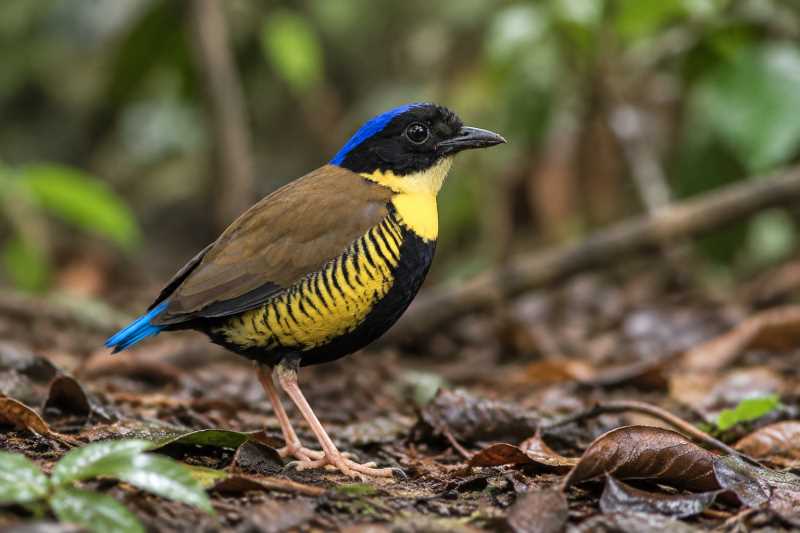
Gurney’s Pitta is especially notable for its strong sexual dimorphism. Adult males have a brilliant blue crown, black face and underparts, a yellow throat band and warm brown upperparts. Females are substantially less colourful, with brownish upperparts and pale, barred underparts. Despite its striking appearance, the species is difficult to observe because it spends much of its time on or close to the forest floor in dense vegetation.
The bird’s scientific name has historically appeared as Pitta gurneyi. Modern classifications place it in the genus Hydrornis, although older literature, conservation documents and local reports may continue to use the former combination. The specific name honours John Henry Gurney, a nineteenth-century British banker and amateur ornithologist.
Physical Description
Gurney’s Pitta is a compact, short-tailed passerine measuring approximately 18.5–20.5 centimetres in length. It has the characteristic pitta shape: a relatively large head, sturdy legs, a short tail, broad wings and a strong, slightly elongated bill suited to probing leaf litter and soft forest soil. Reliable published information on body mass is limited, but available summaries place adults broadly in the range of about 55–70 grams. (thbif.onep.go.th)
The adult male is among the most visually distinctive of all Asian pittas. The crown and nape are iridescent blue, sometimes appearing turquoise or deep cobalt depending on light and viewing distance. The forehead, face and ear-coverts are black. A bright yellow throat and upper-breast band contrasts sharply with the black breast and belly. The flanks are yellow with dark barring, while the back, scapulars and wing-coverts are warm chestnut-brown to rufous-brown. The wings and tail show darker tones, with blue or blue-green highlights that may be difficult to see on a moving bird.
The female is much more cryptically coloured. Her crown and nape are buffy brown or rufous-brown rather than blue. The face is darker brown, and the underparts are mainly buffy white or pale buff, marked with dark barring on the breast, sides and flanks. This difference between the sexes is unusually pronounced. A female standing motionless among dead leaves can be surprisingly difficult to detect, even when a male nearby is conspicuous.
Juvenile plumage is less well documented than adult plumage. Young birds are expected to be duller overall, with reduced contrast and less intense colour than adults. They should not be identified solely by the absence of the adult male’s blue crown, because adult females also lack that feature. Ageing birds in the field is difficult unless a bird is seen very well or photographed under good conditions.
The species has a rounded head, robust legs and a characteristic upright stance when alert. On the ground it may pause with the body held relatively horizontal, then make short, deliberate movements through leaf litter. The wings are generally kept folded, so the blue tones of the wing and tail may appear only briefly as the bird turns, flicks its wings or moves between cover.
Range and Habitat
Gurney’s Pitta is endemic to the Thai–Myanmar section of the Malay Peninsula. Historically, its distribution extended through parts of southern Thailand and the Tanintharyi region of southern Myanmar. Records from Thailand included areas in the provinces of Krabi, Trang, Phang Nga, Surat Thani and adjacent parts of the southern peninsula. By the late twentieth century, the remaining Thai population was concentrated around Khao Nor Chuchi, in and around Khao Pra-Bang Khram Wildlife Sanctuary in Krabi Province. (gpo.gov)
The species was rediscovered in Myanmar in 2003 after a prolonged period with no confirmed records from the country. Subsequent surveys documented birds in southern Tanintharyi, including the Ngawun, Lenya, Htaung Pru and related reserved-forest landscapes. More extensive surveys recorded the species across a wider area than had previously been known, although detection rates were low and the distribution was uneven. (cambridge.org)
Gurney’s Pitta is a resident rather than a long-distance migrant. Local movements may occur, particularly when young birds disperse or when individuals move through fragmented forest, but there is no evidence that the species undertakes regular seasonal migration comparable with that of many northern Asian passerines.
The bird is principally associated with lowland evergreen and semi-evergreen forest. It can occur in primary forest, but research in Myanmar also recorded it in secondary forest, bamboo-rich areas and regenerating forest where dense ground vegetation remained. Occupied sites tended to have abundant seedlings, saplings, bamboo and rattan, suggesting that structural complexity in the lower layers of the forest may be more important than a simple distinction between pristine and secondary woodland. (cambridge.org)
Most records come from relatively low elevations. Earlier accounts often described the species as a bird of level ground below about 100–150 metres, especially near streams, pools, flooded gullies and damp forest depressions. Later surveys in Myanmar extended the known upper limit to approximately 250–300 metres above sea level, although records at higher elevations were uncommon and may not always represent breeding territories. (cambridge.org)
The species’ habitat requirements help explain its vulnerability. Warm, wet, low-lying forest with suitable ground cover is also attractive for roads, agriculture, rubber and oil-palm cultivation. In southern Myanmar, much of the remaining range lies in landscapes where forest conversion has been extensive. A study of habitat change found that suitable lowland forest in the main Myanmar stronghold declined from approximately 3,225 square kilometres in 1999 to about 656 square kilometres by 2017, an estimated loss of roughly 80 per cent. (cambridge.org)
Where to See This Species
Gurney’s Pitta is not a straightforward target for ordinary birdwatching. Much of its remaining range is remote, politically sensitive or difficult to access, and the species is now absent or extremely difficult to find at many historical sites. Any visit should be arranged through the relevant authorities and local communities, with strict attention to current travel, safety and conservation guidance.
Khao Pra-Bang Khram Wildlife Sanctuary, Krabi Province, Thailand
Khao Pra-Bang Khram Wildlife Sanctuary, also known as the Khao Nor Chuchi area, is the species’ best-known public wildlife-viewing site. It was the location of the famous Thai population discovered in the 1980s and remains an important place for understanding the bird’s conservation history. The sanctuary contains lowland evergreen forest, streams, damp gullies, rattan and dense undergrowth, all of which match the habitat used by Gurney’s Pitta. (gpo.gov)
The site should not be treated as a reliable place to see the species today. Scientific assessments and Thai ornithological literature indicate that Gurney’s Pitta became functionally extinct in Thailand after the last known population around Khao Nor Chuchi disappeared. Occasional recent birding reports should be interpreted cautiously unless supported by a well-documented record reviewed by a recognised authority. Visitors can still explore the sanctuary for its remaining lowland-forest birdlife, but should not expect a sighting of Gurney’s Pitta. (thesiamsociety.org)
Nearby accommodation: The practical bases are Ban Bang Tieo and the wider Khlong Thom area, with guest houses, small hotels and other simple accommodation available around the local villages and the Emerald Pool access area. Krabi provides a larger range of hotels and transport services.
The strongest surviving population is in southern Myanmar, particularly the Tanintharyi lowlands around Lenya, Ngawun and associated reserved forests. These areas are documented in scientific surveys, but they are not equivalent to an established, routinely accessible national-park birding site. Access may require official permissions, local coordination and specialist logistical support, and conditions can change rapidly. For that reason, they are not presented here as ordinary public wildlife-viewing venues.
Behaviour and Diet
Gurney’s Pitta is primarily terrestrial. It spends much of its time walking, hopping and making short runs across the forest floor, usually beneath dense vegetation. It forages among fallen leaves, roots, low herbs, rattan and bamboo rather than remaining in the canopy. Its compact body and powerful legs are well suited to this ground-dwelling lifestyle.
Individuals are generally encountered alone or in pairs. During the breeding season, males defend territories through vocalisations and visual displays. A calling male may perch briefly on a low branch, stump or vine, but the bird usually returns quickly to cover. Wing-flicking and other brief movements may accompany territorial or courtship behaviour, although such displays are easily missed in dense forest.
The call is an important means of detection. Gurney’s Pitta is not considered especially vocal outside the breeding period, and its quiet habits contribute to the difficulty of surveying it. Even in occupied habitat, observers may fail to detect birds unless they are close to a calling individual or conduct repeated searches at suitable times.
The diet consists mainly of forest-floor invertebrates. Documented or widely reported prey includes earthworms, insects and slugs. The bird probes leaf litter and loose soil with its bill, turns over small pieces of debris and may pause for long periods before making a sudden feeding movement. Moist ground is likely to be particularly valuable because it supports earthworms and other soft-bodied prey.
Breeding information comes mainly from studies in Thailand. Nests were built most often in spiny rattan or Salacca palms, with fewer nests in climbers or other vegetation. They were usually positioned less than seven metres above the ground and commonly stood near streams, pools or flooded gullies. The nests are domed structures, helping them blend with surrounding foliage and stems. (cambridge.org)
Recorded clutch sizes were two to four eggs, with three or four eggs most frequently reported in the available sample. Incubation lasted approximately 17 days. Both adults contribute to parental care, including feeding the nestlings. Nest predation can be severe. In one study, snakes attacked several nests, and only four of 18 nests with sufficiently known outcomes were confirmed to have produced fledged young. The study also noted that intensive nest guarding prevented additional losses, illustrating how difficult it is for pairs to breed successfully in fragmented habitat. (cambridge.org)
Identification Tips
The combination of habitat, behaviour and plumage is more useful than any single feature. Look for a compact, short-tailed bird moving deliberately through damp lowland forest undergrowth. It may remain still for long periods, then cross a path or gap in vegetation with a quick, low movement.
An adult male is distinctive when seen well. Key features are:
- A bright blue crown and nape.
- A black forehead and face.
- A yellow throat and upper-breast band.
- A black breast and belly.
- Yellow, dark-barred flanks.
- Warm brown upperparts and darker wings.
The adult female is more difficult to identify. Her brown crown, pale buffy underparts and dark barring may suggest several other forest birds at a distance. The short tail, heavy-bodied shape, pitta-like stance and preference for walking on the ground are useful supporting clues. A female Gurney’s Pitta should not be confused with a dull juvenile of another pitta without considering the habitat and structural details.
The most likely confusion species depend on locality. In southern Thailand and Myanmar, other pittas may occupy similar forest, but their colour patterns differ. Banded Pitta, for example, is a genuine habitat associate in parts of the peninsula, yet it lacks the adult male Gurney’s Pitta’s blue crown, yellow throat band and black belly. Blue-winged Pitta is more strongly associated with a blue wing panel and contrasting rufous, buff and blue-green plumage, while Hooded Pitta has a different head pattern and a more uniformly rich green-and-blue appearance. Identification should be based on the complete pattern rather than a fleeting flash of blue.
A recording of the call can be valuable, but playback should be used sparingly or avoided altogether at occupied sites. The species is severely threatened, and repeated disturbance at a territory or nest could impose unnecessary costs on already vulnerable birds.
Conservation Status
Gurney’s Pitta is currently assessed as Critically Endangered on the IUCN Red List. The species’ status has changed as new survey information has become available. Its rediscovery in Myanmar led to an earlier reassessment from Critically Endangered to Endangered, because the Myanmar population and its potential habitat appeared much larger than the remnant Thai population. More recent habitat assessments, however, documented a major decline in suitable forest and renewed concern over the species’ global survival. (nc.iucnredlist.org)
The principal threat is loss and fragmentation of lowland forest. In Tanintharyi, forest has been cleared or degraded for oil-palm plantations, rubber, small-scale agriculture, roads and associated development. Because Gurney’s Pitta is concentrated in warm, wet lowlands, much of its habitat overlaps with areas considered suitable for commercial cultivation. Habitat conversion also isolates territories, reduces breeding opportunities and makes remaining forest more vulnerable to further disturbance. (cambridge.org)
Hunting and trapping have also been reported in the Myanmar range. Pittas may be targeted for the cage-bird trade or captured incidentally during broader exploitation of forest wildlife. Even low levels of trapping can be significant when populations are small and fragmented. Nest predation, particularly by snakes and other native predators, is a natural ecological pressure that may become more damaging when forest fragments concentrate nests and reduce the quality of surrounding habitat.
Conservation priorities include preventing further clearance of the remaining lowland forest, maintaining connectivity between forest blocks, improving protection and enforcement, reducing trapping, and supporting local communities that help safeguard habitat. Proposed protected landscapes in the Tanintharyi region, including the Lenya and related forest areas, have long been identified as important for the species, although formal protection and effective management have not always kept pace with the conservation need. (whc.unesco.org)
Research remains important. Surveys are needed to establish where birds persist, determine whether apparently suitable forest is occupied, monitor population change and clarify the effects of forest regeneration, plantations and fragmentation. Because the species is difficult to detect, absence from a short survey should not automatically be interpreted as proof of local extinction. At the same time, unconfirmed reports should not be used to minimise the seriousness of the documented decline.
Frequently Asked Questions
Where does Gurney’s Pitta live?
Gurney’s Pitta lives in lowland evergreen and semi-evergreen forest in southern Myanmar’s Tanintharyi Region. It formerly occurred more widely in southern Thailand, but the Thai population is considered functionally extinct.
Is Gurney’s Pitta a migratory bird?
No. It is regarded as a resident species. Young birds may disperse and adults may make local movements through suitable forest, but there is no evidence of regular long-distance migration.
What does Gurney’s Pitta eat?
Its diet consists mainly of forest-floor invertebrates, including earthworms, insects and slugs. It searches through leaf litter and damp soil, often beneath dense undergrowth.
How can you identify a male Gurney’s Pitta?
The adult male has an iridescent blue crown and nape, a black face, a yellow throat and upper-breast band, a black belly, yellow barred flanks and warm brown upperparts.
Can Gurney’s Pitta still be seen in Thailand?
The species’ former stronghold at Khao Pra-Bang Khram Wildlife Sanctuary is historically important, but the Thai population is regarded as functionally extinct. Occasional unconfirmed reports should not be treated as evidence of a secure surviving population.
Why is Gurney’s Pitta critically endangered?
Its remaining lowland forest has been cleared and fragmented, particularly in southern Myanmar, for oil-palm and rubber plantations, agriculture, roads and other development. Trapping, weak protection and low breeding success in fragmented habitat add to the risk.
References
- BirdLife International
- IUCN Red List of Threatened Species
- Bird Conservation International
Related posts