Introduction
The Blue-headed Pitta (Hydrornis baudii), a jewel of the Southeast Asian rainforests, captivates birdwatchers and ornithologists alike with its striking appearance and elusive nature. Endemic to the lowland forests of Borneo, this species is a testament to the island’s rich biodiversity. In this comprehensive article, we delve into the various aspects of the Blue-headed Pitta, including its taxonomy, physical characteristics, habitat, behavior, diet, breeding habits, conservation status, and the challenges it faces in the wild.
Taxonomy and Classification
The Blue-headed Pitta belongs to the family Pittidae, a group of birds renowned for their vibrant plumage and distinctive calls. The scientific name of this species, Hydrornis baudii, honors French naturalist Pierre-Médard Diard, whose contributions to the study of Southeast Asian wildlife are well-documented. The genus name "Hydrornis" is derived from Greek, meaning "water bird," though pittas are not aquatic. The Blue-headed Pitta is one of the many species within the Hydrornis genus, which includes other vividly colored pittas like the Banded Pitta (Hydrornis guajana) and the Garnet Pitta (Hydrornis granatina).
Physical Characteristics
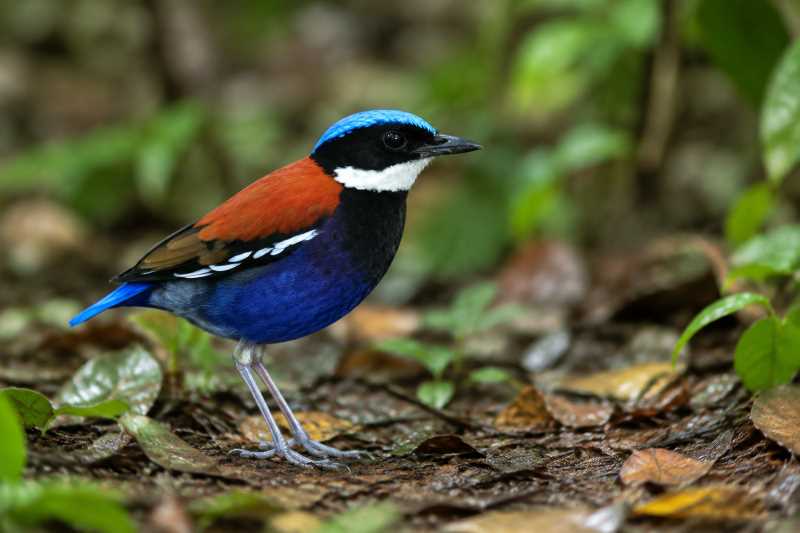
The Blue-headed Pitta is a medium-sized bird, measuring approximately 19-21 centimeters in length. Its most striking feature is its vibrant plumage. The male sports an iridescent blue head, which contrasts sharply with its reddish-brown back and wings. The underparts are white, providing a stark contrast to its colorful upper body. Females, while similar in size, exhibit more subdued coloration, with an olive-brown head and back, allowing them to blend more seamlessly into the forest understory.
The species’ legs are strong and adapted for terrestrial locomotion, aiding in their foraging activities on the forest floor. Their short, rounded wings are not designed for long flights but are perfect for quick, darting movements through dense foliage.
Habitat and Distribution
The Blue-headed Pitta is native to the island of Borneo, which is politically divided among Malaysia, Indonesia, and Brunei. It thrives in the lowland rainforests of the island, favoring areas with dense undergrowth and a rich layer of leaf litter. While primarily a resident of undisturbed primary forests, it can occasionally be found in secondary forests, provided they offer sufficient cover and food resources.
The species’ preference for lowland habitats makes it particularly vulnerable to deforestation and habitat fragmentation, which are prevalent in Borneo due to logging and agricultural expansion.
Behavior and Diet
Blue-headed Pittas are predominantly ground-dwelling birds. They exhibit a solitary or paired lifestyle, rarely forming flocks. Their behavior is characterized by their secretive nature, often remaining hidden in the dense undergrowth. This elusive behavior, coupled with their preference for low-light habitats, makes them a challenge to spot in the wild.
Their diet primarily consists of invertebrates such as insects, worms, and small snails. They forage by hopping along the forest floor, using their sharp eyesight to detect movement in the leaf litter. Occasionally, they may also consume small fruits and seeds.
Breeding and Nesting
Breeding season for the Blue-headed Pitta typically occurs during the rainy months, when food resources are abundant. Their nests are constructed on or near the ground, often hidden among roots or under logs. The nests are cup-shaped structures made from leaves, twigs, and other plant materials.
Females lay a clutch of two to five eggs, which are incubated by both parents. The incubation period lasts around 16-18 days, after which the altricial chicks hatch. Both parents are involved in feeding and caring for the young until they fledge, which occurs approximately 20-22 days post-hatching.
Conservation Status
The International Union for Conservation of Nature (IUCN) currently lists the Blue-headed Pitta as Near Threatened. This status reflects the ongoing threats to its habitat, primarily from deforestation due to logging, palm oil cultivation, and human settlement expansion. The fragmentation of forest habitats poses a significant risk, isolating populations and reducing genetic diversity.
Conservation efforts are crucial to ensure the survival of this species. Protected areas and national parks in Borneo play a vital role in preserving suitable habitats. Additionally, initiatives aimed at sustainable land management and reforestation could help mitigate the impacts of habitat loss.
Challenges and Conservation Efforts
The primary challenge facing the Blue-headed Pitta is habitat destruction. Borneo has one of the highest deforestation rates in the world, driven by the demand for timber and agricultural land. The conversion of forests into palm oil plantations is particularly detrimental, as it leads to large-scale habitat loss and fragmentation.
Conservation organizations and local governments are working to address these challenges through various strategies. These include establishing more protected areas, promoting eco-tourism, and engaging local communities in conservation efforts. Education and awareness programs are also vital in highlighting the importance of preserving Borneo’s unique biodiversity.
In addition to habitat protection, research on the Blue-headed Pitta’s ecology and behavior is essential. Understanding the species’ specific habitat requirements and population dynamics can inform more targeted conservation actions.
Conclusion
The Blue-headed Pitta is a symbol of the rich biodiversity found in Borneo’s rainforests. Its vibrant plumage and elusive nature make it a prized sight for bird enthusiasts. However, the species faces significant challenges due to habitat loss and fragmentation. Concerted conservation efforts are needed to protect this and other endemic species in Borneo.
By raising awareness and implementing effective conservation strategies, we can ensure that the Blue-headed Pitta, along with its rainforest home, continues to thrive for generations to come. Continued research, habitat protection, and community engagement are key to achieving this goal.
References
- BirdLife International. (2021). Hydrornis baudii. The IUCN Red List of Threatened Species 2021.
- Myers, S. (2009). Birds of Borneo: Brunei, Sabah, Sarawak, and Kalimantan. Princeton University Press.
- Phillipps, Q., & Phillipps, K. (2016). Phillipps’ Field Guide to the Birds of Borneo. John Beaufoy Publishing.
Acknowledgments
We extend our gratitude to the numerous researchers and conservationists dedicated to studying and protecting the Blue-headed Pitta and its habitat. Their work is invaluable in our collective efforts to preserve the natural heritage of Borneo.
Related posts