The Enigmatic Blue-moustached Bee-eater: A Jewel of the Avian World
Nestled within the lush, verdant canopies of Central Africa, the Blue-moustached Bee-eater (Merops mentalis) stands as a testament to nature’s penchant for beauty and precision. This striking bird, a member of the Meropidae family, is not just a visual marvel but also an important ecological player in its habitat. In this article, we delve into the fascinating world of the Blue-moustached Bee-eater, exploring its characteristics, behavior, habitat, and the challenges it faces in the wild.
A Distinctive Appearance
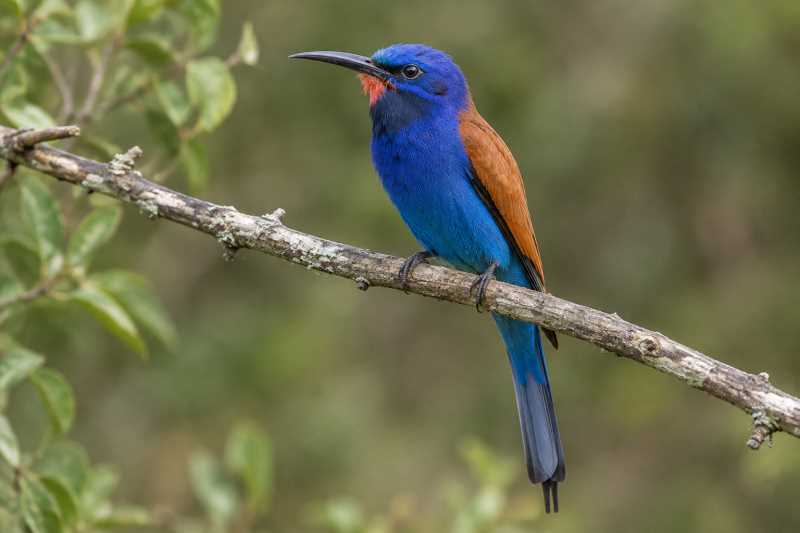
The Blue-moustached Bee-eater is immediately recognizable by its vibrant plumage and the distinctive "moustache" that gives it its name. Measuring about 25 to 30 centimeters in length, this bird is adorned with a brilliant green body, contrasted by a striking azure-blue throat and head. The "moustache" itself is a darker blue streak running from the base of the beak across the face, adding an air of regality to its appearance.
The bird’s slender body is complemented by long, pointed wings and a slightly forked tail, adaptations that make it an agile flyer. This proficiency in the air is crucial for its hunting strategy, as the Blue-moustached Bee-eater primarily feeds on flying insects, with a particular fondness for bees and wasps. Its sharp, curved beak is perfectly designed to snatch these insects mid-flight.
Habitat and Distribution
The Blue-moustached Bee-eater is indigenous to the dense tropical forests of Central Africa, with its range spanning countries such as Gabon, the Republic of Congo, and the Central African Republic. These birds are typically found in lowland and montane forests, favoring regions that offer a rich supply of their insect prey.
These habitats are not just homes but also provide vital resources that sustain the Blue-moustached Bee-eater’s complex life cycle. The dense foliage offers protection from predators and is an ideal environment for nesting and raising their young. However, the specificity of their habitat also means that they are particularly sensitive to environmental changes.
Behavior and Ecology
Blue-moustached Bee-eaters are diurnal and social creatures, often seen in pairs or small family groups. Their social structure is a fascinating aspect of their behavior, with cooperative breeding being a common practice. In such arrangements, younger or non-breeding individuals assist in raising the offspring of breeding pairs, a strategy that enhances the survival rates of the young.
Their feeding habits are a spectacle in themselves. These birds employ a "sit-and-wait" strategy, perching patiently before launching into a swift, acrobatic flight to capture their prey. Once caught, the bee-eater returns to its perch, where it skillfully handles the insect to remove stingers before consumption.
Breeding and Lifecycle
The breeding season of the Blue-moustached Bee-eater is closely tied to the rainy season, when insect populations are at their peak. Nesting occurs in burrows excavated in sandy banks or flat ground, a task undertaken by both members of a breeding pair. These burrows can be quite extensive, sometimes reaching up to two meters in length.
A typical clutch consists of two to four eggs, which are incubated by both parents. After hatching, the chicks are fed a steady diet of insects, with parents and helpers sharing the responsibility of feeding and protecting the young. Fledging occurs after about a month, though juvenile birds often remain with the family group for several more months, honing their flying and hunting skills.
Conservation Status
The Blue-moustached Bee-eater is currently listed as Near Threatened on the IUCN Red List, primarily due to habitat loss. Deforestation for agriculture, logging, and infrastructure development poses significant risks to their natural habitats. As a result, conservation efforts are crucial for safeguarding the future of this species.
Conservation strategies focus on habitat preservation and restoration, alongside community engagement and education to promote sustainable land use. Protected areas and reserves play a pivotal role in providing safe havens for these birds, but ongoing efforts are needed to ensure these measures are effective.
Conclusion
The Blue-moustached Bee-eater is more than just a visual delight; it is an integral part of the ecosystem, contributing to the control of insect populations and serving as an indicator of forest health. Its presence in the wild is a reminder of the intricate balance of nature and the importance of preserving our planet’s biodiversity.
As we continue to learn about and appreciate the Blue-moustached Bee-eater, it becomes increasingly clear that protecting this species is not just about conservation but about maintaining the delicate web of life that sustains all living creatures. Through concerted efforts and awareness, we can ensure that future generations will also have the privilege of witnessing the beauty and ecological significance of the Blue-moustached Bee-eater.
Related posts