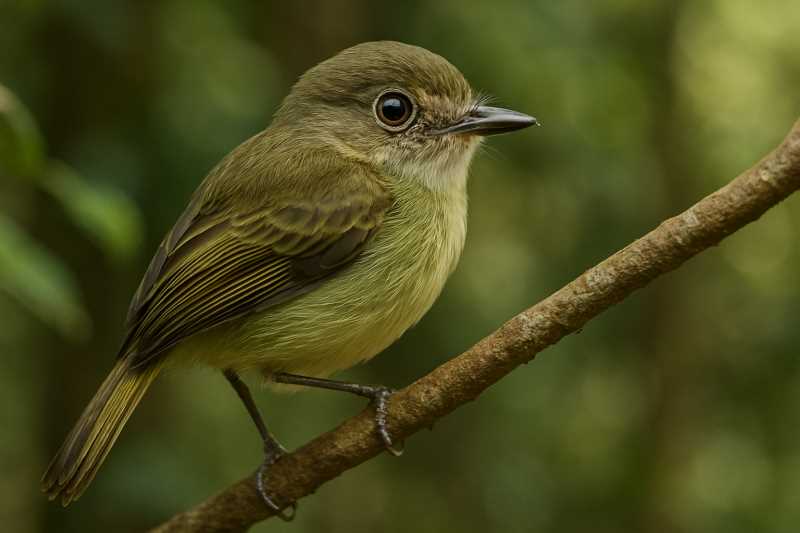
The Enigmatic Pelzeln’s Tody-Tyrant: A Detailed Examination of Hemitriccus inornatus
In the dense, verdant jungles of South America, where sunlight barely pierces the thick canopy, resides a bird so diminutive and elusive that it often escapes the notice of even the most seasoned ornithologists. This is Pelzeln’s Tody-Tyrant (Hemitriccus inornatus), a member of the Tyrannidae family, a group notable for its diversity and adaptability. This article delves into the intriguing aspects of this small bird’s life, examining its habitat, behavior, and conservation status.
Habitat and Distribution
Pelzeln’s Tody-Tyrant is primarily found in the Amazon Basin, with its range extending across several countries, including Brazil, Peru, and Bolivia. This bird prefers lowland forests, where it inhabits the understory, a layer rich in biodiversity but often overrun by dense vegetation. Such a habitat provides both the cover and the rich insect life that form its primary food source.
The bird’s preference for dense understory makes it particularly challenging to observe. Its habitat is typically characterized by high humidity and a closed canopy, making the forest floor a dim and shadowy place. This environment not only serves as a refuge from predators but also influences the bird’s behavior and feeding strategies.
Physical Characteristics
Pelzeln’s Tody-Tyrant is a small bird, measuring about 10 centimeters in length, with a relatively inconspicuous plumage dominated by shades of olive and brown. This coloration is perfectly suited to its environment, providing excellent camouflage amidst the leaves and branches of the forest understory.
The bird’s most distinctive feature is perhaps its disproportionately large eyes, which are well-adapted for spotting prey in the low light conditions of its habitat. Its beak, while small, is perfectly shaped for catching and consuming insects, its primary diet.
Behavior and Diet
Hemitriccus inornatus is primarily insectivorous, feeding on a variety of small insects and arthropods. It employs a sit-and-wait tactic, often perching quietly before making short, rapid flights to catch unsuspecting prey. This feeding strategy minimizes energy expenditure and maximizes the bird’s chances of capturing its prey in the dimly lit environment.
Pelzeln’s Tody-Tyrant is known for its solitary nature, though it may occasionally be observed in mixed-species flocks. This behavior is thought to be a strategy to reduce predation risk while foraging. The bird’s vocalizations are subtle and are used primarily for communication during the breeding season.
Breeding and Lifespan
Breeding habits of Pelzeln’s Tody-Tyrant are not extensively documented, largely due to the challenges of observing these birds in their natural habitat. However, it is known that like many other members of its family, it builds small, cup-shaped nests where the female lays two to three eggs.
The incubation period and parental roles during the breeding season remain areas ripe for research, as detailed observations in the wild are scant. The bird’s lifespan is presumed to be similar to other small passerines, ranging from 3 to 5 years, though this can vary based on environmental conditions and predation pressures.
Conservation Status
Currently, Pelzeln’s Tody-Tyrant is not listed as threatened or endangered. However, ongoing deforestation and habitat degradation in the Amazon pose significant threats to its long-term survival. The loss of habitat not only reduces available resources but also makes the bird more vulnerable to predators and environmental changes.
Conservation efforts in the Amazon Basin are crucial for the protection of this species, among countless others that rely on this unique ecosystem. Initiatives aimed at preserving large tracts of forest and promoting sustainable land use practices are essential for maintaining the biodiversity of the region.
Conclusion
Pelzeln’s Tody-Tyrant is a fascinating example of avian adaptation to a specific ecological niche. Its elusive nature and preference for dense forests make it a challenging subject for study, yet it offers valuable insights into the complexity of tropical ecosystems.
To ensure the continued survival of Hemitriccus inornatus, it is imperative that conservation efforts focus not only on this species but also on the broader ecosystem upon which it depends. Through increased awareness and targeted conservation strategies, there is hope that future generations will continue to marvel at the subtle beauty and ecological significance of Pelzeln’s Tody-Tyrant.
—
References
– BirdLife International. (2016). “Hemitriccus inornatus.” The IUCN Red List of Threatened Species 2016.
– Schulenberg, T. S., Stotz, D. F., Lane, D. F., O’Neill, J. P., & Parker, T. A. (2007). “Birds of Peru: Revised and Updated Edition.” Princeton University Press.
Meta Information
– **Meta Title**: Pelzeln’s Tody-Tyrant: Secrets of Hemitriccus inornatus
– **Meta Description**: Discover the elusive Pelzeln’s Tody-Tyrant, its habitat, behavior, and conservation status in the dense Amazon forests.
Related posts