Introduction
The Andaman Wood Pigeon, Columba palumboides, is an endemic pigeon of the Andaman and Nicobar Islands, India. It is a resident forest species and the state bird of the Andaman and Nicobar Islands. Its restricted island range and dependence on evergreen forest make it an important species for regional conservation. (andamannicobar.gov.in)
Physical Description
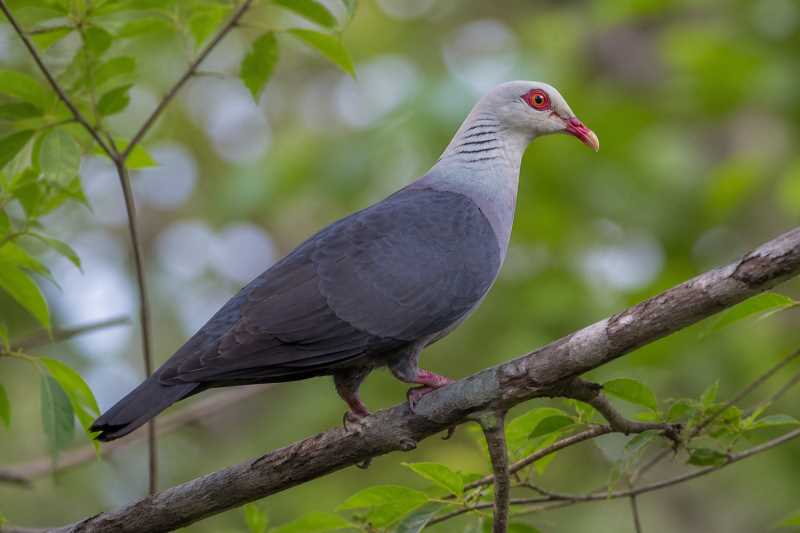
The Andaman Wood Pigeon is about the size of a domestic pigeon but has a noticeably longer tail. Adults have a pale grey to whitish head, a silvery neck with dark chequered markings, dark slate-grey upperparts and paler blue-grey underparts. The upperparts may show a metallic green sheen in good light.
The bare skin around the eye is reddish or purplish red. The bill is reddish at the base and becomes pale or yellowish towards the tip. These features, together with the bird’s long-tailed shape and contrasting pale head, help distinguish it from other large forest pigeons. Reliable information on sexual dimorphism and age-related plumage differences is limited. (ebird.org)
Range and Habitat
The species is endemic to the Andaman and Nicobar Islands and is not known to undertake regular long-distance migration. It occurs mainly in dense, broad-leaved evergreen forest, including mature lowland forest and other areas with a well-developed canopy. Records come from several of the larger islands and from protected forest landscapes in both the Andaman and Nicobar groups.
The Andaman Wood Pigeon is closely associated with fruiting trees and is generally found in or near continuous forest. Habitat clearance, agricultural expansion and other forms of forest disturbance can reduce the quality and connectivity of its habitat. (datazone.birdlife.org)
Where to See This Species
Mount Harriet National Park, South Andaman, India
Mount Harriet National Park, now also known as Mount Manipur National Park, supports extensive evergreen forest and has an official record of the Andaman Wood Pigeon among its avifauna. The bird is most likely to be encountered quietly in forested areas, particularly where mature canopy and fruiting trees are present. Early morning birding offers the best chance of detecting a calling or feeding bird. (moef.gov.in)
Nearby accommodation: Sri Vijaya Puram, formerly Port Blair, is the main practical base, with hotels, guest houses and other visitor accommodation. A forest guest house is also associated with the Mount Harriet area, subject to local availability and permissions. (tourism.gov.in)
Saddle Peak National Park, North Andaman, India
Saddle Peak National Park contains broad-leaved evergreen forest and is documented by the Government of India as supporting the Andaman Wood Pigeon. The species may be encountered along suitable forest edges, trails and quiet canopy habitats, although sightings can be difficult because it is unobtrusive and often remains high in the trees. (moef.gov.in)
Nearby accommodation: Diglipur is the usual gateway settlement, with small hotels, guest houses and other basic accommodation suitable for visitors exploring North Andaman.
Chidiyatapu Reserve Forest, South Andaman, India
Chidiyatapu’s reserve forest contains dense forest and is used for guided bird walks. A recent programme issued by the Andaman and Nicobar Forest Department identifies the Andaman Wood Pigeon as frequently recorded in the area, making it a realistic place to look for the species in South Andaman. Canopy watching along forest tracks is more promising than open coastal viewpoints. (forest.and.nic.in)
Nearby accommodation: Chidiyatapu has a forest guest house, while Sri Vijaya Puram provides a wider choice of hotels, guest houses and self-catering accommodation. (andamantourism.gov.in)
Behaviour and Diet
The Andaman Wood Pigeon is mainly arboreal and usually forages in the upper and middle canopy. It is generally encountered alone, in pairs or in small groups. Birds may remain still among foliage for long periods, making them easier to detect by movement or call than by active flight.
Its diet consists mainly of berries and other fruit, with seeds and additional plant material probably taken when available. By consuming fruit and moving between trees, the species may contribute to the dispersal of forest seeds, although detailed studies of its ecological role are limited. (ebird.org)
Breeding information is poorly documented. The original article’s specific claims about clutch size and shared incubation are not retained here because reliable, current evidence was not found to support them.
Identification Tips
- Look for a large, long-tailed pigeon in dense forest canopy.
- Note the pale grey or whitish head contrasting with the dark slate-grey body.
- Check for a silvery neck with dark chequered markings and a metallic green sheen on the upperparts.
- The reddish bare skin around the eye and the reddish-based, pale-tipped bill are useful features.
- The species is often quiet and inconspicuous, so patient scanning of fruiting trees is more effective than relying on open perches.
- It can resemble the Green Imperial-Pigeon, but the Andaman Wood Pigeon is generally identified by its paler grey underparts, reddish eye skin and distinctive bill pattern. (ebird.org)
Conservation Status
The Andaman Wood Pigeon is currently classified as Near Threatened on the IUCN Red List. Available assessments indicate a declining population, although a precise current population estimate should be treated cautiously.
The principal concerns are habitat disturbance, forest loss and fragmentation associated with agriculture and other human encroachment. Hunting may also reduce adult survival in parts of the range. Protection of remaining evergreen forest, effective management of protected areas, control of unauthorised hunting and continued monitoring are important conservation measures. (datazone.birdlife.org)
Frequently Asked Questions
Where is the Andaman Wood Pigeon found?
It is endemic to the Andaman and Nicobar Islands of India, where it occurs mainly in dense evergreen forest on several islands.
Is the Andaman Wood Pigeon migratory?
No regular long-distance migration is known. It is regarded as a resident species, although local movements between forest areas and islands may occur.
What does the Andaman Wood Pigeon eat?
It feeds mainly on berries and other fruit, with seeds and other plant material taken when available.
How can the Andaman Wood Pigeon be identified?
Look for a long-tailed pigeon with a pale grey or whitish head, dark slate-grey upperparts, paler underparts, reddish eye skin and a reddish-based, pale-tipped bill.
Where are the best places to look for this pigeon?
Documented wildlife-viewing locations include Mount Harriet National Park, Saddle Peak National Park and Chidiyatapu Reserve Forest. It is most likely to be found in mature forest canopy, especially near fruiting trees.
Why is the Andaman Wood Pigeon threatened?
Its restricted island range makes it vulnerable to forest loss, habitat fragmentation, human encroachment and possible hunting pressure.
References
- BirdLife International
- IUCN Red List of Threatened Species
- Andaman and Nicobar Administration, Department of Environment and Forests
Related posts