Introduction
The Andean Saddle-back Tamarin (Saguinus leucogenys) is a captivating primate species that captures the attention of wildlife enthusiasts and researchers alike. Known for its distinctive appearance and intriguing behaviors, this small monkey is part of the Callitrichidae family, which includes marmosets and tamarins. Found primarily in the dense rainforests of the Andes, the Andean Saddle-back Tamarin plays a crucial role in the ecosystem. This article explores the unique aspects of this species, from its physical characteristics to its conservation status.
Physical Description
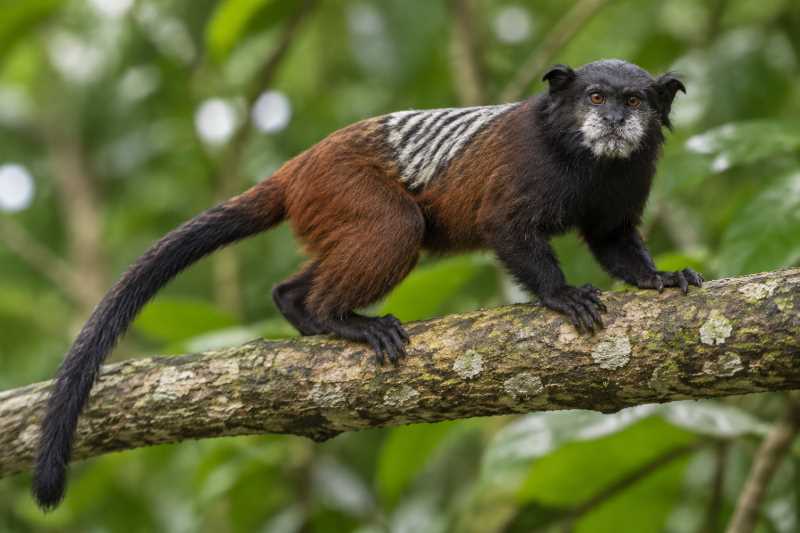
The Andean Saddle-back Tamarin is a small primate, typically weighing between 350 and 500 grams and measuring about 20 to 25 centimeters in body length, with a tail that can extend up to 35 centimeters. The species is easily recognizable by its unique coloration and markings. The body is predominantly covered in a combination of reddish-brown, gray, and black fur, giving it a ‘saddle-back’ appearance from which it derives its name. The face is hairless, showcasing a pale, almost white complexion that starkly contrasts with its dark fur.
One of the most striking features of Saguinus leucogenys is its thick, bushy tail, which is not prehensile but aids in balance as the tamarin navigates the forest canopy. Its limbs are relatively short, but the hands and feet are equipped with sharp claws instead of nails, a trait that distinguishes it from other primate families and assists in climbing and foraging.
Range and Habitat
The natural habitat of the Andean Saddle-back Tamarin is confined to the tropical rainforests of the Andes Mountains, particularly in regions spanning Colombia and Peru. These primates thrive in the dense, humid environments of these forests, where they can be found at elevations ranging from 200 to 1,500 meters above sea level.
Saguinus leucogenys prefers habitats with rich biodiversity, which provide ample opportunities for foraging and protection from predators. The dense canopy of these forests offers the ideal environment for their arboreal lifestyle, enabling them to move swiftly and efficiently through the trees. They are often found in areas with a high density of fruit-bearing trees, which are essential for their diet.
Behavior and Diet
The Andean Saddle-back Tamarin is a diurnal creature, exhibiting most of its activity during daylight hours. They are social animals, typically living in groups of 4 to 12 individuals, which consist of a mix of males, females, and their offspring. Group dynamics are intricate, with a clear hierarchy often led by a dominant breeding pair.
Communication within groups is facilitated by a range of vocalizations, body postures, and facial expressions. These interactions are crucial for maintaining social bonds and coordinating group activities, such as foraging and grooming.
Diet-wise, the Andean Saddle-back Tamarin is omnivorous, with a preference for fruits, insects, and small vertebrates. They have also been observed consuming flowers, nectar, and even tree sap. Their feeding habits play a vital role in seed dispersal, contributing to forest regeneration and biodiversity.
Identification Tips (Field Recognition Cues)
Identifying the Andean Saddle-back Tamarin in the wild can be an exciting experience for wildlife enthusiasts. Here are some tips for field recognition:
- Coloration and Markings: Look for the distinctive ‘saddle-back’ pattern on the back, characterized by a mix of reddish-brown, gray, and black fur.
- Facial Features: Observe the pale, almost white facial skin that contrasts with their darker fur.
- Size and Proportions: Note their small size, with a body length of 20 to 25 cm and a long bushy tail.
- Behavior: Look for groups moving rapidly through the canopy, often using vocalizations to communicate.
Conservation Status (With Threats and Protections)
The Andean Saddle-back Tamarin is currently listed as Near Threatened on the IUCN Red List of Threatened Species. The primary threats to their survival include habitat destruction due to deforestation, agricultural expansion, and human encroachment. Illegal pet trade also poses a significant threat, as these primates are often captured and sold due to their appealing appearance.
Conservation efforts are underway to protect the natural habitats of these tamarins and to curb illegal trade. Protected areas have been established in some regions of their range, and there are ongoing efforts to increase awareness about the importance of preserving these unique primates and their ecosystems.
Frequently Asked Questions
1. What is the typical lifespan of an Andean Saddle-back Tamarin?
In the wild, Andean Saddle-back Tamarins can live up to 10 to 12 years, although this can vary depending on environmental conditions and threats from predators or human activities. In captivity, with optimal care, they may live slightly longer.
2. How does the Andean Saddle-back Tamarin contribute to its ecosystem?
These tamarins play a crucial role in seed dispersal, which helps maintain the biodiversity of their forest habitats. Their foraging activities contribute to the regeneration of plant species, which in turn supports a variety of other wildlife.
3. Are Andean Saddle-back Tamarins endangered?
While not currently classified as endangered, they are listed as Near Threatened due to habitat loss and other human-induced pressures. Conservation efforts are critical to preventing further decline in their populations.
4. Can Andean Saddle-back Tamarins be kept as pets?
It is illegal and unethical to keep wild primates such as the Andean Saddle-back Tamarin as pets. They require specific environmental conditions and social structures that cannot be replicated in a domestic setting.
5. What are the main predators of the Andean Saddle-back Tamarin?
Natural predators include birds of prey, snakes, and larger mammals. However, human activities currently pose the greatest threat to their survival.
Related posts