Introduction
The Moluccan Brush Cuckoo, Cacomantis aeruginosus, is an endemic cuckoo of Indonesia’s Maluku Islands. It inhabits forested islands in the northern and central Moluccas and is more often detected by its distinctive accelerating call than by a clear view. The species belongs to the family Cuculidae, although details of its breeding biology remain poorly documented.
Physical Description
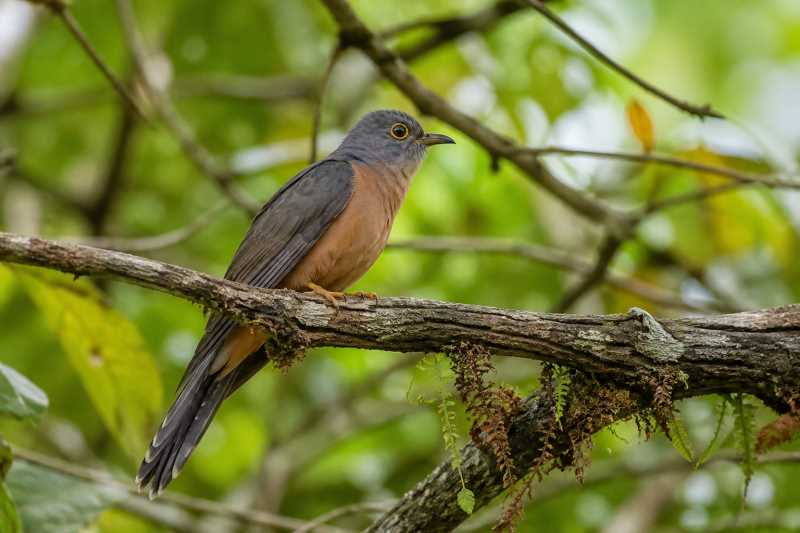
The Moluccan Brush Cuckoo is a medium-sized cuckoo, about 23 centimetres long. Adults have dark olive-brown upperparts, a dark grey head and throat, rich rufous or chestnut underparts, and reddish undertail-coverts. The combination of a grey head and throat with strongly coloured lower underparts is useful for identification.
The sexes are similar in appearance. Juveniles are browner overall and show much more extensive barring on the underparts. Plumage can vary between islands, and the species is part of a taxonomically complex group of brush cuckoos in the Moluccas.
Range and Habitat
The Moluccan Brush Cuckoo is endemic to the Maluku Islands of Indonesia. It has been recorded from islands including Halmahera, Bacan, Obi, Buru and Seram, with additional records from nearby Moluccan islands and islets. Current taxonomic treatments differ in how some island populations are divided from related brush cuckoos, but Cacomantis aeruginosus is recognised as a species by the IOC World Bird List.
It uses humid forest habitats, including hill and montane forest, lowland forest, dense secondary growth and other heavily vegetated areas. Observations from Obi indicate that it may occur in swamp forest and dense secondary forest as well as montane habitats. It is generally associated with more closed and luxuriant vegetation than the more open-country brush cuckoos found in the same region.
The species is regarded as resident within the Moluccas. Its exact elevation range and distribution on several islands remain incompletely documented.
Where to See This Species
Aketajawe-Lolobata National Park, North Maluku, Indonesia
Aketajawe-Lolobata protects extensive lowland and hill forest on Halmahera, one of the principal islands in the Moluccan Brush Cuckoo’s range. Recent birding reports from Halmahera have recorded the species, and the park’s forest trails and access roads provide a realistic setting for listening for its call. Early morning visits are most suitable, particularly in dense forest and along quiet, vegetated tracks.
Nearby accommodation: Local homestays and simple guesthouses are available around Aketajawe, while Sofifi provides a wider choice of hotels and other practical accommodation.
Behaviour and Diet
The Moluccan Brush Cuckoo is usually secretive and spends much of its time within dense foliage. It is commonly encountered alone or in pairs, although its social behaviour has not been studied in detail. It forages among leaves and branches for insects and other small invertebrates.
Its call is an important means of detection. Descriptions include repeated, whistled notes that may become faster and more emphatic towards the end of the phrase. The call can carry through forest, but the bird may remain hidden while vocalising.
Many cuckoos practise brood parasitism, but reliable species-specific information on the Moluccan Brush Cuckoo’s hosts, nesting season and egg-laying behaviour is limited. Claims about particular host species or nestling behaviour should therefore be treated cautiously until supported by further field research.
Identification Tips
- Look for a medium-sized cuckoo with dark grey head and throat, olive-brown upperparts and rich rufous underparts.
- The reddish undertail-coverts can be noticeable when the bird shifts position or flies.
- Juveniles are browner and more heavily barred than adults.
- Listen for a repeated whistle that becomes faster or more insistent towards the end.
- Distinguish it from other brush cuckoos by its preference for denser forest, its stronger rufous colour extending onto the chest, and its distinctive vocal pattern.
- Silent birds can be difficult to identify, especially in areas where related brush cuckoo taxa occur. A photograph, recording or detailed field notes are useful for confirmation.
Conservation Status
The Moluccan Brush Cuckoo is currently assessed as Least Concern. It has a restricted island distribution, and its population size and trend are not well quantified. Forest clearance, logging, agricultural expansion and degradation of native vegetation may reduce suitable habitat, particularly on islands where lowland forest is being converted.
Protection of remaining forest, careful management of protected areas and improved surveys on the smaller Moluccan islands are important conservation measures. Because the species is difficult to detect and its taxonomy remains under review, additional fieldwork is also needed to clarify its distribution and population status.
Frequently Asked Questions
Where is the Moluccan Brush Cuckoo found?
It is endemic to Indonesia’s Maluku Islands, including Halmahera, Bacan, Obi, Buru and Seram, with records from other nearby islands.
What does the Moluccan Brush Cuckoo look like?
Adults have dark olive-brown upperparts, a dark grey head and throat, rich rufous underparts and reddish undertail-coverts. Juveniles are browner and more heavily barred.
What habitat does the Moluccan Brush Cuckoo prefer?
It is associated mainly with humid, densely vegetated forest, including hill forest, montane forest, lowland forest and dense secondary growth.
Is the Moluccan Brush Cuckoo migratory?
It is generally regarded as resident in the Maluku Islands. Its movements within and between islands are not well documented.
What does the Moluccan Brush Cuckoo eat?
Its recorded and presumed diet consists mainly of insects and other small invertebrates collected from foliage and branches.
Is the Moluccan Brush Cuckoo endangered?
No. It is currently assessed as Least Concern, although habitat loss and degradation remain potential threats and the species is not well studied.
References
- IOC World Bird List
- BirdLife International
- eBird, Cornell Lab of Ornithology
Related posts