Saunders’s Tern (Sternula saundersi): A Comprehensive Overview
Saunders’s Tern (Sternula saundersi) is a small seabird belonging to the family Laridae, which includes gulls and other terns. Known for its delicate grace and distinctive plumage, Saunders’s Tern inhabits coastal regions across the western Indian Ocean. Despite its relatively small size, this tern plays a significant role in its habitat, and understanding its life cycle and ecological importance is crucial for its conservation.
Description and Identification
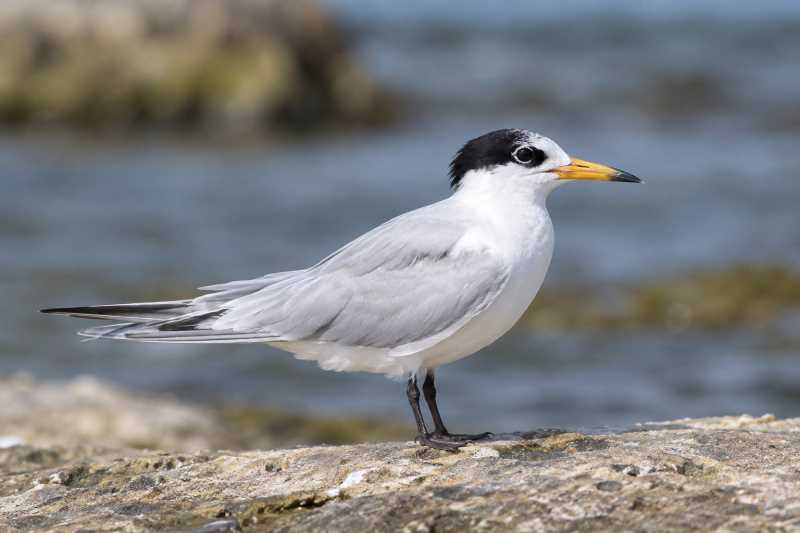
Saunders’s Tern is a diminutive bird, measuring about 21-25 centimeters in length with a wingspan of approximately 45-55 centimeters. It is characterized by its slender body, pointed wings, and a forked tail. The plumage of this tern is notably striking: it has a white underbody and forehead, with a contrasting black cap and nape. The upperparts are gray, and it sports a distinctive yellow bill with a black tip, along with black legs.
The Saunders’s Tern is often confused with the Little Tern (Sternula albifrons), but can be differentiated by its slightly smaller size and subtle differences in plumage, such as the pattern of the black cap and the coloration of the bill and legs.
Habitat and Distribution
Saunders’s Tern is primarily found along coastal areas, including sandy beaches, mudflats, and estuaries. Its range covers parts of the Red Sea, Persian Gulf, and stretches along the coastlines of countries such as Somalia, Yemen, Oman, the United Arab Emirates, and parts of Pakistan and India.
These terns prefer nesting on sandy substrates near shorelines, often choosing sites that are relatively free from human disturbance. The availability of small fish and other marine organisms in these regions is crucial for their feeding habits.
Behavior and Diet
Saunders’s Tern is a highly agile flier, capable of executing swift aerial maneuvers while foraging. Like many other terns, it feeds primarily on small fish, which it catches by plunge-diving into the water. Crustaceans and other small marine invertebrates also form part of its diet.
During the breeding season, these terns exhibit a variety of courtship displays, including aerial acrobatics and fish offerings from males to females. This behavior not only strengthens pair bonds but also plays a crucial role in mate selection.
Breeding and Life Cycle
The breeding season for Saunders’s Tern typically occurs between May and August, coinciding with optimal weather conditions and food availability. These birds are colonial nesters, often forming loose colonies on sandy beaches or islands.
Nests are simple scrapes in the ground, sometimes lined with shells or vegetation. A typical clutch consists of one to three eggs, which are incubated by both parents for about 18-22 days. Chicks are semi-precocial, meaning they are relatively mature and mobile shortly after hatching, though they depend on their parents for food and protection.
Fledging occurs approximately 20-25 days post-hatching, with young terns gradually learning to fly and forage independently. The survival of chicks is highly dependent on environmental conditions and predation pressure, making suitable nesting sites critical for the population’s success.
Conservation Status and Threats
The International Union for Conservation of Nature (IUCN) currently classifies Saunders’s Tern as a species of Least Concern. However, its populations face numerous threats, primarily due to habitat degradation and human disturbance.
Coastal development, pollution, and recreational activities pose significant threats to their nesting habitats. Additionally, climate change and rising sea levels could further exacerbate habitat loss. Predation by introduced species, such as rats and feral cats, also impacts their breeding success.
Conservation Efforts
Conservation efforts for Saunders’s Tern focus on habitat protection and management. Establishing protected areas where human disturbance is minimized can greatly benefit nesting colonies. Public awareness campaigns aimed at reducing human impact on coastal regions are also essential.
Research and monitoring programs are crucial for understanding population trends and the effectiveness of conservation strategies. By tracking breeding success and habitat changes, conservationists can adapt measures to ensure the long-term survival of Saunders’s Tern.
Conclusion
Saunders’s Tern is a remarkable seabird, whose survival is intricately linked to the health of coastal ecosystems. While currently not at immediate risk of extinction, proactive conservation efforts are vital to address the challenges it faces. By safeguarding its habitat and mitigating human-induced threats, we can help ensure that future generations will continue to witness the graceful presence of Saunders’s Tern along the world’s coastlines.
Related posts