Introduction
The Lesser Ground Cuckoo, Morococcyx erythropygus, is a small, mainly terrestrial cuckoo of dry forests, thorn scrub and other open habitats in Mexico and Central America. Unlike many cuckoos, it builds its own nest and raises its young. It is secretive and is more often detected by its distinctive rolling, whistled song than by sight.
Physical Description
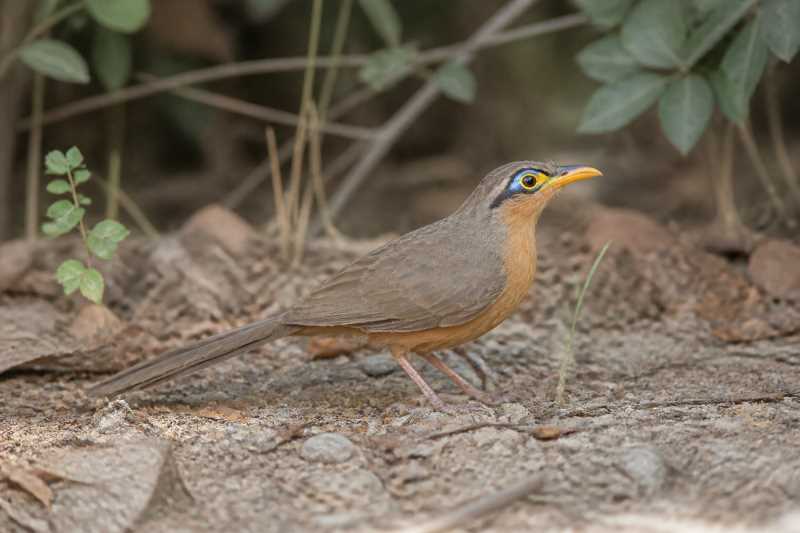
The Lesser Ground Cuckoo measures approximately 25–28 cm in length. It has a relatively long, graduated tail and a compact, ground-dwelling posture. The upperparts are grey-brown to dark brown, with rufous tones on the rump, wings and tail. The underparts are generally cinnamon or warm buff, while the face has a contrasting dark mask and conspicuous bare blue skin around the eye.
The sexes are similar in appearance. Juveniles resemble adults but are usually duller, with less distinct tail patterning and reduced contrast in the plumage. The species is easily overlooked because its colours blend well with dry leaf litter, shadowed understorey and thorny vegetation.
Range and Habitat
The Lesser Ground Cuckoo occurs from southern and western Mexico south through Guatemala, El Salvador, Honduras and Nicaragua to northern Costa Rica. It is generally resident rather than migratory, although local movements may occur in response to seasonal conditions.
It favours dry and semi-arid environments, including tropical dry forest, thorn forest, woodland edges, scrub, savanna and regenerating secondary vegetation. In parts of western Mexico, it is particularly associated with thorn forest and seasonally dry woodland. Records extend from near sea level to approximately 1,200 metres, although the species is most often associated with lowland and lower-elevation habitats.
Where to See This Species
Área de Conservación Guanacaste, Guanacaste, Costa Rica
The Sector Pailas of Área de Conservación Guanacaste supports tropical dry forest and scrub habitat suitable for the species. Local conservation records document a pair near the Sector Pailas facilities, and the species is reported to be vocal but difficult to observe because it stays close to the ground among shrubs. The dry season can make birds easier to detect by sight and sound, although conditions vary.
Nearby accommodation: Liberia is the main practical gateway, with hotels, guest houses, lodges and self-catering accommodation available in the surrounding area.
Chamela-Cuixmala Biosphere Reserve, Jalisco, Mexico
The Chamela region contains tropical deciduous and semi-deciduous forest, thorn scrub and open woodland, all habitats associated with the Lesser Ground Cuckoo. Ornithological surveys and the bird list maintained by the Universidad Nacional Autónoma de México document the species in the Chamela area. Quiet walks along suitable forest edges and scrubby trails are most appropriate, especially during the dry season when vegetation is more open.
Nearby accommodation: San Patricio-Melaque and Barra de Navidad provide hotels, guest houses, small lodges and self-catering accommodation, while local accommodation may also be available near Chamela.
Parque Nacional El Tepozteco, Morelos, Mexico
The park’s official management documentation includes the Lesser Ground Cuckoo among its resident bird species and describes it as rare in the protected area. Dry forest, scrub and open woodland around the lower and middle elevations provide the most suitable conditions. Because records are limited, this is better treated as a possibility for experienced birders rather than a reliable target site.
Nearby accommodation: Tepoztlán is the principal gateway, with hotels, guest houses, inns and self-catering accommodation.
Behaviour and Diet
The Lesser Ground Cuckoo spends much of its time on the ground, walking or running through leaf litter, low scrub and shaded undergrowth. It may make short leaps to take prey from vegetation, but it is usually cautious and quick to disappear into cover. It is often solitary or seen in pairs, particularly during the breeding season.
Its diet consists mainly of insects and other small invertebrates, including grasshoppers, caterpillars, beetles and spiders. Other small prey may occasionally be taken, but detailed information on its diet remains limited.
The song is a conspicuous series of rich, rolling or trilling notes, often preceded by a few clear, ascending whistles. Calling is important for communication and territorial advertisement, and is frequently the first indication that the species is present.
Breeding information is incomplete. The species is not considered a regular brood parasite. It builds a shallow nest from twigs and leaves, usually on or close to the ground, and available records indicate a small clutch of about two eggs. Both adults are reported to participate in incubation and care of the young. Breeding dates vary geographically, with records in Costa Rica concentrated from February to May and records in Mexico extending into May and June.
Identification Tips
- Look for a small, long-tailed cuckoo moving through dry scrub or leaf litter rather than sitting prominently in a tree.
- Note the combination of grey-brown upperparts, cinnamon underparts, rufous rump and tail, dark facial markings and bare blue skin around the eye.
- Listen for a sequence of rolling whistles and trills, particularly in dry forest during the breeding season.
- Do not confuse it with the Lesser Roadrunner, which is larger, longer-legged and more heavily streaked, or with the Squirrel Cuckoo, which is larger, more arboreal and has a distinctly longer tail.
- Sightings are often brief. Watching the edges of dense shrubs and listening for movement in dry leaf litter can be more productive than searching open ground continuously.
Conservation Status
The Lesser Ground Cuckoo is currently classified as Least Concern on the IUCN Red List. It has a broad distribution and is not presently considered to face a sufficiently rapid global decline to qualify for a threatened category.
The species nevertheless depends heavily on the continued availability of dry forest, thorn woodland and scrub. Habitat conversion for agriculture, grazing, roads and development can reduce suitable cover and fragment local populations. Protecting remaining dry forests, maintaining connected scrub and woodland, and managing protected areas for natural regeneration are important conservation measures. Because the species is secretive and difficult to survey, local population trends may be poorly documented.
Frequently Asked Questions
Where is the Lesser Ground Cuckoo found?
It is found from southern and western Mexico through Guatemala, El Salvador, Honduras and Nicaragua to northern Costa Rica. Its distribution is concentrated in seasonally dry regions and lower-elevation habitats.
Is the Lesser Ground Cuckoo migratory?
It is generally considered a resident species. Local movements may occur, but it is not known for long-distance seasonal migration.
What does the Lesser Ground Cuckoo eat?
It mainly eats insects and other small invertebrates found in leaf litter, on the ground or in low vegetation. Grasshoppers, caterpillars, beetles and spiders are among the likely prey.
Does the Lesser Ground Cuckoo lay its eggs in other birds’ nests?
No. Unlike the best-known brood-parasitic cuckoos, the Lesser Ground Cuckoo builds its own nest. Available records indicate that both adults incubate the eggs and care for the young.
How can the Lesser Ground Cuckoo be identified?
Look for a small, secretive, long-tailed bird with grey-brown upperparts, cinnamon underparts, rufous tones on the rump and tail, dark facial markings and bare blue skin around the eye. Its rolling, whistled song is often easier to detect than the bird itself.
Is the Lesser Ground Cuckoo endangered?
It is currently classified as Least Concern. However, the loss and fragmentation of dry forest and thorn scrub can reduce local habitat, so protection of remaining seasonally dry landscapes remains important.
References
- BirdLife International
- Cornell Lab of Ornithology, Birds of the World
- International Ornithological Congress, IOC World Bird List
Related posts