Introduction
Savile’s Bustard (Lophotis savilei) is a medium-sized bustard of the Sahel and adjacent Sudanian savannas. It belongs to the family Otididae and is largely terrestrial, relying on cryptic plumage and cautious behaviour in dry grassland, thorn scrub and lightly wooded savanna.
Physical Description
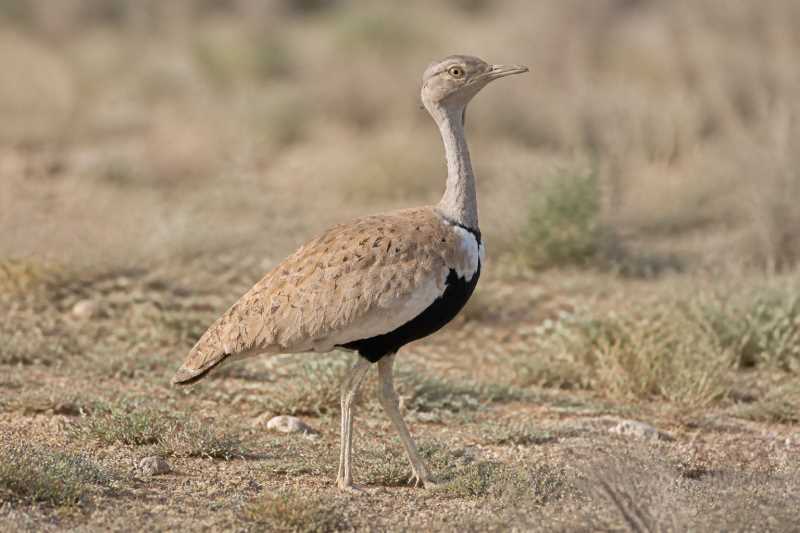
Savile’s Bustard is about 42 centimetres long and weighs approximately 700–925 grams. It has a large head, a relatively short neck, long legs and a compact, ground-dwelling build.
The upperparts are sandy-brown and heavily marked with darker streaks and arrowhead-shaped patterns, providing effective camouflage among dry grasses and scrub. The head and upper neck are greyish, with darker markings on the chin and throat. The bill and legs are generally yellowish to clay-coloured.
The sexes are distinctly different. The male has stronger black and grey markings on the head and neck, dark underparts and a small rufous crest or nape tuft that is most conspicuous during display. The female is duller and more uniformly patterned, with a paler throat and less extensive dark plumage. Juveniles are less strongly marked than adults and are generally more subdued in colour.
Range and Habitat
Savile’s Bustard occurs across the Sahel and adjoining dry savannas of West and Central Africa. Its range extends from Senegal and The Gambia eastwards through Mauritania, Mali, Burkina Faso, Niger and northern Nigeria to Chad and western Sudan. It has also been recorded in northern Cameroon and northern Côte d’Ivoire.
The species favours semi-arid grassland, dry savanna, thorn scrub, light woodland, fallows and open areas near seasonal pools. It is especially associated with habitats containing scattered shrubs and grasses, including Aristida species, rather than dense woodland or completely barren desert. The species is generally sedentary, although local or seasonal movements may occur in response to rainfall, food availability and changing vegetation conditions.
Where to See This Species
Waza National Park, Far North Region, Cameroon
Savile’s Bustard is included among the notable birds recorded from Waza National Park. The park’s open Sahelian grasslands, dry woodland and seasonal floodplain habitats provide suitable conditions for ground-dwelling bustards. Look for it during the drier months when birds are more readily detected in open areas, while checking park access and local security conditions before travelling.
Nearby accommodation: Waza village and Maroua are the practical accommodation areas, with basic guesthouses, hotels and wildlife-oriented camps available depending on current local conditions.
Yankari Game Reserve, Bauchi State, Nigeria
Savile’s Bustard has been documented in Yankari Game Reserve, including during systematic bird surveys. The reserve’s Sudan–Guinea savanna contains open grassland, woodland and lightly disturbed areas suitable for the species. Sightings may be possible in both wet and dry seasons, although local abundance can vary with rainfall and grass conditions.
Nearby accommodation: Accommodation is available within or near the reserve in camp-style facilities, while Bauchi provides the nearest larger town for hotels and guesthouses.
Niokolo-Koba National Park, Tambacounda Region, Senegal
Savile’s Bustard has been recorded in Niokolo-Koba National Park and the surrounding dry savanna of eastern Senegal. Open grassland, scrub and lightly wooded habitats are suitable, particularly during the dry season when birds may use clearer ground and roadsides. It is a difficult species to find, so searches are best undertaken with an experienced local guide.
Nearby accommodation: Tambacounda is the main practical gateway, with hotels, guesthouses and safari-oriented accommodation serving visitors to the park.
Behaviour and Diet
Savile’s Bustard spends most of its time on the ground. It usually walks steadily while foraging, but relies on stillness and camouflage when disturbed. It is often encountered alone or in pairs, although more than one bird may occur in suitable habitat.
The diet is opportunistic and includes grasshoppers and other insects, seeds and other plant material. In Senegal, the species has been recorded taking Senegalese Grasshoppers, suggesting that it can be an important predator of large grasshoppers in some areas. Feeding patterns probably change seasonally, with animal prey more readily available after rain and seeds or other plant foods becoming more important during dry periods.
The species is not considered a true long-distance migrant. Local movements linked to rainfall and food availability have been reported. Breeding behaviour is poorly documented, but males perform displays involving raised or fluffed plumage, movements and vocalisations. The nest is made on the ground, as is typical of bustards, and young are capable of walking soon after hatching.
Identification Tips
- Look for a medium-sized, long-legged bird walking through dry grassland or open scrub.
- The sandy-brown, strongly patterned upperparts provide excellent camouflage, especially when the bird crouches or stands motionless.
- The greyish head and neck, dark chin markings and pale shoulder accents can help identify adults at close range.
- A displaying male may show darker underparts and a small rufous nape crest or tuft.
- In flight, the dark flight feathers contrast with paler wing areas and the bird’s broad, rounded profile.
- Do not rely on size alone. Compare the bird’s grey-and-black head pattern, small crest and Sahelian distribution with other bustards in the region, particularly the more strongly patterned or differently coloured Arabian and white-bellied bustards.
Conservation Status
Savile’s Bustard is currently classified as Least Concern. It is widespread, but its population is not well quantified and detailed monitoring is limited across much of its range.
The main pressures are likely to include conversion of dry savanna for agriculture, overgrazing, loss of vegetation structure, disturbance, hunting in some areas and the effects of increasing drought and climatic variability. Sustainable grazing, protection of remaining Sahelian grasslands, careful management of agricultural expansion and improved field surveys would benefit the species.
Frequently Asked Questions
Where is Savile’s Bustard found?
It occurs across the Sahel and adjoining dry savannas from Senegal and The Gambia eastwards through West Africa to Chad and western Sudan, with additional records in parts of Cameroon and Côte d’Ivoire.
Is Savile’s Bustard migratory?
It is generally sedentary rather than truly migratory. Local or seasonal movements may occur after rainfall or when birds follow changes in food and vegetation.
What does Savile’s Bustard eat?
Its diet includes grasshoppers and other insects, seeds and other plant material. The balance between animal and plant foods probably changes with the season.
How can Savile’s Bustard be identified?
Look for a medium-sized bustard with sandy, heavily patterned upperparts, a greyish head and neck, dark chin markings and long yellowish legs. Males have stronger dark markings and may show a rufous nape tuft during display.
Is Savile’s Bustard endangered?
No. The species is currently assessed as Least Concern, although habitat degradation, agricultural expansion, overgrazing, hunting and increasing climatic pressure may affect local populations.
Where is the best place to look for Savile’s Bustard?
Documented sites include Waza National Park in Cameroon, Yankari Game Reserve in Nigeria and Niokolo-Koba National Park in Senegal. It remains an elusive bird, so sightings are more likely with local guides familiar with dry-country bird habitats.
References
- BirdLife International
- Birds of the World, Cornell Lab of Ornithology
- IOC World Bird List
Related posts