The Great Swallow-tailed Swift: A Marvel of Avian Aerodynamics
In the richly diverse tapestry of the avian world, the Great Swallow-tailed Swift (Panyptila sanctihieronymi) emerges as a fascinating embodiment of elegance and agility. Belonging to the swift family Apodidae, this species is noted for its streamlined physique and its exceptional aerial prowess. Found predominantly in the tropical regions of Central and South America, the Great Swallow-tailed Swift is a remarkable avian athlete, whose existence is intricately woven with the dynamic ecosystems it inhabits.
Physical Characteristics
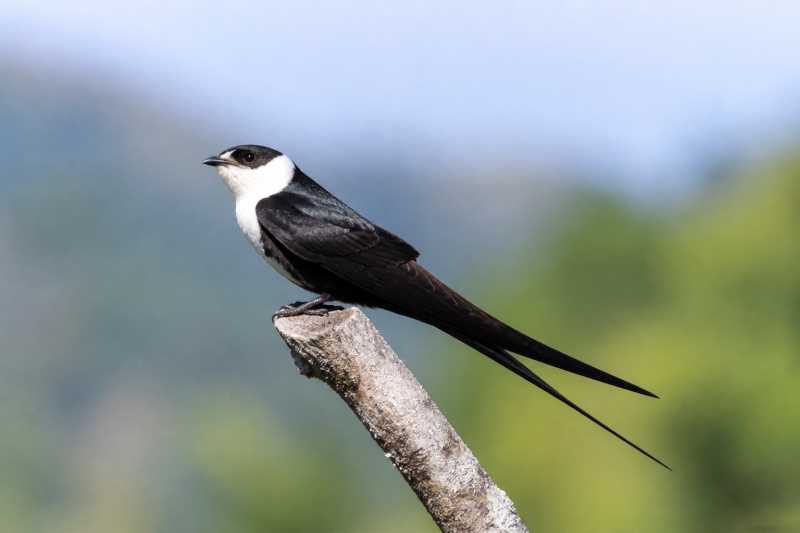
The Great Swallow-tailed Swift is a medium-sized swift, with a body length ranging from 15 to 18 centimeters. Its most distinguishing feature is its deeply forked tail, reminiscent of a swallow’s, which gives the bird its name. The tail is not merely ornamental; it plays a crucial role in the bird’s aerial maneuverability. The plumage of this swift is predominantly black, with a subtle sheen that can appear blue or green in certain lighting. The bird’s underparts are generally lighter, providing a striking contrast that aids in identification during flight.
This swift’s wings are long and narrow, adapted for speed and endurance. These physical adaptations enable the Great Swallow-tailed Swift to spend much of its life on the wing, feeding, mating, and even sleeping in the air. Its beak is small yet robust, perfectly suited to snapping up insects mid-flight.
Habitat and Distribution
The Great Swallow-tailed Swift is primarily found in the forests and open woodlands of Central and northern South America. Its range extends from southern Mexico through Guatemala, Honduras, and El Salvador, into Nicaragua, Costa Rica, and parts of Colombia. This bird tends to favor habitats that offer a combination of open airspace for foraging and forested areas for nesting.
These swifts are often seen in the company of other swift species and swallows, forming large, mixed-species flocks that can be observed performing intricate aerial displays. Their presence is often a sign of a healthy insect population, as they are entirely insectivorous, feeding on a wide variety of flying insects.
Behavior and Ecology
The Great Swallow-tailed Swift is a diurnal bird, most active during the early morning and late afternoon. It is an expert flyer, capable of remarkable speeds and agile maneuvers. This agility is vital for capturing prey and avoiding predators. Unlike many birds, the swift’s legs are short and weak, making them almost incapable of perching. Instead, they cling to vertical surfaces, such as cliffs or large trees, when resting.
Breeding typically occurs during the rainy season, when insect availability is at its peak. The Great Swallow-tailed Swift builds its nest in secluded areas, often high in tree cavities or cliff crevices. The nest is constructed using a combination of feathers, plant materials, and saliva, which hardens to form a secure structure. Both parents share responsibilities in raising the young, from incubating the eggs to feeding the chicks.
Conservation Status
Currently, the Great Swallow-tailed Swift is not considered to be at immediate risk of extinction. However, like many species, it faces challenges from habitat destruction and climate change. Deforestation in Central and South America poses a significant threat to their natural habitats, potentially reducing the available nesting sites and food sources.
Conservation efforts are focused on preserving large tracts of forested areas and promoting sustainable land-use practices. Continued research and monitoring are essential to understand the population dynamics of this swift and to ensure its long-term survival.
The Role in Ecosystem and Human Culture
As an insectivore, the Great Swallow-tailed Swift plays a crucial role in controlling insect populations, which can benefit agriculture and help maintain ecological balance. Its presence is often indicative of a thriving ecosystem, and it serves as a bioindicator species, reflecting the health of its environment.
Culturally, swifts have been admired for their speed and grace, often associated with freedom and swiftness in various traditions. The Great Swallow-tailed Swift, with its impressive aerial displays, continues to captivate birdwatchers and ornithologists alike, contributing to the growing interest in avian conservation and biodiversity.
In conclusion, the Great Swallow-tailed Swift is a fascinating species that exemplifies the wonders of avian adaptation and ecology. Its survival hinges on the health of the ecosystems it inhabits and highlights the intricate connections within the natural world. Protecting this swift and its habitat ensures that future generations can continue to marvel at its aerial acrobatics and the rich biodiversity it represents.
Related posts