Introduction
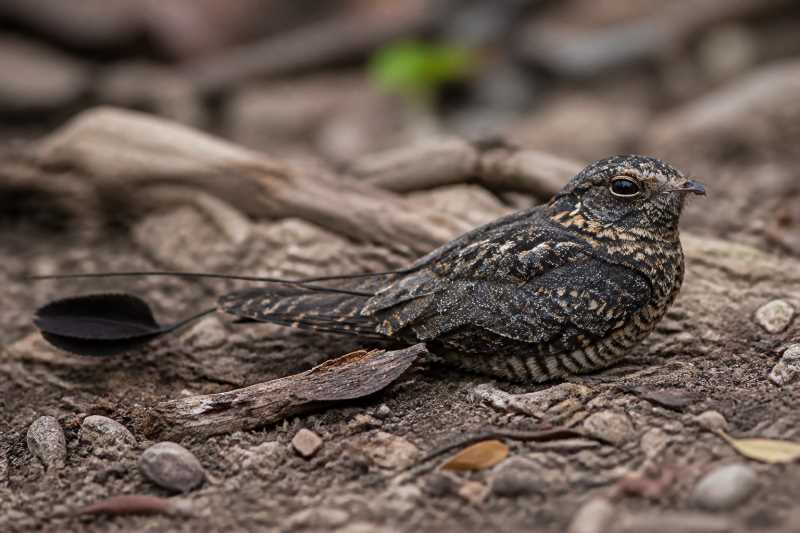
The Standard-winged Nightjar (Caprimulgus longipennis) is a nocturnal African nightjar noted for the extraordinary wing ornaments developed by breeding males. It is usually encountered in open savanna and woodland habitats, where its mottled plumage provides effective camouflage by day. The species is seasonally migratory across parts of its range.
Physical Description
The Standard-winged Nightjar is a medium-sized nightjar, measuring approximately 20–23 centimetres in body length, excluding the male’s elongated ornamental feathers. Its plumage is predominantly mottled brown, grey, black and buff, providing excellent concealment against dry ground, leaf litter and sparse vegetation.
During the breeding season, the male develops a highly distinctive elongated central flight feather on each wing. Each feather may reach about 38 centimetres, with much of the shaft bare and a broad, flag-like vane at the tip. These ornaments project well beyond the normal wing and are displayed during courtship flights.
Females lack the long wing standards and are generally less conspicuous. Non-breeding males also lose or moult these specialised feathers, making them considerably more difficult to distinguish from females and some other nightjars. Juveniles resemble adults but have softer, less sharply defined plumage and lack the adult male’s breeding ornaments.
Range and Habitat
The Standard-winged Nightjar occurs across sub-Saharan Africa. Its breeding range extends from Senegambia and southern Senegal eastwards through the savanna belt towards South Sudan, north-eastern Democratic Republic of the Congo and north-western Uganda. During the non-breeding season, populations move north and east into areas including southern Mauritania, northern Senegal, central Chad, Sudan, Eritrea, western Ethiopia and western Kenya.
It favours dry savanna, open woodland, scrub and other lightly vegetated habitats with bare or sparsely covered ground. These environments provide suitable daytime roosting and nesting sites, as well as open airspace for catching flying insects. The species is not confined to protected areas and may also occur in suitable pastoral and agricultural landscapes, although habitat quality varies considerably across its range.
Where to See This Species
Mole National Park, Northern Region, Ghana
Mole National Park is one of the better-documented places to look for Standard-winged Nightjar. The species has been recorded in the park’s open savanna and dry woodland, including around tracks, airstrips and other open areas. Males are most likely to attract attention during the breeding season, when their wing ornaments are visible during display flights. Night drives or guided evening walks should be arranged through the park, with care taken not to disturb roosting or nesting birds.
Nearby accommodation: Larabanga and the Mole National Park area provide practical access to park lodges, guest accommodation and campsites.
Shai Hills Resource Reserve, Greater Accra Region, Ghana
Shai Hills Resource Reserve contains open woodland, scrub and grassland habitats suitable for nightjars, and recent biodiversity records document Standard-winged Nightjar within the reserve. The species is most realistically sought around open tracks and savanna margins near dusk, particularly during periods when males are displaying.
Nearby accommodation: The Shai Hills and Tema area offers guest houses, hotels and other accommodation, with wider options available in Accra.
Kalakpa Resource Reserve, Volta Region, Ghana
Kalakpa Resource Reserve supports a mixture of savanna, woodland and open country habitats. Standard-winged Nightjar has been recorded in the reserve, including sightings of displaying males. The best opportunities are likely to be around open roads, clearings and savanna edges during the evening and early night, especially in the local breeding season.
Nearby accommodation: Ho is the main practical gateway, with hotels, guest houses and self-catering accommodation available in and around the town.
Behaviour and Diet
The Standard-winged Nightjar is mainly active at dusk, during the night and before dawn. It spends the day resting on the ground or on low perches, relying on cryptic plumage to avoid detection. When flushed, it may rise silently and fly only a short distance before settling again.
It feeds chiefly on flying insects, including moths, beetles and other night-flying arthropods. Prey is captured in flight using the wide gape typical of nightjars. Its flight is buoyant and agile, allowing it to forage over open ground, woodland edges and clearings.
Breeding is associated with seasonal rainfall and prey availability, so timing varies geographically. The female lays one or two eggs directly on the ground, usually without constructing a substantial nest. The eggs and incubating bird are difficult to detect because of their camouflage. The female is reported to undertake incubation, while the young are relatively well developed at hatching and can move soon after leaving the eggs.
Breeding males use their elongated wing feathers in display flights. The ornaments are raised or carried prominently during courtship, making displaying males much easier to identify than females or non-breeding individuals.
Identification Tips
- Look for a medium-sized, cryptically patterned nightjar in dry savanna, open woodland or scrub.
- The breeding male is unmistakable when seen well, because each wing carries an extremely long, flag-like ornamental feather.
- Females and non-breeding males lack the obvious standards and may appear plain brown, grey and buff at a distance.
- Activity around dusk and dawn, a silent moth-like flight and sudden flushing from a track or clearing are useful clues.
- The Pennant-winged Nightjar can create confusion, particularly when females or non-breeding birds are involved. Identification should take account of size, plumage, wing pattern, vocalisations, season and geographic range rather than relying on a single feature.
- A torch should be used sparingly, and observers should avoid approaching suspected nesting birds or repeatedly flushing roosting individuals.
Conservation Status
The Standard-winged Nightjar is currently assessed as Least Concern. It has a broad distribution and is not presently considered globally threatened. However, local populations may be affected by the conversion of savanna and woodland to intensive agriculture, habitat degradation, inappropriate fire regimes and disturbance of breeding areas.
Conservation measures should focus on maintaining open savanna mosaics, protecting remaining woodland and scrub, managing fire and grazing carefully, and retaining suitable ground habitat within protected areas and other important bird sites. Because the species is difficult to survey and seasonal in many regions, further monitoring is useful for clarifying local population trends.
Frequently Asked Questions
Where does the Standard-winged Nightjar live?
It occurs in sub-Saharan Africa, using dry savanna, open woodland, scrub and other lightly vegetated habitats. Its breeding and non-breeding distributions differ because many populations move seasonally.
Why does the male have such long wing feathers?
The elongated feathers are breeding ornaments used in courtship displays. They are grown by males during the breeding season and are moulted or absent outside that period.
What does the Standard-winged Nightjar eat?
It feeds mainly on flying insects, especially moths, beetles and other night-flying arthropods captured during aerial foraging.
Does the Standard-winged Nightjar build a nest?
Usually not. The female lays one or two eggs directly on the ground, where the eggs and adult depend on camouflage for protection.
Is the Standard-winged Nightjar migratory?
It is seasonally migratory across parts of its range. Breeding populations in western and central Africa may move north or east after breeding, while the exact pattern varies by region.
Where is it easiest to see this species?
Mole National Park, Shai Hills Resource Reserve and Kalakpa Resource Reserve in Ghana are documented wildlife-viewing locations. The best time to search is around dusk, particularly in open savanna and woodland-edge habitat.
References
- BirdLife International
- IUCN Red List of Threatened Species
- International Ornithologists’ Union World Bird List
Related posts