Introduction
The Taiwan Partridge (Arborophila crudigularis), also known as the Taiwan Hill Partridge, is a resident galliform bird endemic to Taiwan. It inhabits forest undergrowth and is more often heard than seen because of its shy, secretive nature. Its restricted island range makes it an important part of Taiwan’s native birdlife.
Physical Description
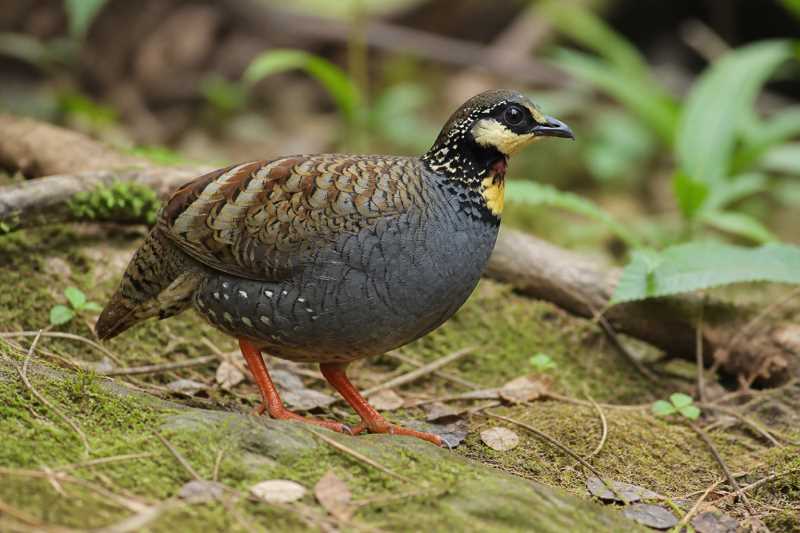
The Taiwan Partridge is a compact, short-tailed bird measuring about 28 cm in length. The sexes are broadly similar in appearance. Adults have a greyish to olive-brown head and upperparts, a pale eyebrow, dark markings through the eye, and a white throat and fore-neck. The sides of the neck form a distinctive pattern of black, white and chestnut markings.
The back and wings are olive-brown with dark barring and mottling. The underparts are greyish, often marked with pale streaks or patches, while the legs are reddish. The bill is dark. Its rounded body, short tail, red legs and strongly patterned head and neck are useful identification features.
Juveniles are generally duller and less sharply marked than adults, which helps them blend into leaf litter and dense vegetation. Detailed information on age-related plumage differences remains limited.
Range and Habitat
The Taiwan Partridge is endemic to Taiwan and is not naturally found elsewhere. It is a non-migratory resident of the island’s mountain forests, especially thick evergreen broadleaf woodland, mixed forest and areas with dense ground cover.
The species is associated mainly with low- to mid-elevation forest, although it has been recorded across a wider elevational range, from approximately 50 m to more than 2,600 m. Many records come from about 700-2,000 m. Suitable habitat usually includes shaded forest floor, leaf litter, shrubs, bamboo or other thick undergrowth, and relatively undisturbed woodland.
Although forest clearance and land-use change have reduced or fragmented suitable habitat in parts of Taiwan, the species still occurs in several protected mountain landscapes.
Where to See This Species
Yushan National Park, Nantou, Chiayi and Kaohsiung, Taiwan
Yushan National Park is a verified locality for the Taiwan Partridge. National Park research has documented the species in the park, including ecological studies of its activity patterns, movements and habitat selection. Look for it in forested areas with dense undergrowth, particularly during quiet periods in the early morning or late afternoon. It is more likely to be detected by its clear, repeated calls than by a direct view.
Nearby accommodation: Tataka and Meishan are useful gateway areas, while Alishan and other nearby mountain settlements offer hotels, guest houses, lodges and self-catering accommodation. Access and trail conditions should be checked before travelling.
Behaviour and Diet
The Taiwan Partridge is mainly ground-dwelling. It moves through leaf litter and low vegetation, using its legs and bill to search for food. Its diet includes insects and other small invertebrates, seeds, fruits, young leaves and other plant material.
It is usually encountered singly, in pairs or in small family groups. The species is wary and tends to remain concealed in thick vegetation, flying only when disturbed or when it needs to cross a short distance. Research in Yushan National Park found that activity patterns vary seasonally. Birds were most active around dawn and dusk during summer, while activity shifted towards midday in late autumn and early winter.
The Taiwan Partridge is resident rather than migratory. Its calls are loud, repeated notes that may be given by members of a pair or group and are often the first indication that birds are nearby.
Breeding records indicate that nesting takes place on or close to the ground, often at the base of a tree or bamboo in a sheltered, dry creek valley. Recorded nests were made from fallen leaves and fine twigs. Documented clutches contain three or four eggs, and one detailed study recorded an incubation period of approximately 24-26 days. Newly hatched chicks leave the nest with a parent soon after hatching.
Identification Tips
- Listen for loud, repeated calls from dense forest undergrowth, especially around dawn or dusk.
- Look for a compact, round-bodied bird with a short tail and reddish legs.
- Check the head for a pale eyebrow, dark eye-line and pale throat.
- The black, white and chestnut pattern on the sides of the neck is particularly distinctive.
- Search the forest floor and edges of thick vegetation rather than open high branches.
- Avoid confusing it with the Taiwan Bamboo Partridge, which is a different species and generally favours more open or lower-elevation habitats. The Taiwan Partridge is usually more closely associated with shaded mountain forest and has a different head and neck pattern.
Conservation Status
The Taiwan Partridge is currently assessed as Least Concern on the IUCN Red List. It is nevertheless a restricted-range endemic and remains vulnerable to local habitat loss, forest fragmentation, disturbance and hunting pressure. Taiwan also recognises it as a species requiring conservation protection under national wildlife regulations.
Protected areas, including national parks and other forest reserves, are important for maintaining continuous habitat. Continued protection of mature forest, dense undergrowth and breeding sites, together with monitoring and enforcement against illegal hunting, supports the species’ long-term conservation.
Frequently Asked Questions
Is the Taiwan Partridge endemic to Taiwan?
Yes. The Taiwan Partridge occurs naturally only on Taiwan, making it a true island endemic.
Where does the Taiwan Partridge live?
It lives mainly in thick evergreen broadleaf and mixed mountain forests with dense undergrowth and leaf litter. It is most often associated with low- to mid-elevation woodland, but has been recorded from roughly 50 m to above 2,600 m.
What does the Taiwan Partridge eat?
Its diet includes seeds, fruits, young leaves, insects and other small invertebrates found on or near the forest floor.
Is the Taiwan Partridge easy to see?
No. It is shy, alert and usually concealed in undergrowth. Birdwatchers are more likely to hear its loud calls than obtain a clear view, particularly in dense forest.
When does the Taiwan Partridge breed?
Breeding records have been reported from spring and summer, although timing may vary with elevation. Documented nests contain three or four eggs, with incubation lasting about 24-26 days.
What is the conservation status of the Taiwan Partridge?
The species is classified globally as Least Concern. Habitat protection remains important because its range is restricted to Taiwan and local populations can be affected by forest disturbance, fragmentation and hunting.
References
- BirdLife International
- IUCN Red List of Threatened Species
- Yushan National Park Headquarters, National Park Service, Taiwan
Related posts