Brooks’s Leaf Warbler: A Jewel of the Canopy
In the lush canopies of the Himalayas and the adjoining regions, a small bird with a big personality flits from branch to branch, its presence often announced by its distinctive and melodious song. This is Brooks’s Leaf Warbler, scientifically known as Phylloscopus subviridis. Its discovery and classification have intrigued ornithologists and bird enthusiasts alike, owing to its unique characteristics and the charm it adds to the ecosystem.
Taxonomy and Nomenclature
Brooks’s Leaf Warbler belongs to the family Phylloscopidae. The genus name Phylloscopus is derived from Greek, meaning "leaf watcher" or "leaf seeker," which aptly describes the bird’s behavior of foraging among foliage. The species name, subviridis, indicates its subtly greenish color. Named after the English naturalist William Edwin Brooks, who contributed significantly to the study of Indian birds, this warbler holds a special place in avian taxonomy.
Physical Description
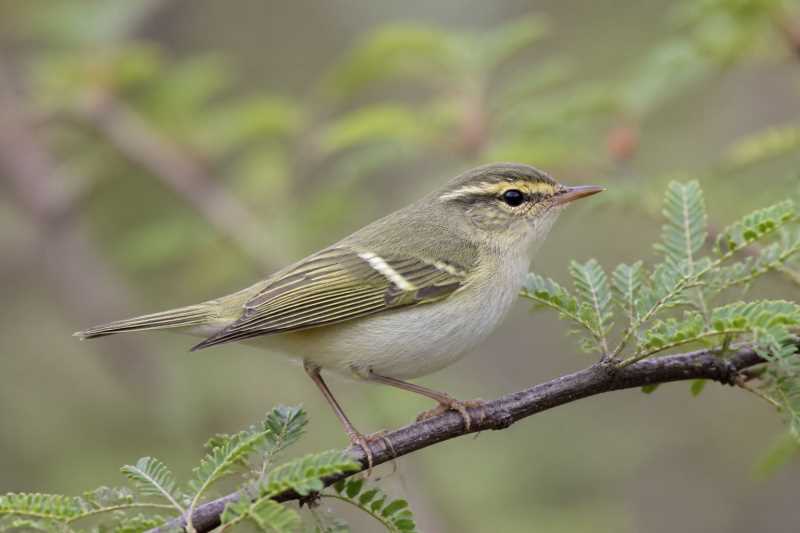
Despite its modest size, measuring approximately 10 to 11 centimeters in length, Brooks’s Leaf Warbler makes a striking impression. It exhibits a delicate blend of green and yellow tones that provide excellent camouflage among the leaves. Its underparts tend to be paler, while the upper body showcases a more vibrant green. The bird’s wings are adorned with faint wing bars, contributing to its identification. One of the most notable features is its supercilium—a distinct, contrasting stripe above its eye, which aids in distinguishing it from other similar leaf warblers.
Habitat and Distribution
Brooks’s Leaf Warbler is predominantly found in the forests of the Himalayas, extending from northern Pakistan through India and into western Nepal. It favors montane and submontane forests, thriving in the dense canopy where it can forage for insects and caterpillars. The bird is altitudinally migratory, retreating to lower elevations during the colder months. This seasonal movement not only underscores its adaptability but also highlights the importance of conserving diverse habitats that cater to its year-round needs.
Behavior and Diet
Primarily insectivorous, Brooks’s Leaf Warbler is a relentless forager. It flits energetically among leaves, branches, and twigs, picking off small insects and larvae with precision. Its feeding behavior is characterized by a series of short, rapid flights interspersed with brief pauses, during which it inspects the foliage for prey. This dynamic feeding strategy is supported by its lightweight build and agile flight.
In terms of vocal behavior, Brooks’s Leaf Warbler is renowned for its complex and melodious song. The male uses its vocalizations not only to attract a mate but also to establish territory. The calls are often high-pitched, comprising a series of trills and tweets that resonate through the forest, enhancing its presence despite its diminutive size.
Breeding and Reproduction
The breeding season for Brooks’s Leaf Warbler typically spans from April to June, coinciding with the abundance of food resources necessary for raising young. The female constructs a cup-shaped nest, usually hidden within dense foliage to protect against predators. Clutches typically consist of 3 to 5 eggs, which are incubated for about two weeks. Both parents participate in feeding the fledglings, ensuring a high survival rate for the offspring.
Conservation Status
Currently, Brooks’s Leaf Warbler is classified as a species of Least Concern by the International Union for Conservation of Nature (IUCN). However, ongoing habitat loss due to deforestation and land-use changes poses a potential threat. Conservation efforts aimed at preserving forest habitats are critical for ensuring the long-term survival of this species. Protecting the ecological integrity of its habitat will not only benefit Brooks’s Leaf Warbler but also countless other species that share its environment.
Importance in the Ecosystem
Brooks’s Leaf Warbler plays a crucial role in the ecosystem as both a predator and prey. By controlling insect populations, it helps maintain ecological balance within its habitat. Furthermore, as a prey species, it supports a range of predators, including larger birds and mammals. Its presence is indicative of a healthy, functioning ecosystem.
Conclusion
Brooks’s Leaf Warbler exemplifies the beauty and complexity of avian life in the Himalayas. Its vibrant plumage, melodious song, and dynamic behavior make it a fascinating subject for birdwatchers and researchers alike. As we continue to explore and understand the natural world, the conservation of species like Brooks’s Leaf Warbler becomes ever more vital. By safeguarding their habitats and promoting biodiversity, we ensure that future generations can enjoy the rich tapestry of life that these magnificent birds contribute to.
Related posts