The Scissor-tailed Flycatcher: A Master of Aerial Acrobatics
The Scissor-tailed Flycatcher, scientifically known as Tyrannus forficatus, is a striking bird renowned for its breathtaking tail feathers and agile flight. Native to North and Central America, this bird captivates birdwatchers with its elegance and grace, making it a true marvel of the avian world.
Appearance and Identification
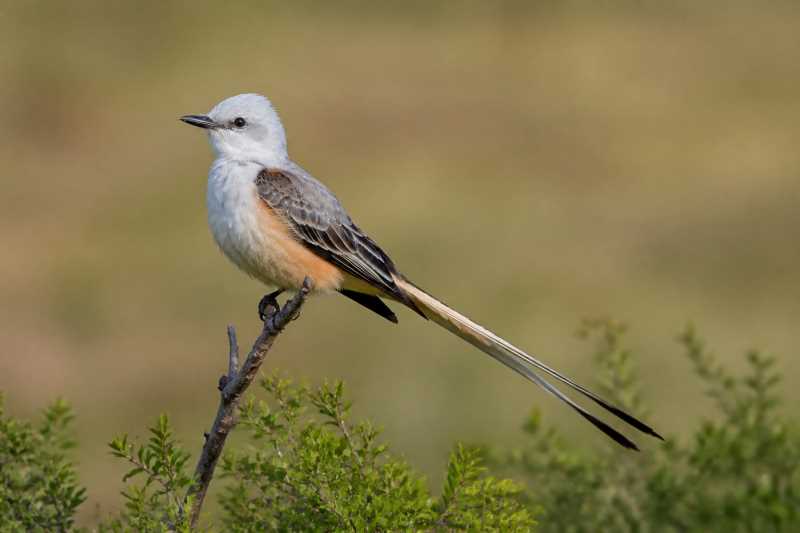
The Scissor-tailed Flycatcher is easily distinguishable by its long, forked tail, which can measure up to twice the length of its body. This tail is not only a defining feature but also a functional tool used in flight maneuvers. The bird’s plumage is predominantly a soft gray on the head and back, with a contrasting white underbelly. Its wings are darker with a hint of salmon-pink on the sides, adding to its visual appeal. During the breeding season, the males’ tails grow longer, enhancing their aerial displays to attract mates.
Habitat and Distribution
These birds are predominantly found in the southern United States, particularly in Texas, Oklahoma, and Kansas, extending into northern Mexico during the breeding season. They favor open areas such as prairies, ranchlands, and savannas, where they can easily spot and catch their prey. During the winter months, Scissor-tailed Flycatchers migrate to Central America, traveling in flocks to warmer climates.
Behavior and Diet
Scissor-tailed Flycatchers are known for their aerial agility and are often seen performing acrobatic flights to catch insects in mid-air. Their diet mainly consists of insects such as grasshoppers, crickets, and beetles, which they hunt using their keen eyesight and swift maneuvers. Occasionally, they may also consume berries and small fruits.
These birds are highly territorial, especially during the breeding season. Males can be observed engaging in complex aerial displays, characterized by steep dives, loops, and tail-fanning movements to establish dominance and attract females.
Breeding and Nesting
The breeding season for Scissor-tailed Flycatchers begins in late spring, typically around April to June. They build their nests in isolated trees or shrubs, using twigs, grass, and other plant materials. The female usually lays three to five eggs, which she incubates for about two weeks. Both parents take part in feeding the chicks, which fledge within two to three weeks after hatching.
Interestingly, these birds exhibit a high degree of site fidelity, often returning to the same breeding grounds each year. This behavior ensures that successful breeding pairs can continue to thrive in familiar environments.
Conservation Status
Currently, the Scissor-tailed Flycatcher is listed as Least Concern by the International Union for Conservation of Nature (IUCN). However, habitat loss due to agricultural expansion and urbanization poses a potential threat to their populations. Conservation efforts focus on preserving native grasslands and open spaces, which are crucial for their survival.
Cultural Significance
The Scissor-tailed Flycatcher holds a special place in the hearts of many, particularly in Oklahoma, where it is the state bird. Its presence is celebrated in local folklore and art, symbolizing the spirit of freedom and the beauty of nature.
Conclusion
The Scissor-tailed Flycatcher, with its extraordinary tail and remarkable flight skills, is a testament to the wonders of avian evolution. Observing these birds in their natural habitat is a captivating experience, offering a glimpse into the intricate balance of nature. As stewards of the environment, it is our responsibility to ensure that these magnificent creatures continue to grace our skies for generations to come.
Related posts