Introduction
The Golden Nightjar (Caprimulgus eximius) is a distinctive nocturnal bird of the Sahel. Its golden-buff plumage, cryptic markings and quiet, ground-based habits make it difficult to locate by day, while its short periods of activity at dusk and during the night can make it equally elusive after dark. It belongs to the nightjar family, Caprimulgidae, and remains one of the less thoroughly studied nightjars of Africa. (worldbirdnames.org)
Physical Description
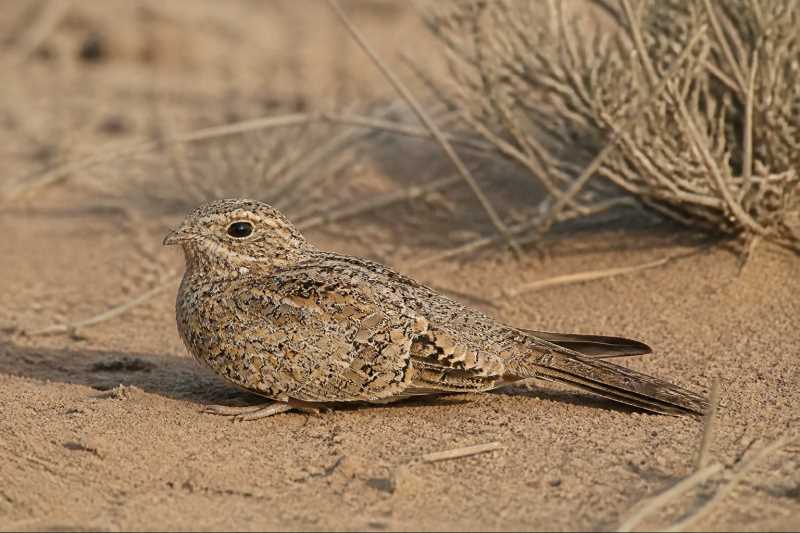
The Golden Nightjar is approximately 23–25 centimetres long. It has a broad, flat head, a very wide gape and large eyes adapted to low-light conditions. The upperparts and wing-coverts are predominantly tawny, golden-buff and sandy brown, with greyish-white markings edged or heavily speckled with dark brown. This pattern blends closely with sand, gravel, dry grass and sparse scrub.
The throat has a conspicuous whitish patch, while the breast is mottled and the lower breast and belly become paler and more uniformly buff. White markings on the wings and outer tail feathers can be visible in flight, although they are easily missed in poor light. The sexes are broadly similar in appearance, and reliable information on age-related plumage differences is limited. (en.wikipedia.org)
Range and Habitat
The Golden Nightjar occurs across parts of the Sahel, from southern Mauritania and northern Senegal eastwards through Mali, Niger and Chad to Sudan. Records also extend into northern Nigeria, and breeding has been confirmed in the Aousserd region of southern Morocco, north of the species’ traditionally recognised Sahelian range. Its distribution is uneven, with the bird locally scarce in some areas and more regularly encountered in suitable habitat elsewhere. (avibase.bsc-eoc.org)
It favours arid and semi-arid lowlands, including semi-desert with scattered grasses and shrubs, open savanna, sandy or stony plains, rocky areas and dry wadis. It may also occur near seasonal water, fallow cultivation and sparse acacia vegetation. The species is generally regarded as sedentary, although local post-breeding dispersal or nomadic movements may occur, particularly in response to rainfall and insect abundance. Two subspecies are commonly recognised, with C. e. simplicior occupying much of the western and central range and the nominate C. e. eximius occurring in Sudan. (researchgate.net)
Where to See This Species
The Golden Nightjar is not a predictable bird at most sites. Local knowledge, suitable weather and careful listening around dusk or before dawn are important, and access to remote Sahelian areas may require an experienced local guide.
Oued Jenna, Aousserd region, Western Sahara, Morocco
Oued Jenna is one of the best-documented places to look for the species in the Western Palearctic. Golden Nightjars have been repeatedly recorded in the surrounding sandy and stony wadis, open grassland and sparse scrub, and breeding was confirmed in the wider Aousserd region in March 2019. Spring visits, particularly after rainfall, may offer the best chance of hearing singing birds or seeing individuals hawking over roads and open ground. (magornitho.org)
Nearby accommodation: Aousserd is the closest practical settlement, while Dakhla provides a broader choice of hotels, guest houses and camps for visitors planning a longer birding trip.
Diawling National Park, Trarza Region, Mauritania
A Golden Nightjar was observed at night in the dunes of Diawling National Park during a field survey in January 2020. The record demonstrates that the park’s sandy dunes, open acacia woodland and surrounding Sahelian habitats can support the species, although it should be treated as a scarce and irregular target rather than a guaranteed sighting. (go-south.grepom.org)
Nearby accommodation: Keur Macène and accommodation within or near the park provide the most practical bases, with camping and simple lodge-style options available in the wider park area.
Behaviour and Diet
The Golden Nightjar is mainly crepuscular and nocturnal. It may begin calling shortly before darkness and can remain active through the night, with another period of activity before dawn. During the day it usually rests on the ground, where its sandy plumage makes it extremely difficult to detect.
It feeds by making short, silent or nearly silent flights from the ground or a low perch to intercept insects in the air. Grasshoppers and other orthopterans appear to be important prey, while moths, beetles and other flying invertebrates are also taken. Individuals may forage around seasonal water, roads or areas where insects have concentrated after rain. (magornitho.org)
The species is believed to nest on the ground, laying its eggs directly on sand, gravel or bare soil rather than constructing a substantial nest. Breeding records remain limited, but confirmed breeding near Aousserd and observations of adults with young show that the species can breed in open desert and semi-desert landscapes. Breeding activity may be associated with rainfall and periods of increased insect availability. (magornitho.org)
Identification Tips
- Look for a small to medium-sized nightjar with an unusually warm golden, tawny or sandy appearance.
- At rest, note the large head, broad bill, whitish throat patch and heavily patterned upperparts.
- In flight, look for pale wing markings and white on the outer tail feathers, although these features may be difficult to see at night.
- Search open sandy, stony or grassy ground rather than dense woodland or tall vegetation.
- Listen at dusk and before dawn for a prolonged churr or rapidly repeated territorial call. The song can carry deceptively far and may seem no louder when the bird is nearby.
- Egyptian Nightjar (Caprimulgus aegyptius) may occur in some of the same broad regions. The Golden Nightjar is generally warmer and more richly golden, with more prominent pale and dark patterning on the upperparts and a clearer whitish throat patch. Identification should be confirmed with photographs, recordings or several field marks where the two species overlap. (researchgate.net)
Conservation Status
The Golden Nightjar is currently assessed as Least Concern on the IUCN Red List. It has a broad geographic range and is not considered globally threatened, but its population size and long-term trend are poorly documented. The species’ patchy distribution and limited field records make local declines difficult to detect. (en.wikipedia.org)
Potential pressures include habitat conversion, degradation of open Sahelian vegetation, disturbance around breeding sites, increasing road traffic and changes in rainfall patterns. Conservation measures are best linked to the protection of intact dry savanna, dune and wadi habitats, sustainable land management and improved monitoring of breeding and seasonal movements. Protected areas such as Diawling National Park also provide valuable opportunities for research and habitat protection.
Frequently Asked Questions
Where is the Golden Nightjar found?
It occurs mainly across the Sahel, from Mauritania and Senegal eastwards through Mali, Niger and Chad to Sudan. It has also been recorded in northern Nigeria and southern Morocco.
Is the Golden Nightjar migratory?
It is generally considered sedentary, although local post-breeding dispersal or nomadic movements may occur. Rainfall and the availability of insect prey may influence where birds are found from season to season.
What does the Golden Nightjar eat?
Its diet consists mainly of flying insects, including grasshoppers, moths, beetles and other invertebrates. Orthopterans can be particularly important when they are abundant.
When is the best time to look for a Golden Nightjar?
The best opportunities are usually around dusk, during the first hours of darkness and shortly before dawn. Birds may be easier to detect after rain, when insect activity increases.
Does the Golden Nightjar build a nest?
No substantial nest is normally expected. Like other nightjars, it lays its eggs directly on the ground, relying on camouflage and the surrounding substrate for concealment.
Is the Golden Nightjar endangered?
No. The species is currently classified as Least Concern, although reliable information on its population size and trend is limited and local habitat loss remains a concern.
References
- IUCN Red List of Threatened Species
- BirdLife International
- Go-South Bulletin
Related posts