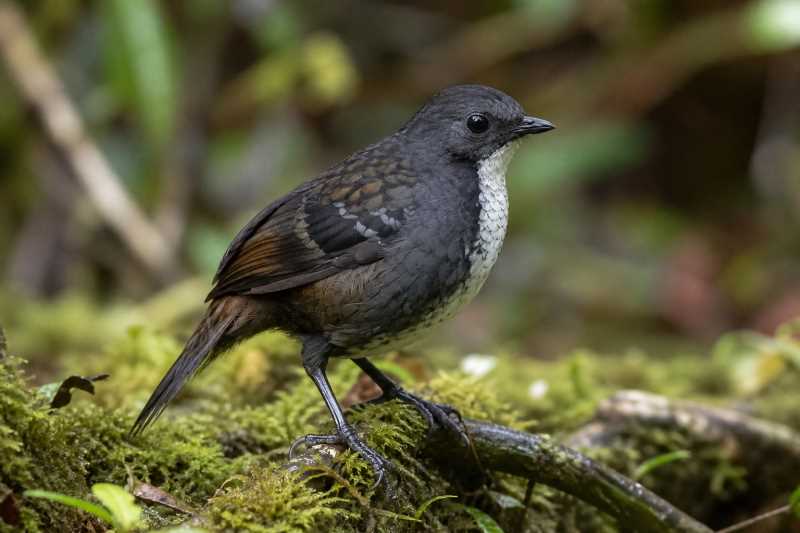
The Remarkable Papuan Logrunner: A Hidden Gem of New Guinea’s Avifauna
Nestled in the rich and diverse ecosystems of New Guinea, the Papuan Logrunner (Orthonyx novaeguineae) emerges as a fascinating subject of study for ornithologists and bird enthusiasts alike. This elusive bird, often overshadowed by its more flamboyant cousins in the region, is a testament to the unique evolutionary journey undertaken by the avian inhabitants of this island. With its distinct behaviors and adaptations, the Papuan Logrunner offers a compelling glimpse into the complexity of New Guinea’s biodiversity.
Taxonomy and Distribution
The Papuan Logrunner belongs to the family Orthonychidae, a small group of birds endemic to the Australasian region. Historically, the logrunner was classified with the Australian Logrunner but has since been recognized as a separate species due to its unique geographical and ecological niches. It is predominantly found in the montane and submontane forests of New Guinea, thriving at altitudes ranging from 300 to 2,800 meters.
The distribution of the Papuan Logrunner is broadly confined to the central and eastern highlands of New Guinea, spanning across the sovereign states of Papua New Guinea and the Indonesian province of Papua. Despite its limited range, the species’ adaptability to various forest types, from primary rainforests to secondary growths, underscores its resilience and evolutionary success.
Morphological Characteristics
The Papuan Logrunner is a medium-sized bird, measuring approximately 17-20 cm in length. It features a robust body with a distinctively short tail, a characteristic that aids its ground-dwelling lifestyle. The bird’s plumage is predominantly brown with subtle variegations, allowing it to blend seamlessly into the forest floor.
Sexual dimorphism is evident in this species, with males typically showcasing a darker, more pronounced plumage compared to the females. The male Papuan Logrunner’s throat is marked by a striking black patch, contrasting sharply with the pale underparts. Females, on the other hand, exhibit a lighter coloration, with a more muted palette that serves as effective camouflage while nesting.
Behavioral and Ecological Insights
One of the most intriguing aspects of the Papuan Logrunner is its foraging behavior. The species is primarily insectivorous, relying on its strong legs and curved bill to sift through leaf litter and soil in search of invertebrates. This ground-foraging habit is complemented by a unique method of locomotion, where the bird uses its wings to maintain balance while its legs propel it forward.
Papuan Logrunners are generally solitary or found in pairs, maintaining a territory that they vigorously defend against intruders. Their vocalizations, consisting of soft whistles and trills, serve both as a means of communication between mates and as a deterrent to other birds encroaching on their space.
The breeding season for the Papuan Logrunner is closely tied to the climatic conditions of its habitat, with peak activity observed during the wet season when food abundance is at its highest. Nests are typically constructed on the ground, concealed among dense foliage and protected by the female’s cryptic plumage.
Conservation Status and Threats
Currently, the Papuan Logrunner is classified as ‘Least Concern’ by the International Union for Conservation of Nature (IUCN). However, this status does not imply that the species is free from threats. The primary concern for the Papuan Logrunner is habitat destruction, driven by logging activities and agricultural expansion in New Guinea.
The encroachment of human settlements and the subsequent fragmentation of forest habitats pose significant risks to the long-term survival of the species. Conservation efforts aimed at preserving the unique montane ecosystems of New Guinea are crucial in ensuring the continued existence of the Papuan Logrunner and countless other endemic species.
Conclusion
The Papuan Logrunner stands as a remarkable example of avian adaptation and diversity. Its specialized ecological role within the forest ecosystem highlights the intricate balance of life in New Guinea’s montane habitats. As we continue to study and appreciate this enigmatic bird, it serves as a reminder of the rich biodiversity that thrives in the world’s less-explored regions. Preserving the habitats that support such unique species is not just a conservation priority but a testament to our commitment to safeguarding the planet’s natural heritage.
In conclusion, the Papuan Logrunner, with its distinctive behaviors and adaptations, offers valuable insights into the ecological tapestry of New Guinea. Through concerted conservation efforts, we can ensure that this hidden gem of the avian world continues to thrive for future generations to marvel at and study.
Related posts