Introduction
The Mountain Velvetbreast (Lafresnaya lafresnayi) is a small hummingbird of the northern and central Andes. It is the only species in the genus Lafresnaya and is recognised for its long, curved bill, green plumage and contrasting dark or pale underparts, which vary among subspecies.
Physical Description
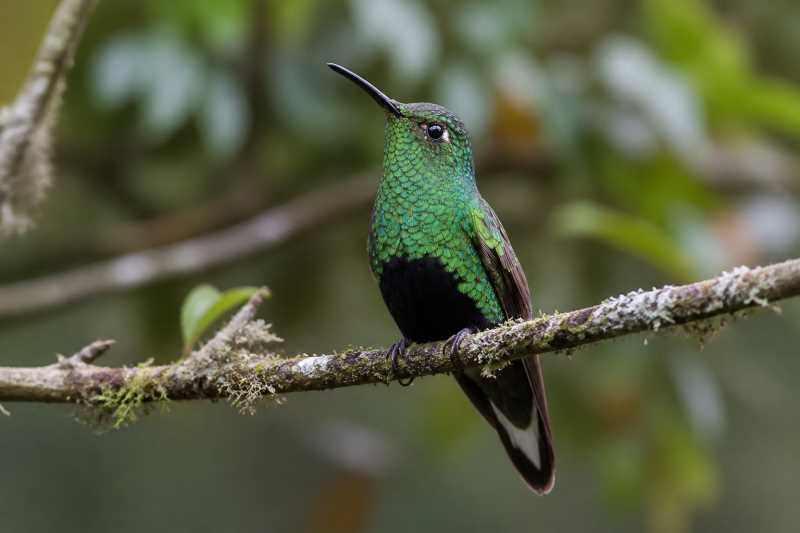
The Mountain Velvetbreast is about 11.5–12 cm long and weighs approximately 4.5–6 g. It has a slender black bill that is strongly decurved, although bill length and curvature vary geographically. A small white spot behind the eye is usually visible.
Adult males generally have bright grass-green upperparts, with an iridescent emerald-green throat and breast. In some populations, especially the nominate form, the centre of the belly is deep velvet-black. The central tail feathers are bronzy green, while the outer feathers are buff or whitish with dark tips.
Females are less strongly marked. They usually have green upperparts and pale buff or whitish underparts patterned with green spots or scaling. Juveniles resemble females, although young males gradually develop the darker belly and richer iridescent plumage of adults. The exact colour and pattern of both sexes vary between subspecies.
Range and Habitat
The Mountain Velvetbreast occurs in the Andes from western Venezuela through Colombia and Ecuador to Peru. Several recognised subspecies are associated with separate mountain regions, including the Sierra Nevada de Santa Marta, the Colombian Andes, western Venezuela and different sections of the Peruvian Andes.
It is primarily found between about 1,800 and 3,400 metres above sea level, with records reaching approximately 3,500–3,700 metres in Ecuador. It favours humid montane forest edges, cloud-forest borders, shrubby slopes, subpáramo and other areas with abundant flowering plants. It is generally less common in the interior of dense forest than along edges and open, shrubby vegetation.
The species is resident across its range but can make seasonal movements up and down mountain slopes. These altitudinal movements are associated with flowering cycles and changing conditions between montane forest and higher páramo vegetation.
Where to See This Species
Yanacocha Ecological Reserve, Pichincha, Ecuador
Yanacocha is a high-elevation reserve on the slopes of Pichincha west of Quito. The reserve protects humid montane forest, forest edges and páramo vegetation, and the Mountain Velvetbreast is documented from the reserve, including around its bird-feeding areas and trails. It is a realistic location for searching for the species in Ecuador, particularly where flowering shrubs border forest and open highland vegetation.
Nearby accommodation: Quito is the main practical base, with hotels, guest houses, lodges and self-catering accommodation. Rural accommodation is also available in the wider Pichincha highlands.
Chingaza National Natural Park, Cundinamarca and Meta, Colombia
Chingaza protects extensive Andean forest, shrubland and páramo habitat east of Bogotá. The park’s bird guide documents the Mountain Velvetbreast across an elevation range of approximately 1,500–3,700 metres. Look along forest edges, sheltered tracks and flowering vegetation in suitable highland habitat, subject to park access rules and local conditions.
Nearby accommodation: Guasca and La Calera are practical gateway areas with rural lodges, guest houses and self-catering accommodation. Bogotá provides a wider choice of hotels and other accommodation.
Behaviour and Diet
The Mountain Velvetbreast feeds mainly on nectar from a variety of flowering plants, especially flowers with long tubular corollas. Plants in the genus Siphocampylus are among the recorded food sources. Its curved bill is well suited to reaching nectar in tubular flowers.
Males commonly defend productive feeding territories. Females may forage by trap-lining, travelling between a regular circuit of flowering plants rather than defending a single feeding area. Both sexes supplement nectar with small insects and other arthropods, which they glean from foliage or capture during short aerial sallies.
Breeding activity varies between localities and may occur during different months of the year. The female builds a cup-shaped nest using moss, lichen and spider silk. Nests are usually placed about 1–3 metres above the ground in vegetation on a steep bank or rock face, although some are attached to tree trunks. A normal clutch contains two eggs. The female incubates them for about 16–19 days, and the young generally leave the nest 23–26 days after hatching.
Identification Tips
- Look for a small, green hummingbird with a long, black, noticeably curved bill.
- The white spot behind the eye can be useful when the bird is perched.
- Adult males may show an emerald-green throat and breast with a contrasting velvet-black belly.
- Females and juveniles are paler below, with buff or whitish underparts marked by green spots.
- The outer tail feathers are often pale or buff with dark tips, creating a noticeable pale-sided tail in flight.
- Do not rely on plumage colour alone, as the species varies geographically. Bill shape, the pale tail pattern and the combination of green upperparts with spotted or dark underparts are more reliable when used together.
- The Mountain Velvetbreast can occur alongside other Andean hummingbirds, but its strongly decurved bill and pale outer tail feathers help separate it from many similarly sized species.
Conservation Status
The Mountain Velvetbreast is currently assessed as Least Concern. It has a broad Andean distribution and occurs in a number of protected areas, although it is unevenly distributed and can be uncommon in parts of Venezuela and Ecuador. A reliable global population estimate is not available.
The principal concerns are the loss and degradation of humid montane forest, forest-edge habitat and high-elevation shrubland through agricultural expansion, deforestation, development and other land-use changes. Climate-driven changes to flowering patterns and the distribution of montane habitats may create additional pressure. Protecting connected forest belts, páramo margins and flowering plant communities is important for maintaining suitable habitat.
Frequently Asked Questions
Where is the Mountain Velvetbreast found?
It occurs in the Andes from western Venezuela through Colombia and Ecuador to Peru. Its distribution is divided among several mountain regions and subspecies.
What habitat does the Mountain Velvetbreast use?
It favours humid montane forest edges, cloud-forest borders, shrubby slopes, subpáramo and other highland habitats with abundant flowering plants.
What does the Mountain Velvetbreast eat?
Its main food is nectar from flowering plants. It also catches or gleans small insects and other arthropods, particularly as a source of protein.
How can the Mountain Velvetbreast be identified?
Useful field marks include the long, strongly curved black bill, green upperparts, a white spot behind the eye and pale outer tail feathers with dark tips. Adult males may have a striking velvet-black belly.
Is the Mountain Velvetbreast migratory?
It is not a long-distance migrant, but it can make seasonal altitudinal movements between lower montane forest and higher subpáramo or páramo habitat.
Is the Mountain Velvetbreast threatened?
It is currently listed as Least Concern. Nevertheless, habitat loss and degradation in the Andes remain important conservation concerns, particularly where montane forest and high-elevation vegetation are being cleared or fragmented.
References
- BirdLife International
- Cornell Lab of Ornithology, Birds of the World
- Parques Nacionales Naturales de Colombia
Related posts