Introduction
The Indian Spot-billed Duck (Anas poecilorhyncha) is a large dabbling duck of freshwater wetlands across the Indian subcontinent. It is mainly resident, although local movements may occur when water levels, food supplies or seasonal conditions change. The species is named for the coloured spot near the base of its bill.
Physical Description
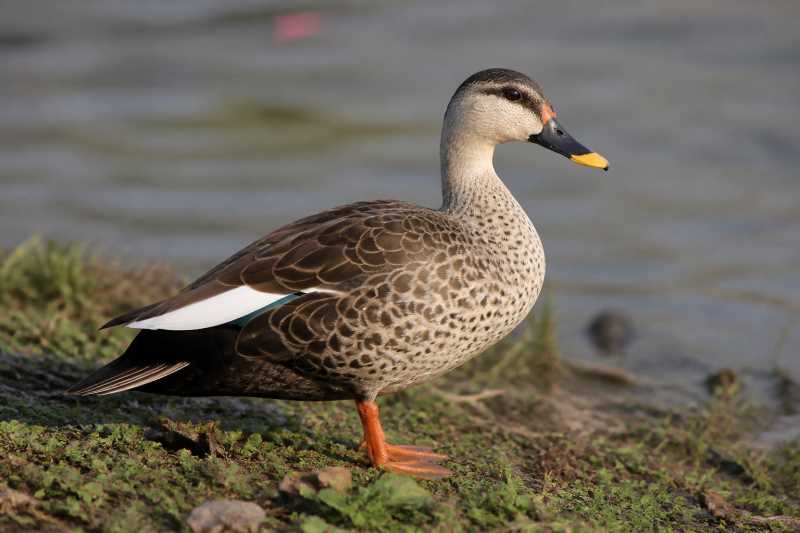
The Indian Spot-billed Duck is a medium to large duck, measuring approximately 55–63 cm in length, with a wingspan of about 83–95 cm. Its body is dark brown with a finely scaled appearance, while the head and neck are paler brown. The crown is usually darker, and the legs and feet are orange to reddish.
The bill is black with a yellow tip and a conspicuous orange or red spot near the base. In flight, the green speculum bordered with white is a useful identification feature. The sexes are broadly similar, although females may appear slightly duller and males can show more strongly marked bill spots. Juveniles are generally less boldly coloured, with less distinct facial and bill markings.
Range and Habitat
The species occurs across much of the Indian subcontinent, including Pakistan, India, Nepal, Bangladesh and Sri Lanka. It is also recorded in parts of mainland Southeast Asia, although the related Eastern Spot-billed Duck is treated as a separate species in current taxonomic classifications.
Indian Spot-billed Ducks favour freshwater lakes, marshes, irrigation tanks, slow-flowing rivers, seasonal pools and flooded agricultural land, including paddy fields. They usually prefer shallow water with emergent vegetation, grassy margins and nearby cover for resting or nesting. They are not regarded as long-distance migrants, but local and regional movements can take place in response to rainfall, flooding and the availability of feeding sites.
Where to See This Species
Sultanpur National Park, Haryana, India
The Haryana Forest Department lists the Indian Spot-billed Duck among the birds recorded at Sultanpur National Park. The park’s shallow wetland, reed beds, open water and muddy margins provide suitable habitat, and the species may be encountered throughout the year.
Nearby accommodation: Gurgaon and Sultanpur village provide practical options including hotels, guest houses and other accommodation suitable for visitors to the park.
Kaziranga National Park, Assam, India
A government-supported birding checklist for Kaziranga includes the Spot-billed Duck. The park’s floodplain wetlands, beels, river channels and grassland pools offer suitable habitat, particularly when water remains in shallow marshy areas. The park is generally open to visitors during the main tourism season from November to April, although local access and conditions should be checked before travelling.
Nearby accommodation: Kohora, Bagori and the wider Kaziranga gateway area offer forest lodges, guest houses, camps and other visitor accommodation.
Melghat Tiger Reserve, Maharashtra, India
The Maharashtra Forest Department’s bird guide for Melghat records the Indian Spot-billed Duck as a resident wetland species that is locally common. Look for it around suitable reservoirs, ponds, river edges and other open freshwater sites within the reserve and its surrounding landscape.
Nearby accommodation: Chikhaldara and the Melghat gateway villages provide practical accommodation, including forest lodges, guest houses and homestays.
Behaviour and Diet
Indian Spot-billed Ducks are usually seen singly, in pairs or in small groups. Larger gatherings may form where food and safe roosting sites are concentrated. They spend much of the day resting on banks, islands or open water, with feeding often taking place in shallow water and along vegetated margins.
As dabbling ducks, they feed mainly at the surface rather than making deep dives. Their diet includes aquatic vegetation, grasses, seeds, rice and other plant material, supplemented by insects, snails and other small aquatic invertebrates. They may feed by tipping the front of the body into the water, grazing on banks or searching through wet vegetation.
Breeding is influenced by rainfall and local water conditions. In northern India it commonly coincides with the monsoon period, while breeding in southern areas may occur later. The nest is usually a shallow structure of grass, weeds and down, concealed in vegetation on the ground near water. Clutches commonly contain about 6–12 eggs, and incubation lasts roughly 24 days. The female performs most of the incubation and care of the precocial ducklings, which leave the nest soon after hatching and follow her to water.
Identification Tips
- Look for a large brown duck with a finely scaled body and a darker crown.
- Check the black bill for a yellow tip and orange or red spot near the base.
- In flight, look for the green wing speculum bordered with white.
- The species is often found in shallow freshwater rather than deep open water.
- Males and females look similar, so bill pattern, body scaling and the white-bordered green wing patch are more useful than sex-specific features.
- Do not confuse it with the related Eastern Spot-billed Duck, which has a more easterly distribution and is treated as a separate species. The two can be difficult to separate where their ranges approach one another, so location and the full combination of plumage features should be considered.
Conservation Status
The Indian Spot-billed Duck is classified as Least Concern globally on the IUCN Red List. Its broad distribution and continued presence in many wetlands support this assessment, but the species remains dependent on the protection and quality of freshwater habitats.
Important local pressures include wetland drainage, conversion of marshes and floodplains, pollution, disturbance, changes in water management and unsustainable hunting in some parts of its range. Conservation measures include protecting wetlands, maintaining suitable water levels and vegetation, controlling pollution, enforcing hunting regulations and monitoring resident waterbird populations. National and regional assessments indicate that local trends may differ from the global assessment, and some populations may be declining where wetlands are heavily modified.
Frequently Asked Questions
Where is the Indian Spot-billed Duck found?
It is found mainly across Pakistan, India, Nepal, Bangladesh and Sri Lanka, with the species also recorded in parts of mainland Southeast Asia. It occupies freshwater wetlands, marshes, lakes, rivers, irrigation tanks and flooded farmland.
Is the Indian Spot-billed Duck migratory?
It is generally a resident species rather than a long-distance migrant. Local movements may occur when wetlands dry, flood or change in their food supply.
What does the Indian Spot-billed Duck eat?
Its diet consists mainly of aquatic plants, grasses, seeds and cultivated grains such as rice. It also takes insects, snails and other small aquatic invertebrates.
How can the Indian Spot-billed Duck be identified?
Look for its brown, finely scaled plumage, dark crown, yellow-tipped black bill and orange or red spot near the bill base. The green wing speculum bordered with white is especially clear in flight.
When does the Indian Spot-billed Duck breed?
Breeding varies with rainfall and local conditions. In northern India it commonly occurs during or shortly after the monsoon, while breeding in southern areas may take place later in the year.
Is the Indian Spot-billed Duck endangered?
No. The species is currently assessed globally as Least Concern, although habitat loss, pollution, disturbance and hunting can threaten local populations.
References
- IUCN Red List of Threatened Species
- IOC World Bird List
- Cornell Lab of Ornithology
Related posts