Introduction
The Hispaniolan Lizard Cuckoo (Coccyzus longirostris) is a large, long-tailed cuckoo endemic to Hispaniola, the Caribbean island shared by Haiti and the Dominican Republic. It is also recorded on several nearby islands and is recognised for its long, curved bill, red bare skin around the eye and habit of hunting lizards among dense vegetation.
Physical Description
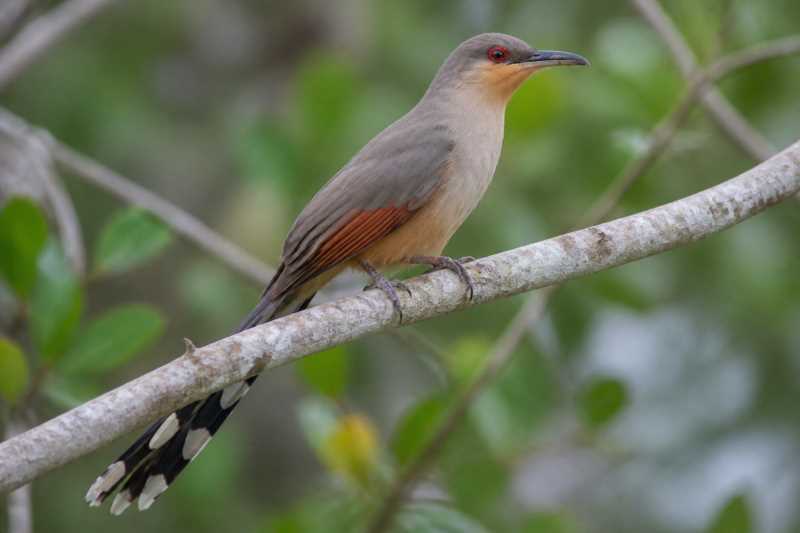
The Hispaniolan Lizard Cuckoo is a large cuckoo with a slender body, long graduated tail and strong legs. Adults have grey upperparts and greyish underparts, with rufous or reddish-brown tones on the throat, lower belly and undertail area. The tail is dark and shows contrasting white markings, especially on the outer feathers.
The bill is long, blackish and distinctly decurved. Bare red skin surrounds the eye, producing one of the species’ most useful field marks. Males and females are similar in appearance, with no consistent sexual dimorphism reported.
Juveniles are generally browner and duller than adults. They may show a whitish throat and a narrower brown tail with buff rather than clean white tips.
Range and Habitat
The Hispaniolan Lizard Cuckoo is endemic to the Hispaniolan region. The main population occurs on Hispaniola, with related island populations or subspecies recorded on Gonâve, Tortuga and Saona. It is considered largely sedentary rather than a long-distance migrant.
The species occupies a wide range of wooded habitats, including tropical deciduous forest, evergreen forest, dry woodland, thickets, scrub, plantations, gardens and secondary growth. It can occur from near sea level to high mountain areas, with records reaching approximately 2,200 metres. Dense undergrowth, woodland edges and vegetation-rich slopes provide cover and suitable hunting areas.
Where to See This Species
Sierra de Bahoruco National Park, Pedernales and Barahona, Dominican Republic
The park contains dry broadleaf forest, moist forest and higher-elevation habitats. The Hispaniolan Lizard Cuckoo is reported from the southern-slope dry forest and is also considered common around the Puerto Escondido and Rabo de Gato areas on the northern slope. Early visits are most productive, particularly along forest trails and quiet roads where the species may move through dense vegetation.
Nearby accommodation: Puerto Escondido is the practical gateway for the northern slope, with simple guest accommodation and small eco-lodging options. Villa Barrancolí near the Rabo de Gato trail also provides cabin-style accommodation when available.
Del Este National Park, Padre Nuestro Trail, La Altagracia, Dominican Republic
The Padre Nuestro route passes through dry forest and adjoining mangrove habitat near Bayahibe. The Hispaniolan Lizard Cuckoo is listed among the birds likely to occur along the trail. Visitors should remain on the established route and consider using an available local interpretive guide.
Nearby accommodation: Bayahibe and Dominicus provide a wide range of hotels, guest houses, apartments and other visitor accommodation.
Loma Quita Espuela Scientific Reserve, Duarte Province, Dominican Republic
The lower parts of this reserve include shaded cacao plantations and woodland where the Hispaniolan Lizard Cuckoo is frequently reported. The reserve is managed through a co-management arrangement and visits should be organised in advance, especially for trails beyond the main accessible areas.
Nearby accommodation: San Francisco de Macorís is the nearest practical town for hotels, guest houses and other basic visitor accommodation. Longer visits may require organised camping and an approved guide.
Behaviour and Diet
The Hispaniolan Lizard Cuckoo is usually seen alone or in pairs. It often moves slowly through branches, vines and dense undergrowth, using short flights and deliberate movements to search for prey. Its loud, repeated calls can help locate a bird that remains hidden in vegetation.
Its diet includes lizards, small snakes and large insects such as grasshoppers, mantids, caterpillars, beetles, cockroaches and cicadas. Spiders and other sizeable invertebrates may also be taken. The long bill is well suited to probing foliage, bark crevices and tangled vegetation.
Unlike several Old World cuckoos, species in this group normally build their own nests rather than relying on obligate brood parasitism. The Hispaniolan Lizard Cuckoo constructs a simple platform nest in a tree or shrub. Detailed information on the timing and division of breeding duties remains limited compared with better-studied cuckoo species.
Identification Tips
- Look for a large, secretive cuckoo with a long graduated tail and a noticeably long, curved bill.
- The grey head and upperparts contrast with rufous tones on the throat, belly and undertail area.
- The red bare skin around the eye is a strong identification feature at close range.
- Black-and-white tail markings are often easier to see than the body plumage when the bird moves through cover.
- The species is more likely to be detected by its harsh, repeated calls than by prolonged views.
- Do not confuse it with the smaller Mangrove Cuckoo, which is associated more closely with coastal mangroves and has a different facial and underpart pattern. The Hispaniolan Lizard Cuckoo is generally larger, greyer and more strongly marked in the tail.
Conservation Status
The Hispaniolan Lizard Cuckoo is currently assessed as Least Concern on the IUCN Red List. It remains relatively widespread and uses several modified habitats, but local populations may be affected by deforestation, agricultural expansion, logging, charcoal production, urban development and the degradation of dry and moist forests.
Protecting remaining native woodland, maintaining connected forest and scrub habitats, and managing protected areas effectively are important conservation measures. Further field research would also help clarify population trends, breeding biology and the status of island populations.
Frequently Asked Questions
Where is the Hispaniolan Lizard Cuckoo found?
It is endemic to the Hispaniolan region, occurring mainly in Haiti and the Dominican Republic. Related populations or subspecies are also associated with nearby islands including Gonâve, Tortuga and Saona.
Is the Hispaniolan Lizard Cuckoo migratory?
It is generally considered a sedentary species. Individuals may move locally in response to food availability and habitat conditions, but it is not known for regular long-distance migration.
What does the Hispaniolan Lizard Cuckoo eat?
Its diet includes lizards, small snakes, grasshoppers, mantids, caterpillars, beetles, cicadas, spiders and other large invertebrates.
How can the species be identified?
Useful field marks include the long curved bill, grey body, rufous throat and belly, red bare skin around the eye, and dark tail with contrasting white markings. Its distinctive calls are often easier to detect than the bird itself.
Does the Hispaniolan Lizard Cuckoo build its own nest?
Yes. It is understood to build a simple platform nest in a tree or shrub rather than being an obligate brood parasite like the Common Cuckoo.
What is the conservation status of the Hispaniolan Lizard Cuckoo?
The species is currently classified as Least Concern. Nevertheless, habitat loss and degradation remain important local threats across Hispaniola.
References
- BirdLife International
- Cornell Lab of Ornithology, Birds of the World
- BirdsCaribbean, Caribbean Birding Trail
Related posts