Introduction
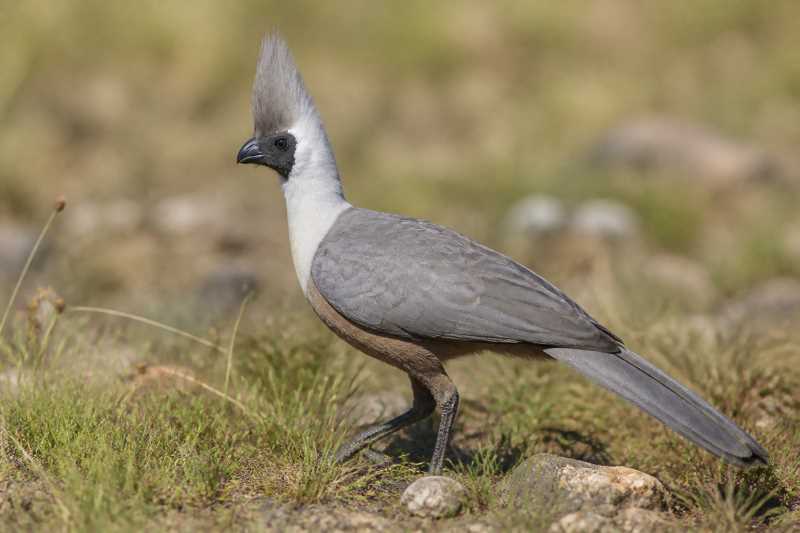
The Bare-faced Go-away-bird (Crinifer personatus) is a medium-sized member of the turaco family, Musophagidae. It is recognised by its mostly grey plumage, prominent crest, long tail and distinctive bare black face. Older field guides and wildlife records may use the former scientific name Corythaixoides personatus.
Physical Description
The Bare-faced Go-away-bird is approximately 48 centimetres long and weighs about 210–300 grams. It has a long tail, short rounded wings, a strong slightly curved bill and a prominent grey crest.
Adults are mainly grey, with a paler throat and neck, darker wings and tail, and some greenish colouring on the breast and underparts. The bare black facial skin creates a sharp contrast with the surrounding plumage. Males and females are generally alike, although the female may have a greener bill. Juveniles are less clearly documented, but young birds are usually duller and less sharply marked than adults.
The species belongs to the grey-plumaged go-away-birds and lacks the vivid green, blue and red plumage associated with many forest turacos.
Range and Habitat
The species has a discontinuous distribution in eastern and central Africa. The nominate form occurs in the Ethiopian Rift Valley, while the form traditionally treated as C. p. leopoldi occurs from southern Uganda, Rwanda and Burundi through south-western Kenya and Tanzania to northern Malawi, north-eastern Zambia and south-eastern Democratic Republic of the Congo. Some modern taxonomic treatments regard this form as a possible candidate for future species-level separation.
Bare-faced Go-away-birds favour open woodland, dry thickets, savanna with scattered trees and cultivated areas retaining mature trees. Acacia woodland is particularly suitable habitat in parts of their range. They may occur from lowlands to higher elevations, including upland areas where open woodland and scrub remain available.
The species is regarded as resident rather than migratory, although local movements may occur in response to food availability and seasonal conditions.
Where to See This Species
Lake Mburo National Park, Western Region, Uganda
Open acacia woodland around Rwonyo is documented as suitable habitat for the Bare-faced Go-away-bird. The park’s mixture of woodland, grassland, wetlands and scattered trees provides several habitats in which to listen for its loud calls and watch for birds moving through the canopy or feeding along woodland edges.
Nearby accommodation: Rwonyo is the park’s main visitor area, with established camps and lodges nearby. Mbarara is the nearest substantial town for a wider choice of hotels, guest houses and other accommodation.
Behaviour and Diet
Bare-faced Go-away-birds are noisy, active birds that may be seen singly, in pairs or in small groups. They move through trees by hopping and climbing along branches, and their flight is usually short and somewhat laboured rather than sustained over long distances.
Their calls are loud, repetitive and nasal. In the related go-away-birds, these calls have been interpreted by English-speaking observers as resembling the words “go away”, giving the group its common name. The calls can function as contact signals and may also draw attention to approaching danger or disturbance.
The diet is principally plant-based. Fruits, seeds and leaf buds are important foods, and flowers and other soft plant material may also be taken. By consuming and later passing viable seeds, the birds may contribute to the dispersal of some woodland plants.
Breeding information for this species is limited in comparison with that of better-studied turacos. Available accounts describe a simple platform nest made from twigs in a tree, with a small clutch, commonly reported as two or three pale eggs. Nesting dates vary across the wide geographic range and are likely influenced by local rainfall and food availability.
Identification Tips
- Look for a large grey bird with a long tail, tall crest and relatively short rounded wings.
- The bare black face is the most distinctive field mark and contrasts strongly with the grey head and body.
- The bird is often detected by its loud repetitive calls before it is seen.
- Observe open woodland, acacia stands, thickets and tree-lined cultivation rather than dense forest.
- Do not confuse it with the Grey Go-away-bird, which has a feathered face and a different range. The White-bellied Go-away-bird is also distinct, with much paler underparts and a different distribution.
- Older guides may label the species Corythaixoides personatus. The currently accepted name is Crinifer personatus.
Conservation Status
The Bare-faced Go-away-bird is currently assessed as Least Concern. It has a broad distribution and is recorded in a variety of woodland, savanna and cultivated habitats. Nevertheless, local populations may be affected by clearance of mature trees, agricultural expansion, woodland degradation and the loss of suitable nesting and feeding areas.
Protecting open woodland, retaining scattered native trees and maintaining connected habitat are useful conservation measures. More detailed information on population size and long-term trends is limited, so the global population trend should be treated cautiously.
Frequently Asked Questions
What is the scientific name of the Bare-faced Go-away-bird?
The accepted scientific name is Crinifer personatus. Older sources may use the synonym Corythaixoides personatus.
Where does the Bare-faced Go-away-bird live?
It occurs in parts of Ethiopia and in a broader eastern African range extending through Uganda, Rwanda, Burundi, Kenya, Tanzania, Malawi, Zambia and the south-eastern Democratic Republic of the Congo.
What does the Bare-faced Go-away-bird eat?
It mainly eats fruit, seeds, leaf buds and other soft plant material. Flowers and additional seasonal foods may also be taken.
Why is it called a go-away-bird?
Its loud, repetitive call has been interpreted by English-speaking observers as sounding somewhat like the words “go away”.
Is the Bare-faced Go-away-bird migratory?
It is generally considered resident. Individuals may make local movements as food supplies and seasonal conditions change, but it is not regarded as a long-distance migrant.
Is the Bare-faced Go-away-bird endangered?
No. The species is currently classified as Least Concern, although habitat loss and woodland degradation can create local pressures.
References
- IOC World Bird List
- IUCN Red List of Threatened Species
- Lake Mburo Game Park
Related posts