Introduction
The Spectacled Eider, Somateria fischeri, is a large Arctic sea duck named for the pale, spectacle-like markings around its eyes. It breeds in coastal tundra and wetland habitats in western and northern Alaska and northeastern Siberia, then moves to marine areas of the Bering Sea for moulting and wintering. Although it is globally assessed as Least Concern, the species is listed as threatened under the United States Endangered Species Act because of severe historical declines in parts of its Alaskan range.
Physical Description
The Spectacled Eider is a heavy-bodied duck measuring approximately 50–53 cm in length, with a wingspan of about 84 cm. Adults typically weigh between 1.3 and 1.8 kg, although weight varies with sex, season and condition.
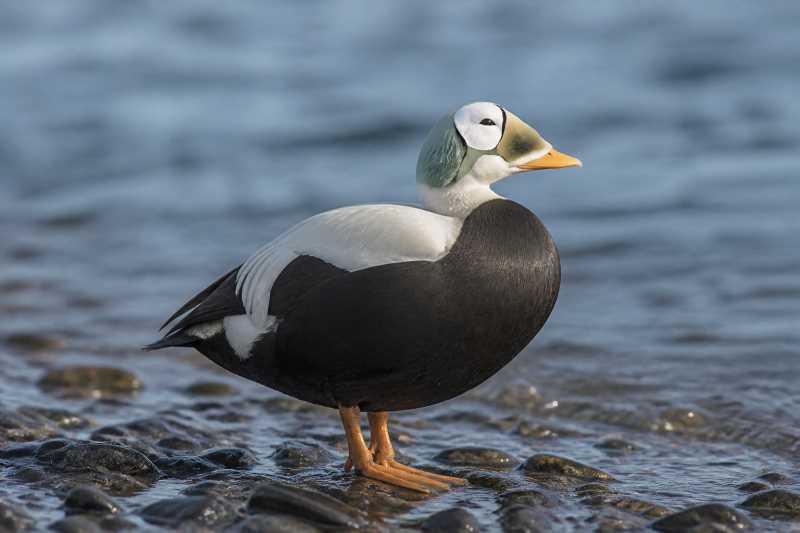
Adult males are distinctive. They have a large, sloping yellow-orange bill, a dark head with a greenish wash on the back and crown, and broad white patches surrounding the eyes. These pale facial markings are outlined in black and give the species its common name. The back and upper wings are largely white, while the breast, belly and flanks are mostly black.
Females are rich brown overall, with fine darker barring and a paler version of the male’s facial pattern. Immature birds resemble females but may show less distinct facial markings and a darker bill. The species has a short, thick neck, a large head and a heavy bill, giving it a compact and powerful appearance on the water.
Range and Habitat
Spectacled Eiders breed in Arctic tundra across western and northern Alaska and northeastern Siberia. In Alaska, important breeding areas include the Yukon–Kuskokwim Delta and the coastal plain from the northern coast near Wainwright eastwards towards Camden Bay. In Russia, the species breeds around several Arctic river deltas and associated coastal wetlands.
Breeding habitat consists of low-lying, wet tundra with shallow ponds, lakes, river deltas and marshes. Nesting females commonly select small, sedge-covered islands or shorelines close to shallow water. Nests are usually concealed among sedges, grasses, mosses, lichens or low shrubs.
After breeding, males generally leave the nesting areas to moult in shallow coastal waters. Birds from different breeding areas then gather in the Bering Sea, particularly in waters south of St Lawrence Island. During winter, they use openings and leads in the pack ice, including polynyas, where they can reach marine prey.
The species is migratory and depends on a linked network of tundra wetlands, shallow coastal waters and seasonally ice-free marine habitat. Its restricted Arctic distribution makes it particularly sensitive to changes in wetland conditions, sea ice and coastal ecosystems.
Where to See This Species
The Spectacled Eider is difficult to see because much of its range is remote and access is often weather-dependent. The following locations are recognised Alaskan viewing areas where the species has been documented or specifically identified as a possible target.
Colville River Delta, Alaska North Slope, United States
The Colville River Delta is a productive Arctic wetland and a documented early-season location for Spectacled Eiders. Birds may be present from early to mid-June after the ice begins to thaw, when breeding ducks return to shallow ponds, river channels and coastal tundra. Access is remote and normally requires careful logistical planning, local knowledge and suitable transport.
Nearby accommodation: Nuiqsut is the nearest practical community, with limited local accommodation and arranged camp or field accommodation depending on the visit.
Freshwater Lake, Utqiagvik, Alaska, United States
Freshwater Lake near Utqiagvik, formerly Barrow, is a recognised spring viewing area. Spectacled Eiders may be looked for from early to mid-June as thawing ponds and wet tundra attract breeding waterbirds. Conditions can change rapidly, and visitors should keep well away from nesting birds and follow local access guidance.
Nearby accommodation: Utqiagvik has hotels, guest houses and other basic visitor accommodation, but seasonal availability should be checked before travel.
Gambell, St Lawrence Island, Alaska, United States
Gambell is located near important Bering Sea wintering and migration areas. Spectacled Eiders have been reported at The Point in spring, although their occurrence varies between years. Larger movements may also be observed in late October and early November, when birds pass near the island on their way to or from wintering areas.
Nearby accommodation: Gambell offers limited village-based accommodation and guesthouse options, usually arranged in advance through local contacts or specialist birding operators.
Behaviour and Diet
Spectacled Eiders forage in shallow water and at sea. On the breeding grounds they commonly dabble or tip forward to feed on aquatic insects, small crustaceans, snails, clams, plants and seeds. Marine feeding areas provide molluscs, crustaceans and other benthic invertebrates, which the birds obtain by diving and searching the sea floor. Small fish have also been recorded in the diet.
The species may feed in groups and can form large concentrations outside the breeding season. Wintering birds gather in openings within sea ice, where access to productive shallow water allows them to feed despite the surrounding Arctic conditions.
Spectacled Eiders are socially monogamous. Courtship displays include head movements, neck stretching and wing-flapping. The female selects the nest site and builds a shallow nest lined with grasses, sedges and down. Clutch size is variable, with reported clutches ranging from 1 to 11 eggs. Incubation lasts about 23 days, and the down-covered ducklings leave the nest soon after hatching. The female remains responsible for care of the brood, while males normally leave the breeding area before or during the early nesting period.
Identification Tips
- Look for a large, heavy eider with a short neck, broad head and long, sloping bill.
- Adult males are unmistakable when seen well: the white facial spectacles, orange bill, greenish head, white back and black underparts form a distinctive combination.
- Females and immature birds are brown and can be confused with female King or Common Eiders. The pale facial spectacles, heavy head and sloping bill are useful clues.
- Spectacled Eiders often appear compact and dark-bodied at a distance, especially when resting on the water.
- In flight, look for the contrast between the white upperparts and darker underparts of the adult male, although distant or poorly lit birds can be difficult to identify.
- Use caution with brief views of females and young birds. Their facial pattern is less obvious, so size, structure, habitat and association with adult males may all be important.
Conservation Status
The Spectacled Eider is currently assessed globally as Least Concern, but it is listed as threatened under the United States Endangered Species Act. The American listing followed a major decline in the western Alaskan population during the late twentieth century.
Important threats include disturbance and degradation of breeding wetlands, contamination, accidental oil spills, exposure to lead and other pollutants, and changes to Arctic coastal and marine systems. Climate change may alter tundra hydrology, prey availability, storm patterns and the timing and extent of sea ice. Concentrated wintering and moulting areas are also vulnerable to disturbance because large numbers of flightless or partially flightless birds may gather there.
Conservation measures include protection of critical habitat, long-term aerial surveys, nest monitoring, research into migration and marine habitat use, and international cooperation between the United States and Russia. Maintaining intact tundra wetlands and limiting disturbance in important moulting and wintering areas remain central to recovery efforts.
Frequently Asked Questions
Where does the Spectacled Eider live?
It breeds in coastal tundra, shallow ponds, marshes and river deltas in Alaska and northeastern Siberia. Outside the breeding season, it uses shallow coastal waters and pack-ice openings in the Bering Sea.
Why is the Spectacled Eider called a spectacled eider?
The name refers to the broad pale markings surrounding the eyes. These markings are especially striking in adult males but are also present in a subtler form in females and immature birds.
What does the Spectacled Eider eat?
Its diet includes aquatic insects, small crustaceans, snails, clams, plants and seeds on the breeding grounds. At sea, it feeds mainly on benthic invertebrates and may also take small fish.
Is the Spectacled Eider endangered?
It is not globally classified as Endangered, but it is listed as threatened under the United States Endangered Species Act. The species experienced a serious historical decline in western Alaska and remains a conservation priority.
When is the best time to see a Spectacled Eider in Alaska?
Early to mid-June is a useful period to search breeding areas such as the Colville River Delta and Freshwater Lake near Utqiagvik. Gambell can be productive during spring passage and again in late October or early November, although sightings vary between years.
How does the Spectacled Eider survive Arctic winters?
It gathers in marine areas where openings in the pack ice provide access to feeding grounds. These polynyas and leads allow the birds to reach benthic prey while remaining in the cold Bering Sea environment.
References
- BirdLife International
- Cornell Lab of Ornithology
- U.S. Fish and Wildlife Service
Related posts