Introduction
The Damara Red-billed Hornbill (Tockus damarensis) is a captivating bird species that enchants ornithologists and bird enthusiasts alike with its striking appearance and unique behaviors. Indigenous to the arid regions of southwestern Africa, this hornbill species has adapted seamlessly to its environment, showcasing fascinating evolutionary traits. This article delves into the ecology, behavior, and conservation status of the Damara Red-billed Hornbill, offering a comprehensive overview of its life and the challenges it faces in the wild.
Taxonomy and Physical Description
The Damara Red-billed Hornbill, part of the Bucerotidae family, is one of several species of red-billed hornbills. It was once classified under the same species umbrella as the Southern Red-billed Hornbill (Tockus rufirostris) but has since been recognized as a distinct species. This distinction was made based on differences in vocalizations, behavior, and minor morphological differences.
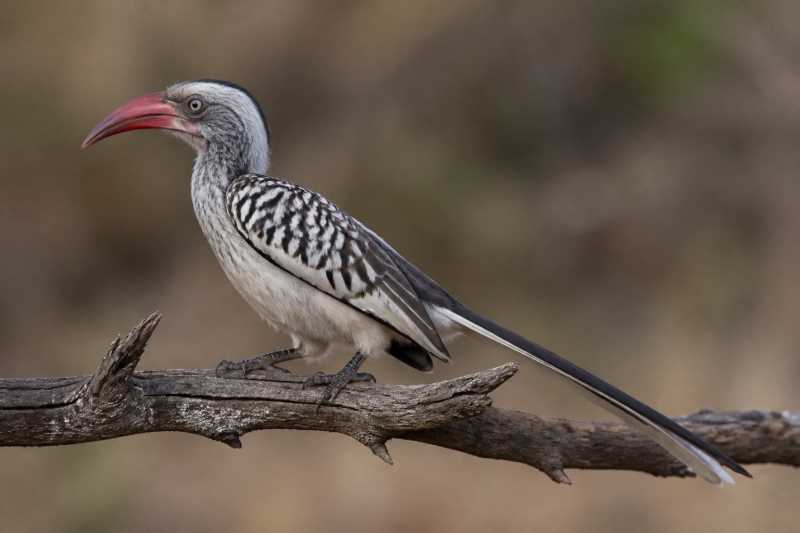
The bird is relatively small in size, measuring around 42 cm in length, with a wingspan of approximately 60 cm. Its most distinguishing feature is its vivid red bill, which contrasts sharply against its predominantly white plumage. The wings and back are covered in a combination of black and white feathers, giving the bird a checkered appearance. Its eyes are surrounded by a patch of bare skin, typically a pale yellow, adding to its distinctive look.
Habitat and Distribution
The Damara Red-billed Hornbill is predominantly found in the arid and semi-arid regions of southwestern Africa, specifically in Namibia, Angola, and parts of Botswana. Its preferred habitats are dry savannas, open woodlands, and scrublands. This bird is well-adapted to dry conditions and can often be seen in areas with sparse vegetation, making use of the available resources.
These hornbills are known to be sedentary, with limited migratory behavior. They typically establish territories where they can find sufficient food and nesting sites. Due to their adaptability, they are often seen in agricultural areas, where they have learned to coexist with human-altered landscapes.
Diet and Foraging Behavior
Damara Red-billed Hornbills are omnivorous, with a diet that includes insects, small reptiles, seeds, and fruits. Their foraging behavior is both opportunistic and strategic, often seen hopping on the ground in search of food. They use their strong bills to dig into the soil, lift debris, and catch prey.
Insects form a significant portion of their diet, especially during the breeding season when protein demand is high. Termites, beetles, and grasshoppers are among their favorite prey. Additionally, they have been observed following larger animals, such as elephants or livestock, to catch insects stirred up by their movement.
Breeding and Nesting
The breeding season for the Damara Red-billed Hornbill typically coincides with the onset of the rainy season, which provides an abundance of food resources. Unlike many other bird species, hornbills have a unique nesting behavior. The female is sealed inside a tree cavity by the male using a mixture of mud, saliva, and droppings, leaving only a small slit through which the male can pass food.
During this time, the female undergoes molting and is entirely dependent on the male for food until the chicks are ready to fledge. This period can last several weeks, during which the male tirelessly provides for the family. Once the chicks are old enough, the female breaks out of the cavity, and the chicks follow shortly after.
Social Structure and Communication
Damara Red-billed Hornbills are generally monogamous, forming long-term pair bonds that last several breeding seasons. They are territorial birds, often seen in pairs or small family groups. Their communication involves a series of calls and displays, which are crucial for maintaining pair bonds and defending territory.
Their calls are distinctive, often described as a series of “tok-tok-tok” sounds, which can be heard over long distances. These vocalizations play a critical role during the breeding season, helping to coordinate activities between the male and female.
Conservation Status and Threats
Currently, the Damara Red-billed Hornbill is classified as Least Concern by the International Union for Conservation of Nature (IUCN). However, like many species, it faces threats from habitat loss and fragmentation due to agricultural expansion and human settlement.
Climate change also poses a significant threat, as alterations in rainfall patterns can affect food availability and breeding success. Conservation efforts are focused on habitat preservation and raising awareness about the importance of biodiversity in maintaining healthy ecosystems.
Conclusion
The Damara Red-billed Hornbill is a remarkable species that exemplifies the adaptability and resilience of wildlife in challenging environments. Its unique behaviors and ecological significance make it a subject of interest for both scientific study and conservation efforts. Protecting this species ensures the preservation of the intricate web of life that sustains the diverse ecosystems of southwestern Africa.
Future Research Directions
Further research is needed to understand the long-term impacts of climate change on the Damara Red-billed Hornbill’s habitat and population dynamics. Studies on their breeding success in relation to environmental changes can provide valuable insights for conservation strategies. Additionally, more information on their interactions with other species and their role in the ecosystem can help highlight their ecological significance.
As we continue to explore and understand the natural world, the Damara Red-billed Hornbill serves as a reminder of the delicate balance that exists within our ecosystems and the importance of preserving it for future generations.
Related posts