Introduction
The Swamp Francolin, Ortygornis gularis, is a ground-dwelling member of the pheasant family, Phasianidae. It is also known as the Swamp Partridge and is closely associated with tall wet grassland, marshes and floodplain habitats in the Terai and adjoining lowlands of the northern Indian subcontinent. The species was formerly placed in the genus Francolinus, but current IOC taxonomy places it in Ortygornis, alongside the Grey Francolin and Crested Francolin. (worldbirdnames.org)
The Swamp Francolin is secretive and often detected by its loud territorial calls rather than by direct observation. Its survival depends on the retention of wet grasslands, riverine vegetation and suitable habitat within agricultural landscapes.
Physical Description
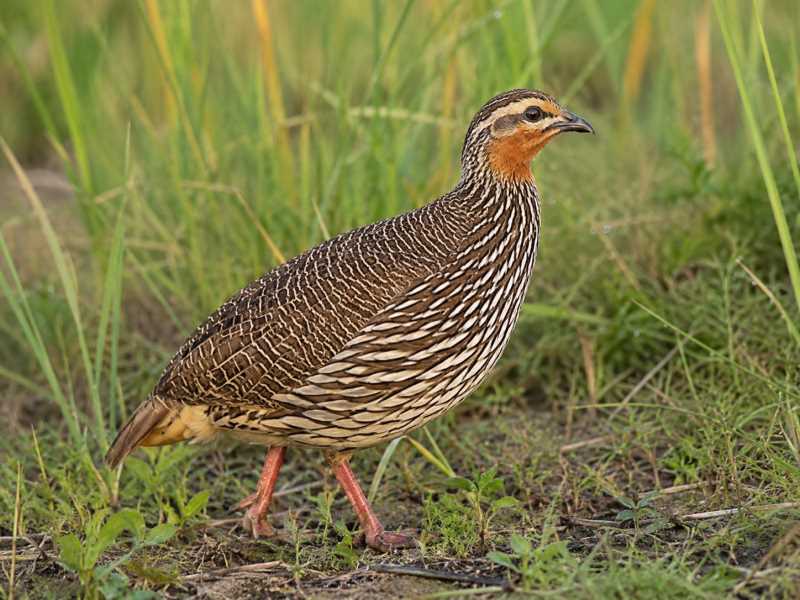
The Swamp Francolin is a medium-sized francolin, measuring approximately 35–37 cm in length. It has a brown upper body with pale buff barring, chestnut outer tail feathers and a distinctive rusty or chestnut throat. The underparts are pale with strong dark streaking, giving the bird a striped appearance. The bill is dark and the legs range from dull orange to reddish.
The sexes are broadly similar in plumage. Males are generally larger and may be distinguished by the presence of spurs and brighter legs, while females lack spurs. Juveniles resemble adults but are usually duller, with less strongly developed colour and patterning. (freshwaterbiodiversity.org.bd)
Range and Habitat
The species occurs in a discontinuous range from the Terai and Gangetic floodplains of northern India through southern Nepal and eastwards into north-eastern India, including Assam. Historical and regional records have also included Bangladesh, although the species is now considered extremely scarce or possibly absent from parts of its former Bangladeshi range. It is a resident species rather than a long-distance migrant.
Swamp Francolins favour tall, dense wet grassland, reeds, marsh edges, seasonally flooded floodplains and riverine vegetation. They may also use sugar-cane, paddy fields and other cultivated areas when these lie close to wetlands or provide dense cover. Most records are from low elevations, generally below about 350 m, although local movements may occur when flooding changes habitat conditions. (birdsofindia.org)
The species’ distribution is strongly linked to the remaining grasslands and wetlands of the Terai and Brahmaputra-associated plains. Conversion of natural grassland, wetland drainage and fragmentation have reduced the continuity of suitable habitat.
Behaviour and Diet
Swamp Francolins are primarily terrestrial and spend much of their time walking through dense vegetation. They are secretive and difficult to observe, but calling activity is greatest during the breeding season and is particularly noticeable in the early morning. At Koshi Tappu in Nepal, surveys found that calling males were most active during February and March. (cambridge.org)
The species feeds on the ground. Its diet is understood to include seeds, grains, shoots, other plant material and small invertebrates, although detailed dietary studies remain limited. It may forage in cultivated fields as well as in natural grassland, especially where cover remains nearby.
Breeding information is incomplete. The species nests on the ground in dense grassland or crop cover. Studies in northern India recorded clutch sizes of four to seven eggs, with a mean of 5.4 eggs in one small sample. Nesting success may be affected by harvesting, grazing, predation, poaching and other disturbance. (cambridge.org)
Identification Tips
Look for the following combination of features:
- A large, long-legged francolin of wet grassland and floodplain habitats.
- Brown upperparts marked with pale buff barring.
- A conspicuous rusty or chestnut throat.
- Pale underparts with strong dark streaking.
- Chestnut outer tail feathers, especially visible when the bird is flushed.
- A dark bill and orange-red to reddish legs.
The Swamp Francolin may occur near the Grey Francolin where wet habitat meets drier cultivation. The Swamp Francolin is usually larger-looking and more strongly associated with tall wet grassland. Its striped underparts and rusty throat are useful clues, while the Grey Francolin generally appears more compact and is associated with drier open country. The two species can nevertheless be difficult to separate during brief or distant views.
Conservation Status
The Swamp Francolin is currently assessed as Near Threatened on the global Red List assessment used by BirdLife International and the IUCN system. Earlier sources commonly listed it as Vulnerable, so older regional publications may show a different category. The current assessment recognises a declining population and a relatively small, fragmented range, while noting that the species does not currently meet the thresholds for a threatened category. (forums.birdlife.org)
The principal threats are the drainage and conversion of wetlands and tall grasslands, agricultural expansion, habitat fragmentation, uncontrolled burning, livestock grazing, disturbance and hunting. Nesting birds may also be affected when tall crops are harvested during the breeding season. Research in northern India and Nepal indicates that protected areas, native wet grassland and suitable habitat mosaics within agricultural landscapes can all be important for the species. (cambridge.org)
Important conservation measures include protecting remaining floodplain grasslands and marshes, maintaining dense wetland vegetation, managing grazing and burning, reducing disturbance during the breeding season, improving monitoring and retaining connections between isolated populations. Agricultural management that preserves wet grassland, field margins and dense cover may also benefit the species.
Frequently Asked Questions
Where does the Swamp Francolin live?
It occurs mainly in the Terai and adjoining lowlands of northern India, southern Nepal and north-eastern India, especially in tall wet grassland, marshes, floodplains and riverine vegetation.
Is the Swamp Francolin migratory?
No. It is generally regarded as a resident species. Local movements may occur when seasonal flooding, vegetation growth or agricultural activity changes the availability of cover and food.
What does the Swamp Francolin eat?
It forages on the ground for seeds, grains, shoots and other plant material, together with small invertebrates. Detailed information about the relative importance of each food type is limited.
How can the Swamp Francolin be identified?
The most useful features are its rusty throat, brown buff-barred upperparts, strongly streaked pale underparts, chestnut outer tail feathers and reddish legs. It is also noticeably associated with tall wet grassland.
When is the Swamp Francolin most easily detected?
It is most often detected by its call, particularly during the breeding season and in the early morning. Direct sightings can be difficult because it remains concealed in dense grass and reeds.
What is the main threat to the species?
The main threat is the loss and fragmentation of wet grassland and floodplain habitat through drainage, cultivation, development, grazing, burning and other forms of disturbance. Hunting and nest losses in cultivated areas may add further pressure.
References
- BirdLife International. 2024. Swamp Francolin Ortygornis gularis: 2024.2 Global Threatened Bird Forums assessment. BirdLife International. Available at https://forums.birdlife.org/2024-2-swamp-francolin-ortygornis-gularis/ (accessed 8 September 2026).
- BirdLife International. 2026. The Chapories of Lohit Reserve: Site factsheet. BirdLife DataZone. Available at https://datazone.birdlife.org/site/factsheet/18059-the-chapories-of-lohit-reserve (accessed 8 September 2026).
- Gill, F., Donsker, D. and Rasmussen, P., eds. 2026. IOC World Bird List, version 15.2. International Ornithologists’ Union. Available at https://www.worldbirdnames.org/ (accessed 8 September 2026).
- Iqubal, P., McGowan, P. J. K., Carroll, J. P. and Rahmani, A. R. 2003. Home range size, habitat use and nesting success of Swamp Francolin Francolinus gularis on agricultural land in northern India. Bird Conservation International 13: 127–138. https://doi.org/10.1017/S0959270903003113.
- McGowan, P. J. K., Carroll, J. P., Rahmani, A. R. and others. 2008. An assessment of census techniques, habitat use and threats to Swamp Francolin Francolinus gularis in Koshi Tappu Wildlife Reserve, Nepal. Bird Conservation International. Available at https://www.cambridge.org/core/journals/bird-conservation-international/article/an-assessment-of-census-techniques-habitat-use-and-threats-to-swamp-francolin-francolinus-gularis-in-koshi-tappu-wildlife-reserve-nepal/F1545F95DE71E6C187C90E6C7C37AE06 (accessed 8 September 2026).
- State of India’s Birds. 2025. Swamp Francolin Ortygornis gularis: Assam species factsheet. Available at https://stateofindiasbirds.in/species/as-swafra1/ (accessed 8 September 2026).
- Birds of India. n.d. Ortygornis gularis (Temminck, 1815), Swamp Francolin. Available at https://www.birdsofindia.org/Francolinus-gularis (accessed 8 September 2026).
Related posts