Introduction
The Hainan Partridge (Arborophila ardens) is a ground-dwelling forest bird endemic to Hainan Island, China. It belongs to the pheasant family, Phasianidae, and is also known in some references as the Hainan Hill-partridge. The species is restricted to the island’s remaining tropical and subtropical forests and is classified as Vulnerable on the IUCN Red List.
Physical Description
The Hainan Partridge is a compact, medium-sized partridge measuring approximately 27–30 centimetres in length. It has a short tail and a largely terrestrial posture suited to moving through dense undergrowth and leaf litter.
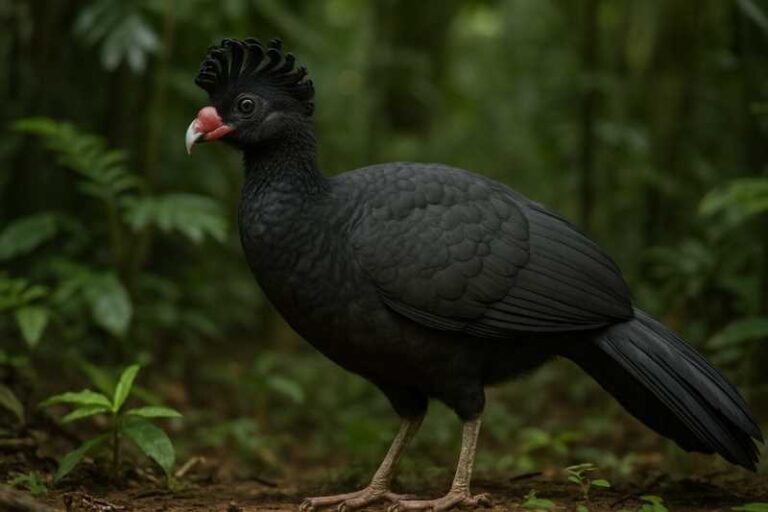
Its most useful field characters are the dark, almost black facial pattern, contrasting white ear-coverts and pale eyebrow, olive-brown upperparts, rufous tones in the wings, and finely marked greyish and buff underparts. The throat and upper breast show warm rufous colouring with darker markings, while the flanks and lower body are more subdued and patterned.
Males and females are broadly similar in plumage. Females may be slightly duller, but sex is not normally determined reliably from a brief field view. Juvenile birds are less distinctly marked and generally show duller, more cryptic plumage than adults.
Range and Habitat
The Hainan Partridge is endemic to Hainan Island and is not migratory. Its known distribution is concentrated in the mountainous central and southern parts of the island, including forest reserves such as Bawangling, Yinggeling, Wuzhishan, Limushan, Diaoluoshan and Jianfengling.
It is principally associated with primary evergreen forest, including broad-leaved mountain rainforest, ravine rainforest and mixed coniferous and broad-leaved forest. It may also use mature, well-recovered secondary evergreen forest where the canopy and ground layer remain suitable. Historical records were concentrated at roughly 500–1,200 metres above sea level, although later observations have documented the species at lower elevations in suitable secondary forest. Recent sources place its usual habitat broadly within the mid-elevation forest belt, but the species appears to be more dependent on intact forest structure than on a single fixed elevation range.
Dense understorey, deep leaf litter and fallen branches are important habitat features. Forest fragmentation reduces habitat quality and may force birds to travel farther while foraging.
Behaviour and Diet
The Hainan Partridge is diurnal and primarily terrestrial. It is secretive and alert, usually moving quietly through dense undergrowth rather than flying unless disturbed. Its presence is often detected by its distinctive calls, which are useful during surveys because the bird can be difficult to see.
It searches through leaf litter on the forest floor for food. The documented diet includes seeds and insects, and the species is generally regarded as omnivorous. Fruits and other plant material may also be taken, although detailed information on seasonal diet remains limited.
The breeding season is generally reported as February to May. Nests are built on the ground and may be concealed beneath dry leaves and small branches, forming an arched covering that helps hide the entrance. Studies have recorded small clutches of approximately two to four white eggs. Adults have also been observed grasping and placing leaves or small branches around the nest, apparently improving concealment during incubation and after hatching.
Radio-tracking research indicates that birds in fragmented rainforest may use larger home ranges than birds in continuous forest. This suggests that fragmentation can reduce foraging efficiency and increase the area required to obtain sufficient resources.
Identification Tips
When searching for the Hainan Partridge, concentrate on quiet forest trails, dense understorey and areas with substantial leaf litter. Useful identification points include:
- A compact, short-tailed partridge that spends most of its time on the ground.
- A strongly contrasting dark face with a white ear patch and pale eyebrow.
- Olive-brown upperparts and rufous tones in the wings.
- Greyish, buff and rufous underparts with fine dark markings.
- A preference for dense, humid evergreen forest rather than open farmland or exposed woodland.
- Distinctive calls, which may be easier to detect than the bird itself.
The combination of the black-and-white facial pattern, short tail and restricted Hainan forest habitat helps separate it from other partridges. Identification should nevertheless be based on several features because poor light, dense vegetation and brief views can obscure the facial markings.
Conservation Status
The Hainan Partridge is currently classified as Vulnerable on the IUCN Red List. It is also protected as a First-Class Nationally Protected Species in China.
The principal threats are the loss and fragmentation of evergreen forest and illegal hunting. Historical forest clearance for timber extraction, agriculture and plantations greatly reduced and divided the species’ habitat. Although legal protection and the establishment of nature reserves have improved the framework for conservation, isolated forest patches remain vulnerable and may support small, poorly connected populations.
Illegal trapping and shooting remain serious concerns because the species is ground-dwelling and can be encountered along forest paths and in the understorey. Climate change may add further pressure by altering forest conditions and the distribution of suitable habitat, although its precise effects on the species require additional study.
Important conservation measures include protecting remaining primary and mature secondary forest, maintaining connections between forest blocks, preventing hunting, improving reserve management and continuing field surveys. Research on home-range use, breeding biology, habitat quality and population connectivity is helping to refine these priorities. Experimental work has also suggested that providing suitable nest-cover structures and natural nest materials could assist breeding in degraded or fragmented habitat, although habitat protection remains the central requirement.
Frequently Asked Questions
Where does the Hainan Partridge live?
It lives only on Hainan Island, China, mainly in mountainous evergreen forests in the central and southern parts of the island.
Is the Hainan Partridge migratory?
No. It is regarded as a sedentary species that remains within its forest range, although individuals may move locally within suitable habitat.
What does the Hainan Partridge eat?
It feeds on the forest floor, taking seeds, insects and other available plant and animal food. Its diet is generally described as omnivorous.
How can the Hainan Partridge be identified?
Look for a compact, short-tailed partridge with a dark face, white ear-coverts, a pale eyebrow, olive-brown upperparts and rufous, finely marked underparts. Its calls can also be useful for detection.
When does the Hainan Partridge breed?
Breeding has generally been reported from February to May. The species builds concealed ground nests covered with dry leaves and small branches, and lays a small clutch of white eggs.
Why is the Hainan Partridge threatened?
The main threats are the loss and fragmentation of evergreen forest and illegal hunting. Fragmented habitat may also reduce access to food, nesting sites and potential mates.
References
- BirdLife International. 2024. Arborophila ardens. BirdLife DataZone species factsheet. BirdLife International. https://datazone.birdlife.org/species/factsheet/hainan-partridge-arborophila-ardens. Accessed 8 September 2026.
- BirdLife International. 2001. Threatened Birds of Asia: The BirdLife International Red Data Book, Part A. BirdLife International, Cambridge. Species account for Arborophila ardens. https://birdlifedata.blob.core.windows.net/red-data-books/arboarde.pdf. Accessed 8 September 2026.
- Gao, Y.-R. 1999. Conservation status of endemic Galliformes on Hainan Island, China. Bird Conservation International 9: 411–416. https://doi.org/10.1017/S0959270900002161.
- Gill, F., Donsker, D. and Rasmussen, P. (eds.). 2026. IOC World Bird List, version 15.2. International Ornithologists’ Union. https://www.worldbirdnames.org/. Accessed 8 September 2026.
- Rao, X., Yang, C. and Liang, W. 2017. Breeding biology and novel reproductive behaviour in the Hainan Partridge (Arborophila ardens). Avian Research 8: 34. https://doi.org/10.1186/s40657-017-0091-4.
- Yang, C., Chen, X., Zhang, Z. and Liang, W. 2023. First report of home range size of Hainan Partridge Arborophila ardens, a vulnerable species endemic to Hainan Island. Ornithological Science 22(1): 87–92. https://doi.org/10.2326/osj.22.87.
- IUCN Species Survival Commission. 2024. Guidelines for the Re-introduction of Galliformes for Conservation Purposes. IUCN, Gland, Switzerland. Species status table listing Hainan Partridge Arborophila ardens as Vulnerable. https://portals.iucn.org/library/efiles/documents/SSC-OP-041.pdf. Accessed 8 September 2026.
Related posts