Introduction
Levaillant’s Cuckoo (Clamator levaillantii) is a large African cuckoo named after the French explorer and ornithologist François Le Vaillant. It is a brood parasite that places its eggs mainly in the nests of babblers and other medium-sized birds. The species occurs across much of sub-Saharan Africa and is especially associated with wooded savannah, bushveld, scrub and riverine vegetation. (birdsoftheworld.org)
Physical Description
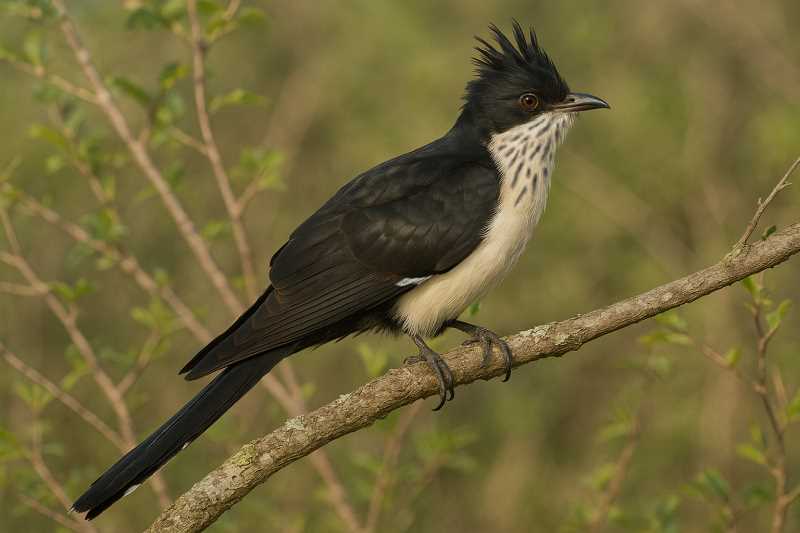
Levaillant’s Cuckoo is a large, long-tailed cuckoo measuring about 37.5 cm in length. Adults have a dark, glossy back, a prominent floppy crest, white wing patches and pale underparts. The throat and lower flanks are heavily streaked, which helps distinguish this species from the smaller Pied Cuckoo.
Two adult colour forms are recognised. The more typical form is black and white, with white markings on the wings and tail. The dark form is predominantly black, retaining a white primary patch and small white spots on the outer tail feathers. Sexes are similar in appearance.
Juveniles are browner than adults, with rufous tones on the wing-coverts and tail, a buff forehead and face, and more extensive streaking on the underparts. (en.wikipedia.org)
Range and Habitat
Levaillant’s Cuckoo is distributed across sub-Saharan Africa, with records from parts of West, East, Central and southern Africa. In southern Africa it is principally a summer breeding visitor, arriving during the wetter months when its babbler hosts are also breeding. It moves northwards or becomes less conspicuous outside the breeding season, although movement patterns vary across the species’ broad range. (birdsoftheworld.org)
It favours bushy habitats, open woodland, savannah, thornveld, scrub and riverine woodland. Dense thickets and areas supporting suitable babbler hosts are particularly important. The species is often found in relatively dry woodland, but it benefits from access to insect-rich vegetation and the nesting territories of its hosts.
Where to See This Species
Kruger National Park, Limpopo and Mpumalanga, South Africa
Levaillant’s Cuckoo is included on the official Kruger National Park bird checklist. It is most realistically sought in wooded savannah, dense woodland and riverine thickets, particularly during the southern African summer breeding season. Listening for its sharp, far-carrying calls and watching areas frequented by babbler groups can improve the chances of detection. (sanparks.org)
Nearby accommodation: Kruger’s rest camps provide campsites, self-catering units and other accommodation, while Skukuza is a practical gateway and service centre for the southern part of the park.
Limpopo National Park, Gaza Province, Mozambique
The official bird checklist for Limpopo National Park includes Levaillant’s Cuckoo. The park’s woodland, bushveld and river-associated habitats provide suitable conditions, especially during the wet season when migrant cuckoos and their host species are more active. (parquelimpopo.gov.mz)
Nearby accommodation: Accommodation is available in park camps and lodges, with Massingir serving as a recognised access and supply area for parts of the park.
Behaviour and Diet
Levaillant’s Cuckoo is usually encountered singly or in pairs. It can be unobtrusive while perched in woodland, but its large size, crest and loud calls often reveal its presence. Adults may fly conspicuously between trees or make short, purposeful movements through dense vegetation.
The species feeds mainly on insects and other invertebrates, including caterpillars, grasshoppers and beetles. Like other large Clamator cuckoos, it is capable of taking relatively large and hairy caterpillars that many smaller insectivorous birds avoid.
It is an obligate brood parasite. The principal hosts are babblers, especially species of Turdoides, although other medium-sized birds have also been recorded as hosts. In southern and south-eastern Africa, the Arrow-marked Babbler is an important host, while host associations vary geographically. During egg-laying, the male may distract or draw away host birds while the female approaches the nest. The cuckoo chick generally remains in the nest with host young rather than ejecting them, but its size and persistent begging can give it a competitive advantage. (onlinelibrary.wiley.com)
Calls include a shrill, ringing note followed by harsh or chattering sounds. Vocal activity is particularly useful for locating birds during the breeding season. (ebird.org)
Identification Tips
Look for the following combination of features:
- Large size and a long, graduated tail.
- Dark, glossy upperparts contrasting with pale underparts.
- Prominent floppy crest.
- White wing patches visible in flight.
- Strong streaking on the throat and lower flanks.
- Loud, harsh or ringing calls from woodland and bushveld.
The most relevant comparison is the Pied Cuckoo, which is smaller and has a less prominent crest. Pied Cuckoo usually lacks the heavy throat streaking characteristic of Levaillant’s Cuckoo. Dark individuals of both species can be difficult to separate visually, so size, structure, habitat and voice should be considered together. (ebird.org)
Conservation Status
Levaillant’s Cuckoo is currently assessed as Least Concern. It has a broad sub-Saharan African distribution and is not regarded as globally threatened. Nevertheless, the species depends on suitable woodland, scrub and riverine habitats, as well as viable populations of its host birds. Habitat clearance, woodland degradation and changes to seasonal rainfall could affect local populations, particularly where suitable babbler habitat is lost.
No reliable global population estimate is required for identification or field observation, and local abundance can vary substantially between regions and seasons. Protecting native woodland, maintaining riverine vegetation and conserving healthy host-bird communities are appropriate measures for its long-term conservation. (birdsoftheworld.org)
Frequently Asked Questions
Where can Levaillant’s Cuckoo be found?
It occurs across much of sub-Saharan Africa, including parts of West, East, Central and southern Africa. Its distribution is linked mainly to wooded savannah, bushveld, scrub and riverine habitats.
Is Levaillant’s Cuckoo migratory?
It is an intra-African migrant in at least part of its range. In southern Africa it is commonly associated with the summer breeding season and may move northwards or become less conspicuous during the dry season.
What does Levaillant’s Cuckoo eat?
Its diet consists mainly of insects and other invertebrates, including caterpillars, grasshoppers and beetles.
Which birds host Levaillant’s Cuckoo eggs?
Babblers are the principal hosts, especially species of Turdoides. The Arrow-marked Babbler is an important host in southern and south-eastern Africa, while host species differ across the wider range.
How can Levaillant’s Cuckoo be identified?
Identify it by its large size, floppy crest, dark upperparts, pale underparts, white wing patches and heavily streaked throat. Its loud, harsh call can also help locate it in woodland.
Is Levaillant’s Cuckoo threatened?
The species is currently classified as Least Concern. Local populations may still be affected by the loss and degradation of woodland, scrub and riverine habitat.
References
- BirdLife International
- Cornell Lab of Ornithology, Birds of the World
- South African National Parks
Related posts