Introduction
The Bornean Crested Fireback (Lophura ignita) is a large, ground-dwelling pheasant in the family Phasianidae. It is native principally to the forests of Borneo and is recognised by its strong sexual dimorphism, blue-black male plumage, chestnut female plumage and conspicuous facial skin. The species was formerly treated more broadly, with Malay Peninsula and Sumatran populations included in some classifications, but those populations are now generally separated as the Malayan Crested Fireback (Lophura rufa).
Physical Description
The Bornean Crested Fireback is a long-tailed forest pheasant. Adult males measure approximately 65–67 cm in total length, while females are about 56–57 cm. Reliable weight data for wild birds are limited.
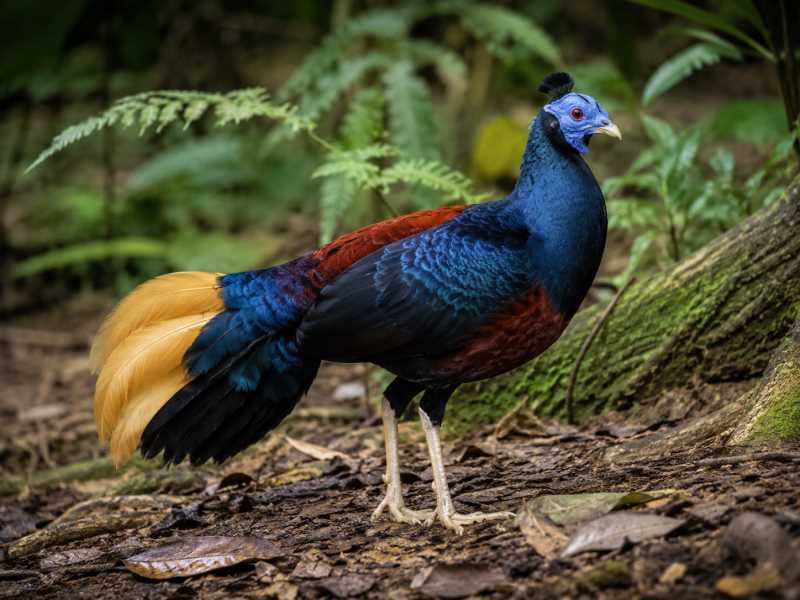
Adult males have glossy blue-black plumage, a short dark crest, vivid blue facial skin and wattles, and a contrasting chestnut to orange breast and belly. The lower back is whitish, and the central tail feathers are buff or cinnamon-buff, while the remaining tail feathers are darker and iridescent. Males also have strong leg spurs.
Females are smaller and predominantly chestnut-brown, with paler scaling or mottling on the underparts. Their less contrasting plumage provides camouflage in leaf litter and dense undergrowth. Females have blue facial skin, although it is generally duller than that of males, and they lack the prominent male spurs.
Juveniles and immature males can be difficult to identify. Young birds may resemble females, while immature males gradually develop the darker adult plumage and ornamental features. Age, sex and identification are best assessed using a combination of body and tail colour, crest development, facial skin, wing markings and spur size.
Range and Habitat
The species is endemic primarily to Borneo, occurring in Brunei, the Malaysian states of Sabah and Sarawak, and Indonesian Kalimantan. Records from nearby islands require taxonomic and population-level interpretation, and older references to Sumatra and the Malay Peninsula often relate to the former, wider treatment of the Crested Fireback complex.
Bornean Crested Firebacks inhabit humid lowland and foothill forests, especially dense primary forest and forest with a well-developed understorey. They may also use logged or secondary forest where suitable cover and food remain, although their tolerance of habitat disturbance is not uniform and remains insufficiently documented. Most field accounts describe the species as a resident rather than a migratory bird, with records generally concentrated at low to moderate elevations, although it can occur higher locally.
Behaviour and Diet
This is a primarily terrestrial pheasant. It moves through the forest undergrowth, often scratching through leaf litter while searching for food. Its diet includes seeds, fallen fruit, young plant material and insects or other small invertebrates. The species is therefore best described as an omnivorous ground-forager rather than solely a frugivore or insectivore.
Bornean Crested Firebacks may occur in small groups, sometimes consisting of a male with several females or immature birds. They are usually shy and can be difficult to observe in dense forest. When disturbed, they generally prefer to run through cover, although they can make short, powerful flights when necessary.
Males use visual and vocal displays during courtship. Reported behaviours include raising the tail, spreading or moving the wings, adopting an upright posture and calling near a female. The timing and details of breeding in the wild remain poorly documented, and breeding activity may vary with locality and environmental conditions.
Identification Tips
Look for the following combination of features:
- A large, long-tailed pheasant travelling on the forest floor.
- In males, glossy blue-black plumage contrasted with a chestnut or orange breast and belly.
- Bright blue facial skin, a short crest and strong leg spurs in adult males.
- A whitish lower back and buff or cinnamon-buff central tail feathers in males.
- In females, rich chestnut-brown plumage with paler scaling and a duller blue face.
- A preference for dense lowland or foothill forest, where the bird may be detected before it is seen.
The most important identification precaution is to check the location. The Malayan Crested Fireback (Lophura rufa) was formerly included within a broader concept of L. ignita, and older field guides may use the name Crested Fireback for both forms. Within Borneo, comparison with other Lophura pheasants should also consider sex and age, because immature birds can resemble adult females and camera-trap images may obscure colour details.
Conservation Status
The Bornean Crested Fireback is assessed as Vulnerable on the IUCN Red List under the current species treatment used in the 2020 assessment. The assessment reflects continuing concern about habitat loss and degradation, particularly from forest clearance and the conversion of natural forest. Hunting and trapping may add pressure in parts of its range, including where forest access has increased.
The species is difficult to survey because it is elusive, occurs in dense habitat and has age- and sex-related plumage variation. As a result, local abundance and population trends are not well documented. Important conservation measures include protecting remaining lowland and foothill forest, maintaining habitat connections, managing hunting pressure and improving monitoring through field surveys and camera trapping. Conservation planning should also account for the recent separation of Bornean and Malayan populations, because older population estimates and distribution summaries may combine more than one species.
Frequently Asked Questions
Where does the Bornean Crested Fireback live?
It is found mainly on the island of Borneo, including Brunei, Sabah, Sarawak and Kalimantan. It inhabits humid forest, particularly lowland and foothill areas with dense undergrowth.
Is the Bornean Crested Fireback migratory?
No. It is generally regarded as a resident forest bird. It moves locally through suitable habitat but is not known for regular long-distance migration.
What does the Bornean Crested Fireback eat?
Its diet includes seeds, fallen fruit, plant material, insects and other small invertebrates. It finds much of this food by scratching through leaf litter on the forest floor.
How can males and females be distinguished?
Adult males are larger and much more brightly coloured, with glossy blue-black plumage, a chestnut or orange belly, blue facial skin, a crest and strong spurs. Females are smaller and mostly chestnut-brown, with paler scaling and less vivid facial skin.
What is the conservation status of the species?
The species is classified as Vulnerable on the IUCN Red List. Habitat loss and degradation are the main concerns, while hunting and trapping may create additional pressure locally.
Why do some older sources show a wider range?
Older classifications often treated Bornean and Malayan populations as one species under the name Crested Fireback. Modern taxonomic treatments generally recognise the Bornean Crested Fireback, Lophura ignita, and the Malayan Crested Fireback, Lophura rufa, as separate species.
References
- BirdLife International. 2020. Lophura ignita, Bornean Crested Fireback. IUCN Red List category update, Red List version 2020-3. IUCN Red List statistics table. Available at: https://nc.iucnredlist.org/redlist/content/attachment_files/2020-3_RL_Stats_Table7.pdf. Accessed 8 September 2026.
- Fischer, J. H., Jones, S. E. I., Brodie, J. F., Marshall, A. J., Setiawan, E., Wain, A., van Berkel, T. B. T., Wearn, O. R., van der Kaaden, A., Granados, A., Mathai, J., Cheyne, S. M., and Denny, M. J. H. 2017. The potential value of camera-trap studies for identifying, ageing, sexing and studying the phenology of Bornean Lophura pheasants. Forktail 33: 92–102. Available at: https://hoscap-borneo.org/wp-content/uploads/2018/08/camera-trap-pheasants.pdf. Accessed 8 September 2026.
- Gill, F., Donsker, D., and Rasmussen, P., eds. 2026. IOC World Bird List, version 15.2. International Ornithologists’ Union. Available at: https://www.worldbirdnames.org/. Accessed 8 September 2026.
- International Ornithologists’ Union. 2023. English name updates, IOC World Bird List version 13.1: change of Lophura ignita from Crested Fireback to Bornean Crested Fireback with the split of Lophura rufa. Available at: https://www.worldbirdnames.org/new/updates/english-names/. Accessed 8 September 2026.
- Myers, S. 2016. Field Guide to the Birds of Borneo: Sabah, Sarawak, Brunei and Kalimantan. 2nd ed. Helm Field Guides. London: Bloomsbury Publishing.
- Zoo Thailand. n.d. Bornean Crested Fireback, Lophura ignita. Department of National Parks, Wildlife and Plant Conservation, Thailand. Available at: https://www.zoothailand.org/en/animal_view.php?c_id=&detail_id=124. Accessed 8 September 2026.
Related posts