Introduction
The Koklass Pheasant, Pucrasia macrolopha, is a resident mountain pheasant of the Himalayas and adjacent regions of China. It is a secretive, ground-feeding bird associated with temperate forests, steep slopes and dense undergrowth. The species is currently recognised as the only member of the genus Pucrasia in the IOC World Bird List. (ww.worldbirdnames.org)
Physical Description
The Koklass Pheasant is a medium-sized pheasant measuring approximately 58–64 cm in body length. Reported body mass varies considerably, from about 510 to 1,415 g. (digitalrepository.wii.gov.in)
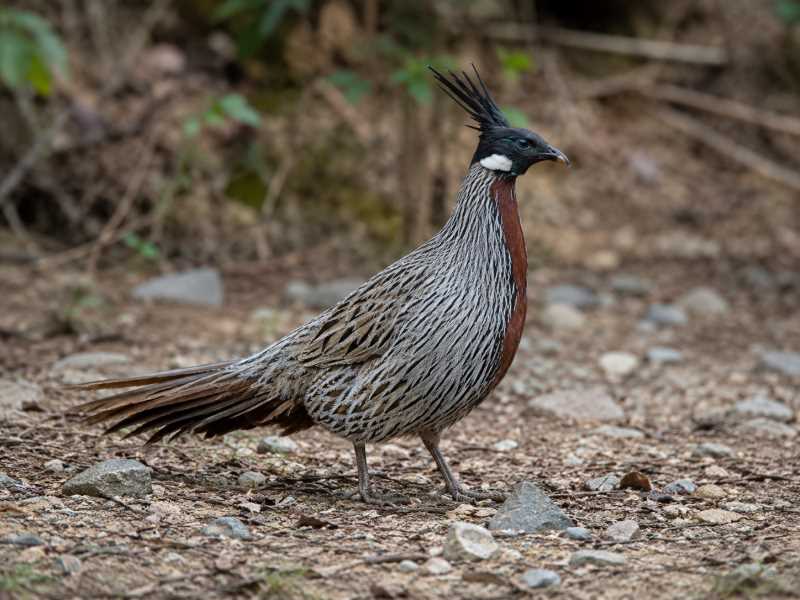
The sexes are distinctly different. The male has a metallic green head, a yellowish-brown crest, prominent horn-like ear tufts and a conspicuous white patch on the side of the neck. The body is heavily streaked, with brown, grey and green tones and variable chestnut colouring on the breast and belly.
The female is smaller-looking and much more cryptic. She has a white throat, short buff ear tufts, mottled black-and-brown upperparts and buff underparts marked with dark streaks. Juveniles and immature birds are less strongly patterned than adult males and rely primarily on brown and buff camouflage.
Range and Habitat
The Koklass Pheasant has a discontinuous range extending from Afghanistan and Pakistan through the Himalayas of India and Nepal to Bhutan, Tibet and central and eastern China. It is a resident species, although birds may move to lower elevations during winter in areas where snow restricts access to higher forests. (journals.plos.org)
It generally inhabits temperate coniferous and mixed forests, including stands containing fir, pine, oak, deodar, rhododendron and birch. Dense shrubs, montane bamboo, grassy openings and steep ravines are important components of suitable habitat. Much of the Himalayan population occurs between approximately 2,100 and 3,300 metres, although the species can occur outside this range locally. (journals.plos.org)
Several geographic forms have been described across the species’ broad range. These include western Himalayan, Nepalese and Chinese populations, which differ in details of plumage and distribution. Taxonomic treatment of some subspecies has varied between authorities, so the species-level name is the most consistent way to refer to the bird.
Behaviour and Diet
Koklass Pheasants are shy and secretive. They are usually encountered singly or in pairs, although several birds may gather during winter. When disturbed, they often run rapidly through dense vegetation before making a short, noisy flight downhill and between trees. They roost in trees and are more frequently heard than seen. (digitalrepository.wii.gov.in)
The species is most active while feeding in the early morning and late afternoon. Its diet is reported to include plant material such as seeds, berries and other forest foods, together with insects and other small invertebrates. Dense understorey is important both for foraging and for concealment.
Males are territorial during the breeding season and call mainly around dawn. The call is commonly rendered as a series resembling “kok-kark-kuk-kukuk”, while a harsher “kwak-kwak-kwak” may be given when the bird is flushed. (digitalrepository.wii.gov.in)
Breeding
Breeding generally takes place from April to June. The nest is a shallow ground nest concealed beneath thick bushes or other dense vegetation. Published regional accounts commonly report clutches of five to seven eggs and an incubation period of approximately 20–21 days, although breeding details may vary across the species’ wide range. (digitalrepository.wii.gov.in)
The chicks are precocial and leave the nest soon after hatching. They remain dependent on the female for protection and guidance while learning to forage in the undergrowth.
Identification Tips
- Look for a medium-sized pheasant in dense Himalayan forest, usually on or close to the ground.
- An adult male shows a metallic green head, yellowish-brown crest, long dark ear tufts, a white neck patch and strongly streaked body plumage.
- The female is mottled brown and buff, with a white throat and dark streaking on the underparts.
- Listen at dawn for the repeated, rough Koklass call, particularly on steep wooded slopes.
- A female Koklass Pheasant may be confused with a female Kalij Pheasant. The Koklass usually has a white throat, more strongly streaked plumage and a less uniform brown appearance. The female Kalij has exposed red facial skin and a more laterally compressed tail. (digitalrepository.wii.gov.in)
Conservation Status
The Koklass Pheasant is assessed as Least Concern on the IUCN Red List. This classification reflects its broad distribution and relatively large overall range, but it should not be interpreted as evidence that all populations are secure. Global population estimates are not available, and local declines have been reported in areas affected by habitat degradation. (nc.iucnredlist.org)
Important pressures include deforestation, habitat fragmentation, overgrazing, fuelwood and fodder collection, disturbance, forest fires and hunting or snaring. The species depends on dense understorey, so the removal of shrubs and bamboo can reduce habitat quality even where the tree canopy remains. (dnpwc.gov.np)
Conservation measures include protecting montane forests, maintaining dense understorey, reducing unsustainable extraction of forest resources, preventing illegal hunting and monitoring populations across the species’ range. Protected areas and locally managed forests are particularly important for retaining connected habitat.
Frequently Asked Questions
Where does the Koklass Pheasant live?
It occurs in mountain forests from Afghanistan and Pakistan across the Himalayas of India and Nepal to Bhutan, Tibet and parts of China. It prefers temperate coniferous or mixed woodland with dense undergrowth.
Is the Koklass Pheasant migratory?
No. It is generally resident, but some birds move to lower elevations during winter, particularly where snow limits access to high-altitude feeding areas.
How can a male Koklass Pheasant be identified?
The male has a metallic green head, a yellowish-brown crest, prominent dark ear tufts, a white neck patch and a strongly streaked body with variable chestnut colouring.
What does the Koklass Pheasant eat?
It feeds mainly on plant material, including seeds and berries, and also takes insects and other small invertebrates found in forest undergrowth and grassy openings.
When does the Koklass Pheasant breed?
Breeding usually occurs from April to June. The female lays a clutch of about five to seven eggs in a concealed ground nest, and incubation is reported to last approximately 20–21 days in regional accounts.
Is the Koklass Pheasant endangered?
The species is currently assessed globally as Least Concern. Nevertheless, habitat loss, degradation of dense undergrowth, hunting and other human pressures can threaten local populations.
References
- BirdLife International. 2016. Species factsheet: Koklass Pheasant Pucrasia macrolopha. BirdLife DataZone. Available at: https://datazone.birdlife.org/species/factsheet/koklass-pheasant-pucrasia-macrolopha. Accessed 8 September 2026.
- Badrulislam, Khan, K. A., Khalil, S., Hussain, M., Saqib, Z., Altaf, J., Hadi, R. and Habiba, U. 2024. Habitat suitability modelling of Koklass pheasant (Pucrasia macrolopha) in moist temperate forest. PLOS ONE 19(2): e0296921. https://doi.org/10.1371/journal.pone.0296921.
- D’Silva, C. 2016. Koklass Pheasant Pucrasia macrolopha. In: Sathyakumar, S. ed., Galliformes of India. Envis Bulletin, Wildlife Institute of India, Dehradun, pp. 40–41. Available at: https://digitalrepository.wii.gov.in/server/api/core/bitstreams/216ad11b-cb40-4333-ad5c-443fa8f52f71/content. Accessed 8 September 2026.
- Gill, F., Donsker, D. and Rasmussen, P. eds. 2026. IOC World Bird List, version 15.2. International Ornithologists’ Union. Available at: https://www.worldbirdnames.org/. Accessed 8 September 2026.
- Government of Nepal, Department of National Parks and Wildlife Conservation. 2019. Pheasant Conservation Action Plan 2019–2023. Kathmandu: Department of National Parks and Wildlife Conservation. Available at: https://dnpwc.gov.np/media/publication/Pheasant_Conservation_Action_Plan_2019_tvXkz80.pdf. Accessed 8 September 2026.
- IUCN. 2024. Green Status of Species: Supplementary Information: Koklass Pheasant Pucrasia macrolopha. The IUCN Red List of Threatened Species. Available at: https://nc.iucnredlist.org/redlist/content/attachment_files/Green_Status_Supplementary_Information_22679179_Pucrasia_macrolopha.pdf. Accessed 8 September 2026.
- Ramesh, K. and Rawat, G. S. 2003. An Ecological Study on the Pheasants of Great Himalayan National Park, Western Himalaya. Wildlife Institute of India, Dehradun. Available at: https://digitalrepository.wii.gov.in/items/6fa5faf0-8be5-45b2-947a-d56fb8711438. Accessed 8 September 2026.
- State of India’s Birds. 2025. Koklass Pheasant Pucrasia macrolopha: Himachal Pradesh factsheet. Available at: https://stateofindiasbirds.in/species/hp-kokphe1/. Accessed 8 September 2026.
Related posts