Introduction
The Least Beaked Whale, scientifically known as Berardius minimus, is a fascinating marine mammal species. As its name suggests, it is the smallest member of the Berardius genus, which also includes the Baird’s and Arnoux’s beaked whales. Discovered relatively recently, the Least Beaked Whale has intrigued marine biologists with its elusive nature and distinct characteristics. This article delves into the unique aspects of the Least Beaked Whale, covering its physical description, habitat, behavior, conservation status, and more.
Physical Description
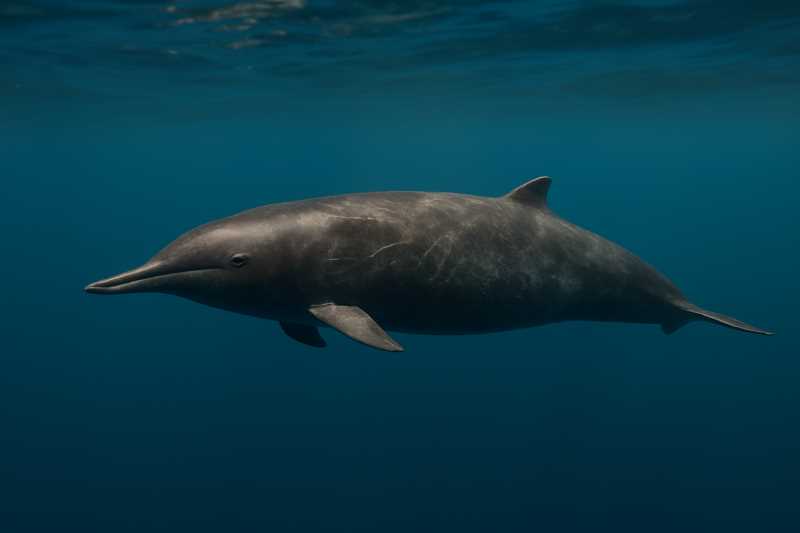
The Least Beaked Whale, Berardius minimus, is the smallest of the beaked whales in its genus, with adults typically measuring around 6.7 meters (approximately 22 feet) in length. These whales have a streamlined body that is dark grey to black, with lighter patches around the throat and belly. A distinguishing feature of the Least Beaked Whale is its long, slender beak, which is more pronounced than in its larger relatives.
The dorsal fin of the Least Beaked Whale is small and falcate, located far back on the body. The pectoral fins are also relatively small compared to the overall size of the whale. Their skin is often marked with scars and scratches, likely resulting from interactions with other whales or encounters with predators. Males and females are similar in appearance, although males may have slightly larger teeth, which are visible even when the mouth is closed.
Range and Habitat
The Least Beaked Whale is primarily found in the North Pacific Ocean, particularly around the coasts of Japan and the Sea of Okhotsk. Their range is not entirely known due to their elusive nature and deep-sea habitat preferences. However, they are believed to inhabit offshore waters where they can dive to great depths in search of food.
These whales prefer cold, deep-sea environments, often avoiding coastal waters. They are typically found in areas with steep underwater topography, such as continental slopes and submarine canyons, where their prey is abundant. Their distribution may overlap with that of the larger Baird’s beaked whale, but they are generally found in deeper and more remote areas.
Behavior and Diet
The Least Beaked Whale is a deep-diving species, capable of reaching significant depths in search of prey. They are known to dive for up to an hour, though typical dives last between 20 to 40 minutes. Their diet primarily consists of deep-sea squid, fish, and crustaceans. Like other beaked whales, they use echolocation to locate prey in the dark depths of the ocean.
These whales are social animals, often found in small pods of two to six individuals. They communicate using a series of clicks and whistles, though their vocalizations are less understood compared to those of other cetaceans. Observations suggest that their social structure may be complex, similar to other toothed whales.
Identification Tips (field recognition cues)
Identifying the Least Beaked Whale in the field can be challenging due to its elusive nature and preference for deep waters. However, there are several cues that can aid in identification:
- Size and Shape: The Least Beaked Whale is noticeably smaller than its relatives, with a slender, elongated body and a pronounced beak.
- Coloration: Look for the dark grey to black coloration with lighter patches on the throat and belly.
- Dorsal Fin: The dorsal fin is small and situated far back on the body, which is a characteristic feature.
- Scarring: The skin often displays scars and scratches, especially around the head and back.
- Behavior: Observing dive patterns and group behavior can also provide clues, as they tend to dive for extended periods and are found in small pods.
Conservation Status (with threats and protections)
The Least Beaked Whale is currently classified as "Data Deficient" by the International Union for Conservation of Nature (IUCN) due to the lack of comprehensive data on its population size and trends. However, several threats have been identified that could impact their survival:
- Bycatch: Like many marine species, Least Beaked Whales are at risk of becoming bycatch in fishing operations, particularly in gillnets and longlines.
- Noise Pollution: Increased noise levels from shipping, military exercises, and seismic surveys can disrupt the whales’ echolocation and communication, affecting their ability to forage and navigate.
- Climate Change: Changes in ocean temperatures and currents may alter the distribution of prey species, impacting the whales’ food availability.
- Plastic Pollution: Ingestion of marine debris, particularly plastics, poses a threat to their health and survival.
Currently, there are no specific conservation measures in place for the Least Beaked Whale. However, broader efforts to protect marine environments and reduce oceanic noise pollution could benefit this species.
Frequently Asked Questions
What are the main threats to the Least Beaked Whale?
The main threats include bycatch in fishing operations, noise pollution from ships and military activities, climate change affecting prey distribution, and plastic pollution. These factors pose significant risks to their survival, though more research is needed to fully understand their impact.
How can I identify a Least Beaked Whale in the wild?
Identification can be challenging due to their deep-sea habitat. Key features include their small size, dark coloration with lighter patches, long slender beak, small dorsal fin located far back, and the presence of scars on the skin. Observing their diving behavior and group dynamics may also aid identification.
Where is the Least Beaked Whale typically found?
The Least Beaked Whale is primarily found in the North Pacific Ocean, especially around Japan and the Sea of Okhotsk. They prefer cold, deep waters and are often found near continental slopes and submarine canyons.
What is the diet of the Least Beaked Whale?
Their diet mainly consists of deep-sea squid, fish, and crustaceans. They are adept at deep diving and use echolocation to hunt for prey in the dark ocean depths.
How does noise pollution affect the Least Beaked Whale?
Noise pollution can interfere with their echolocation and communication abilities, disrupting their foraging and navigation. This can lead to increased stress, reduced feeding efficiency, and potential habitat displacement.
Related posts