Introduction
The White-bellied Slender Opossum, scientifically known as Marmosops noctivagus, is a fascinating marsupial native to South America. Known for its elusive nature and slender physique, this opossum is an integral part of the biodiversity of the tropical forests it inhabits. Understanding the White-bellied Slender Opossum’s ecology, behavior, and conservation status is essential for appreciating its role in the ecosystem and the challenges it faces in the wild.
Physical Description
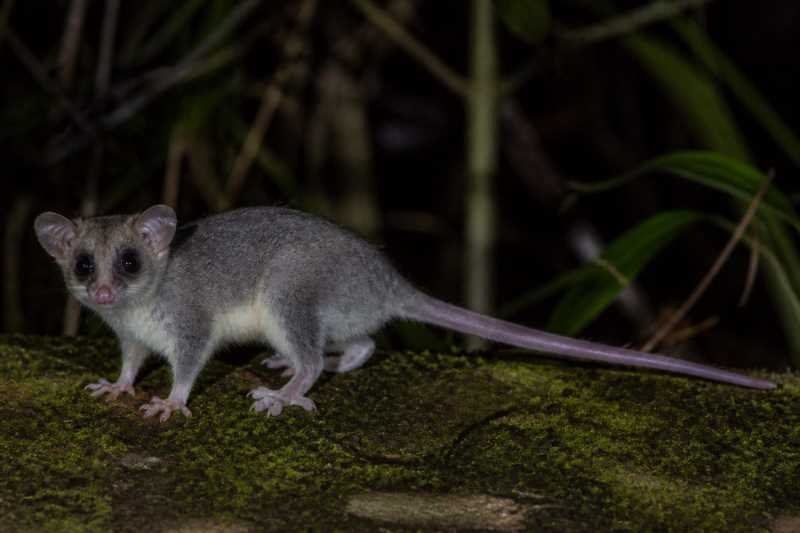
The White-bellied Slender Opossum is aptly named for its distinct physical characteristics. It possesses a slender, elongated body with a length ranging from 10 to 15 centimeters, excluding its tail, which can add another 15 to 20 centimeters. The opossum’s fur is soft and dense, primarily featuring a dark brown or grayish-brown coloration on its back, while the underbelly is a contrasting white or cream color, giving it its common name.
Its face is characterized by a pointed snout and large, round ears, which aid in its nocturnal lifestyle. The eyes are relatively large, enhancing its night vision. The tail is prehensile, assisting the opossum in climbing and maintaining balance in the trees, where it spends much of its time.
Range and Habitat
Marmosops noctivagus is found predominantly in the tropical and subtropical forests of South America, including regions of Brazil, Bolivia, Peru, and Ecuador. These opossums prefer dense, humid environments where they can easily hide from predators and find food.
Their habitat primarily consists of lowland forests and montane forests up to elevations of around 1,500 meters. The species is highly adaptable and can be found in both primary and secondary forests, although deforestation poses a significant threat to their natural habitat.
Behavior and Diet
The White-bellied Slender Opossum is nocturnal, spending the night foraging for food and the day resting in nests made from leaves and twigs. It is arboreal, relying heavily on its prehensile tail and sharp claws to navigate the forest canopy.
Its diet is omnivorous, consisting of a variety of fruits, insects, small vertebrates, and carrion. This diverse diet allows the opossum to thrive in its environment, taking advantage of the seasonal availability of different food sources.
Socially, these opossums are generally solitary creatures, coming together only for mating purposes. Females are known to exhibit a form of parental care, carrying their young in a pouch or on their backs until they are old enough to fend for themselves.
Identification Tips
Field recognition of the White-bellied Slender Opossum can be challenging due to its nocturnal habits and elusive nature. However, several key features can aid in identification:
- Size and Shape: Look for a small, slender marsupial with a long tail.
- Coloration: Note the dark upper body and contrasting white or cream underbelly.
- Facial Features: Large eyes and ears are characteristic, aiding in night vision and hearing.
- Behavior: Active at night and often found in trees.
Conservation Status
The International Union for Conservation of Nature (IUCN) currently lists the White-bellied Slender Opossum as "Least Concern". However, this status does not mean the species is free from threats. Habitat destruction, primarily due to deforestation for agriculture and urban development, poses a significant risk to its survival.
Conservation efforts are focused on habitat preservation and restoration. Protected areas in the opossum’s range provide some refuge, but ongoing monitoring and research are crucial to ensure its long-term survival. Public awareness and education about the species and its role in the ecosystem are also vital components of conservation strategies.
Frequently Asked Questions
1. What is the lifespan of the White-bellied Slender Opossum?
The exact lifespan of Marmosops noctivagus in the wild is not well-documented, but similar species often live for about 2 to 4 years. Captive opossums can sometimes live longer due to the absence of predators and consistent food supply.
2. How does the White-bellied Slender Opossum contribute to its ecosystem?
As an omnivore, the opossum plays a crucial role in controlling insect populations and dispersing seeds, which helps maintain forest health and regeneration.
3. Are White-bellied Slender Opossums dangerous to humans?
No, these opossums are not dangerous to humans. They are shy, elusive, and prefer to avoid contact with humans. If threatened, they may play dead or use their agility to escape.
4. What adaptations help the White-bellied Slender Opossum survive in its environment?
Adaptations such as nocturnal behavior, a prehensile tail, sharp claws for climbing, and keen senses of hearing and vision help the opossum thrive in its forest habitat.
5. How can I help in the conservation of the White-bellied Slender Opossum?
Supporting conservation organizations, spreading awareness about the importance of biodiversity, and advocating for sustainable land-use practices can contribute to the protection of this species.
Related posts