Seri’s Tree Kangaroo (Dendrolagus stellarum): An In-depth Look
Introduction
Seri’s Tree Kangaroo (Dendrolagus stellarum) is a captivating marsupial species native to the lush and secluded rainforests of New Guinea. Known for its striking appearance and arboreal lifestyle, this unique kangaroo species is a subject of fascination among wildlife enthusiasts and researchers alike. As a member of the Macropodidae family, Seri’s Tree Kangaroo exhibits behaviors and adaptations that are distinct from its terrestrial kangaroo relatives, making it an essential focus of biodiversity conservation efforts.
Physical Description
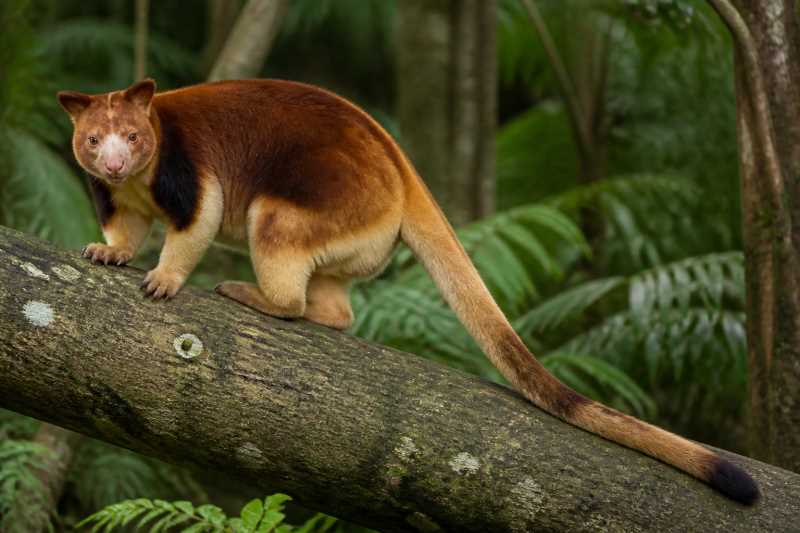
Seri’s Tree Kangaroo is a medium-sized marsupial with a robust and muscular build. Adult individuals typically weigh between 8 to 15 kilograms (17 to 33 pounds) and stand at approximately 50 to 80 centimeters (20 to 31 inches) in length, excluding the tail. Its tail, which can extend up to 70 centimeters (27 inches), is prehensile, aiding in balance and maneuverability among the treetops.
The fur of Seri’s Tree Kangaroo is dense and plush, providing insulation against the cooler temperatures of its high-altitude habitat. Its coloration is primarily a rich chestnut brown with a pale yellow or cream-colored belly. Some individuals may exhibit a pattern of black or dark brown markings on the back and limbs, adding to their distinct appearance.
One of the most notable features of this species is its large, expressive eyes, which are adapted for nocturnal activity. The ears are small and rounded, enhancing their ability to detect subtle sounds within the dense forest canopy.
Range and Habitat
Seri’s Tree Kangaroo is endemic to the montane rainforests of New Guinea, with a distribution range concentrated in the central highlands. These forests are characterized by steep, rugged terrain and dense vegetation, providing an ideal environment for arboreal dwellers like the Seri’s Tree Kangaroo.
These kangaroos primarily inhabit elevations ranging from 1,000 to 3,000 meters (3,280 to 9,840 feet), where the climate is cooler and the ecosystem is rich in biodiversity. The dense canopy and understory vegetation offer ample food sources and protection from predators, making these forests a sanctuary for the species.
Behavior and Diet
Seri’s Tree Kangaroo is a solitary and elusive creature, primarily active during the twilight hours of dawn and dusk. Their arboreal lifestyle is supported by strong forelimbs and curved claws, which facilitate climbing and navigating through the trees.
The diet of Seri’s Tree Kangaroo is predominantly herbivorous, consisting of leaves, fruits, flowers, and bark from a variety of tree species. Their foraging behavior is highly selective, with a preference for young leaves and tender shoots that are easier to digest and provide higher nutritional value.
Interestingly, Seri’s Tree Kangaroo has a slow metabolic rate, an adaptation that allows it to extract maximum nutrients from its fibrous diet. This slow-paced life extends to their behavior, with long periods of rest and minimal movement during the day.
Identification Tips
Field recognition of Seri’s Tree Kangaroo can be challenging due to their elusive nature and the dense forest habitat they occupy. However, several identification cues can aid in their detection:
- Coloration: Look for the distinctive chestnut brown fur with a contrasting pale belly.
- Tail: The long, prehensile tail is a key feature, often seen hanging below branches as the animal moves.
- Movement: Unlike ground kangaroos, Seri’s Tree Kangaroo moves with a deliberate and careful climbing motion.
- Sounds: Listen for soft, low-pitched vocalizations, which may indicate their presence, especially during dawn and dusk.
Conservation Status
The conservation status of Seri’s Tree Kangaroo is currently listed as Vulnerable by the International Union for Conservation of Nature (IUCN). Several factors contribute to their threatened status, including habitat loss, hunting, and the impacts of climate change.
Threats
- Deforestation: Logging and agricultural expansion have led to significant habitat fragmentation and loss.
- Hunting: While not as heavily hunted as some other species, Seri’s Tree Kangaroo is occasionally targeted for bushmeat and traditional medicine.
- Climate Change: Alterations in temperature and weather patterns affect the availability of food and suitable habitat.
Protections
Efforts to protect Seri’s Tree Kangaroo include:
- Protected Areas: Establishing and enforcing conservation areas within their natural range.
- Community Engagement: Working with local communities to promote sustainable land use and conservation practices.
- Research and Monitoring: Ongoing studies to better understand their ecology and inform conservation strategies.
Frequently Asked Questions
What makes Seri’s Tree Kangaroo different from other kangaroo species?
Seri’s Tree Kangaroo is adapted for an arboreal lifestyle, with strong forelimbs and a prehensile tail for climbing. Unlike terrestrial kangaroos, they have a slower metabolism and primarily feed on leaves and fruits.
Where can I see Seri’s Tree Kangaroo in the wild?
They are found in the montane rainforests of New Guinea, particularly in the central highlands. However, they are elusive and difficult to spot due to their solitary and nocturnal nature.
How does climate change impact Seri’s Tree Kangaroo?
Climate change affects their habitat by altering temperature and precipitation patterns, which can influence food availability and habitat suitability. Rising temperatures may also force them to move to higher altitudes, where suitable habitat is limited.
What conservation efforts are in place for Seri’s Tree Kangaroo?
Conservation efforts include the establishment of protected areas, community engagement to promote sustainable practices, and ongoing research to inform conservation strategies.
How can I help conserve Seri’s Tree Kangaroo?
Supporting conservation organizations, advocating for sustainable land use, and raising awareness about the species and its habitat are effective ways to contribute to their conservation.
Related posts