Humboldt’s Night Monkey (Aotus trivirgatus): A Comprehensive Guide
Introduction
Humboldt’s Night Monkey (Aotus trivirgatus), also known as the Northern Night Monkey, is a fascinating and enigmatic primate species native to the neotropical forests of South America. This nocturnal creature, belonging to the Aotidae family, is uniquely adapted to life in the dark and has captivated scientists and wildlife enthusiasts alike with its distinct behaviors and ecological roles. As deforestation and habitat fragmentation threaten their existence, understanding and preserving these remarkable primates has become increasingly crucial. This article provides an in-depth exploration of Humboldt’s Night Monkey, covering its physical characteristics, habitat, behavior, diet, and conservation efforts.
Physical Description
Humboldt’s Night Monkey is a small primate, with adults typically weighing between 800 and 1,200 grams (1.8 to 2.6 pounds) and measuring about 27 to 37 centimeters (10.6 to 14.6 inches) in body length, excluding the tail. Their tails add an additional 30 to 40 centimeters (11.8 to 15.7 inches) to their overall length.
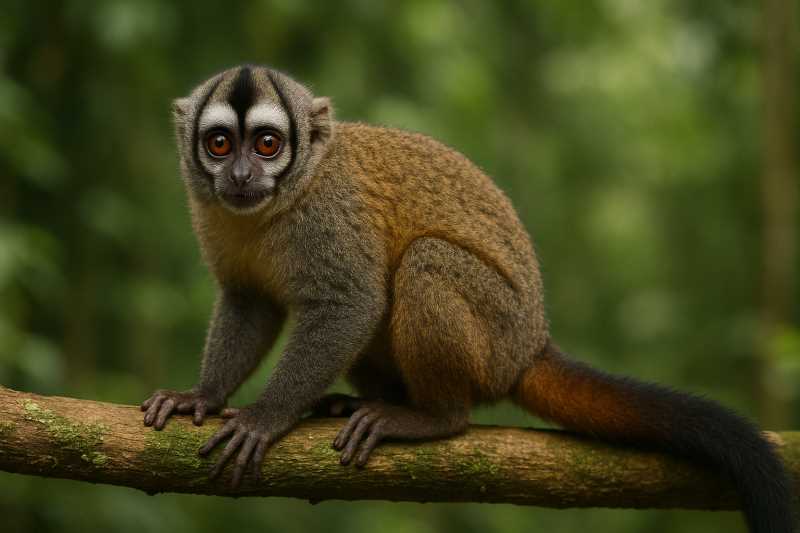
One of the most distinctive features of these monkeys is their large, forward-facing eyes, which are perfectly adapted for nocturnal vision. The eyes have a reflective layer, known as the tapetum lucidum, which enhances their ability to see in low light conditions. The facial markings of Humboldt’s Night Monkey are quite striking, with a dark, triangular patch on the forehead and two prominent white stripes running from the eyes to the nose, giving them a masked appearance.
Their fur is soft and dense, predominantly gray or brown with lighter undersides. The fur’s coloration provides excellent camouflage in their forested habitats. Additionally, these primates have strong, prehensile tails and dexterous fingers, aiding them in navigating the forest canopy and foraging for food.
Range and Habitat
Humboldt’s Night Monkey is primarily found in the northern regions of South America, with its range extending across parts of Venezuela, Colombia, and Brazil. These monkeys inhabit a variety of forest types, including tropical rainforests, deciduous forests, and secondary forests. They are particularly fond of riverine forests, where dense vegetation provides ample cover and feeding opportunities.
These primates are highly arboreal, spending most of their lives in the trees. They prefer areas with a complex canopy structure that offers protection from predators and a diverse diet. Moreover, Humboldt’s Night Monkeys are known to occupy forests at various altitudes, ranging from lowland areas to mountainous regions up to 3,000 meters (9,843 feet) above sea level.
Behavior and Diet
As their name suggests, Humboldt’s Night Monkeys are strictly nocturnal, being most active during the night. They exhibit a monogamous social structure, typically living in small family groups consisting of a mated pair and their offspring. These groups communicate through a series of vocalizations, including hoots, trills, and grunts, which help them maintain contact in the dense forest.
Their diet is highly varied and primarily consists of fruits, leaves, flowers, and insects. They are known to be opportunistic feeders, adapting their foraging habits to the availability of food resources. During the dry season, when fruit is less abundant, they rely more heavily on leaves and insects.
Identification Tips (Field Recognition Cues)
Identifying Humboldt’s Night Monkey in the field can be challenging due to their nocturnal habits and elusive nature. However, certain features can aid in their recognition:
- Large Eyes: Look for the reflective glow of their large eyes when shining a light into the canopy.
- Distinctive Facial Markings: Note the dark triangular patch and white stripes on their faces.
- Vocalizations: Listen for their unique vocal calls, particularly during the early evening and pre-dawn hours.
- Movement: Observe their agile and deliberate movements through the trees, often in pairs or small groups.
Conservation Status (With Threats and Protections)
Humboldt’s Night Monkey is currently listed as "Least Concern" on the IUCN Red List, but their populations are facing increasing threats. The primary threat to their survival is habitat loss due to deforestation and land conversion for agriculture and urban development. Additionally, illegal wildlife trade and hunting pose significant risks.
Conservation efforts are underway to protect these primates and their habitats. Protected areas and national parks in their range help safeguard critical ecosystems. Moreover, local and international organizations are working to raise awareness and promote sustainable land-use practices.
Frequently Asked Questions
What adaptations do Humboldt’s Night Monkeys have for nocturnal life?
Humboldt’s Night Monkeys have large eyes with a reflective layer, enhancing their night vision. Their acute sense of hearing and silent movements also aid in nighttime navigation.
How do Humboldt’s Night Monkeys communicate?
They communicate through vocalizations such as hoots, trills, and grunts. These sounds help maintain group cohesion and coordinate movements in the dense forest.
Are Humboldt’s Night Monkeys endangered?
Currently, they are classified as "Least Concern," but habitat loss and illegal trade are significant threats. Conservation efforts focus on habitat protection and sustainable practices.
What do Humboldt’s Night Monkeys eat?
Their diet is diverse, including fruits, leaves, flowers, and insects. They are opportunistic feeders, adapting to seasonal changes in food availability.
Where can Humboldt’s Night Monkeys be found?
They inhabit the forests of northern South America, particularly in Venezuela, Colombia, and Brazil, favoring areas with dense canopy cover and diverse plant life.
Related posts