Introduction
Delacour’s Langur, scientifically known as Trachypithecus delacouri, is a captivating primate species that belongs to the family Cercopithecidae. This langur is named in honor of French ornithologist Jean Théodore Delacour, who made significant contributions to the study of Southeast Asian wildlife. Found exclusively in Vietnam, Delacour’s Langur is a highly endangered species that has fascinated researchers and conservationists alike. This article delves into the unique physical characteristics, habitat, behavior, and conservation efforts associated with Delacour’s Langur.
Physical Description
Delacour’s Langur is a striking primate, easily recognizable by its distinctive coloration and features. Adult langurs typically weigh between 6.5 to 10 kilograms, with males generally being larger than females. They measure approximately 60-80 centimeters in body length, excluding their tails, which can add another 70-100 centimeters.
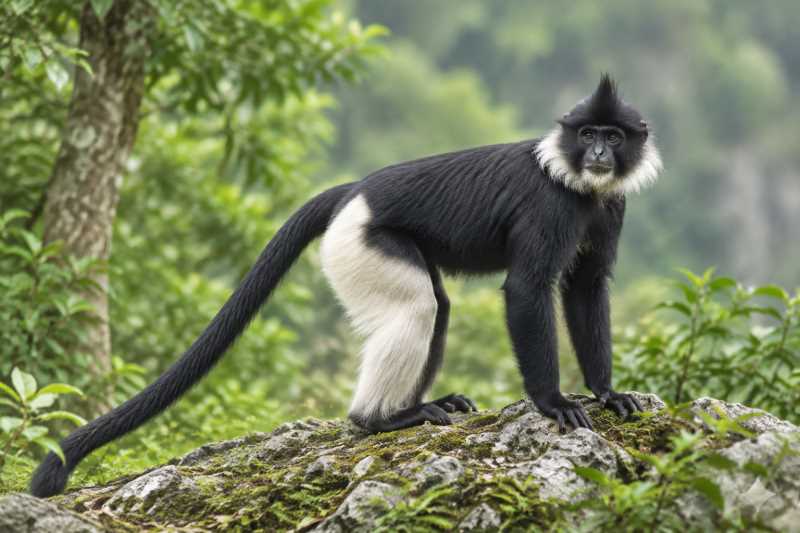
One of the most notable features of Delacour’s Langur is its contrasting black and white coloration. The body and limbs are predominantly black, while the rump and the tops of the thighs are a bright white, creating a striking visual contrast. This unique pattern is thought to play a role in identification and social interactions among individuals.
Their faces are hairless and pale, with a characteristic white band across the forehead, giving them a distinguished appearance. The langur’s eyes are large and expressive, which enhances their visual communication capabilities. Delacour’s Langur is also equipped with strong limbs and a long tail, aiding in their arboreal lifestyle.
Range and Habitat
Delacour’s Langur is endemic to the northern region of Vietnam, specifically within the limestone karst forests. This unique habitat is characterized by rugged terrain, steep cliffs, and dense foliage, providing both shelter and food sources for the langurs. The primary range of Delacour’s Langur includes provinces such as Ninh Binh, Thanh Hoa, and Hoa Binh.
The limestone karst forests are not only vital for the survival of Delacour’s Langur but are also home to diverse flora and fauna, making them ecologically significant. These langurs are highly adapted to their rocky environment, using their strong limbs and tails to navigate the challenging landscape. However, their limited range and specific habitat requirements make them particularly vulnerable to environmental changes and human activities.
Behavior and Diet
Delacour’s Langur is a diurnal species, meaning they are active during the day. They are social animals, typically living in groups of around 5 to 30 individuals. These groups are usually composed of multiple females, their offspring, and one or more males. The social structure is hierarchical, with dominant males often leading the group and making crucial decisions about movement and foraging.
The diet of Delacour’s Langur primarily consists of leaves, fruits, flowers, and seeds. Their digestive system is specially adapted to process a high-fiber diet, allowing them to extract essential nutrients from their food. Foraging occurs mainly in the early morning and late afternoon, with the langurs spending a considerable amount of time resting and socializing during the heat of the day.
Communication within the group is crucial, and Delacour’s Langur employs a variety of vocalizations, facial expressions, and body postures to convey information. These communication methods help maintain social bonds and coordinate group activities.
Identification Tips (Field Recognition Cues)
Spotting Delacour’s Langur in the wild can be a rewarding experience for wildlife enthusiasts and researchers. Here are some tips for identifying this unique species:
- Coloration: Look for the distinctive black and white coloration, with black bodies and limbs and a white rump and thigh area.
- Facial Markings: Note the pale face with a white band across the forehead, a key identifying feature.
- Habitat: Search in limestone karst forests within their known range in northern Vietnam.
- Behavior: Observe for groups resting or foraging in the early morning or late afternoon.
- Sounds: Listen for their vocalizations, which include a range of calls used for communication within the group.
Conservation Status (With Threats and Protections)
Delacour’s Langur is classified as Critically Endangered on the IUCN Red List, with an estimated population of fewer than 250 mature individuals remaining in the wild. This alarming status is primarily due to habitat loss, hunting, and the illegal wildlife trade.
Threats
- Habitat Destruction: The limestone karst forests, crucial for their survival, are being destroyed due to quarrying activities and agricultural expansion.
- Hunting: Despite legal protection, Delacour’s Langur is hunted for traditional medicine and the pet trade, significantly impacting their population.
- Fragmentation: Habitat fragmentation isolates populations, reducing genetic diversity and increasing vulnerability to environmental changes.
Protections
Efforts are underway to protect Delacour’s Langur through various conservation initiatives:
- Protected Areas: Establishment of protected areas and national parks, such as the Van Long Nature Reserve, where conservation efforts are focused on preserving the langur’s habitat.
- Research and Monitoring: Ongoing research and population monitoring provide valuable data for conservation strategies.
- Community Engagement: Involving local communities in conservation efforts and promoting awareness about the importance of protecting this species.
Frequently Asked Questions
Why is this species unique?
Delacour’s Langur is unique due to its striking black and white coloration, limited geographic range, and adaptation to the limestone karst forest habitat. These factors make it an exceptional species in terms of both appearance and ecological niche.
What are the main threats to Delacour’s Langur?
The primary threats to Delacour’s Langur include habitat destruction due to quarrying and agriculture, hunting for traditional medicine and trade, and habitat fragmentation leading to isolated populations.
How can I help in the conservation of Delacour’s Langur?
Supporting conservation organizations, spreading awareness, and advocating for the protection of their habitat are crucial steps. Visiting protected areas and responsible tourism also contribute to conservation efforts.
Where can Delacour’s Langur be found?
Delacour’s Langur is found exclusively in northern Vietnam, particularly in the limestone karst forests of provinces like Ninh Binh, Thanh Hoa, and Hoa Binh.
How does Delacour’s Langur communicate?
Delacour’s Langur uses a range of vocalizations, facial expressions, and body postures to communicate within their group, maintaining social bonds and coordinating activities.
Related posts