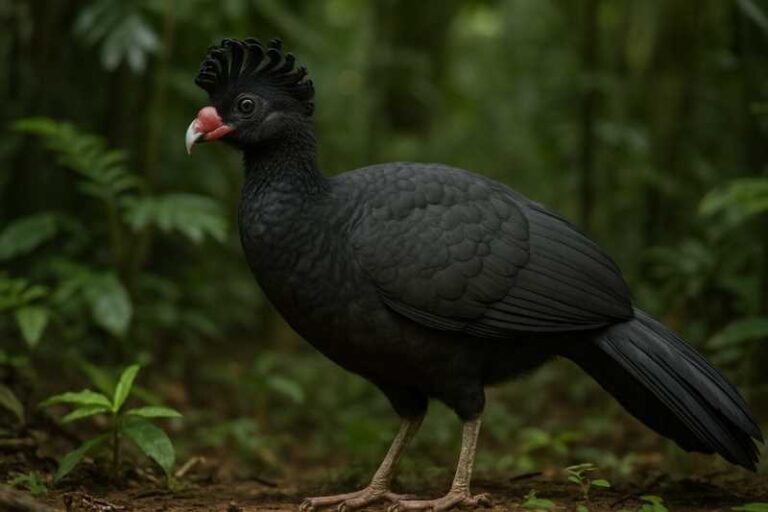
The Yellow-billed Kingfisher (Syma torotoro) is one of the lesser-known but most charming members of the kingfisher family. With its vibrant plumage, melodious calls, and close association with dense tropical rainforests, this species has long captivated naturalists and birdwatchers alike. Although it is more often heard than seen, a sighting of the Yellow-billed Kingfisher offers a delightful glimpse into the rich biodiversity of Australasia’s rainforests.
Identification and Physical Features
The Yellow-billed Kingfisher is a small to medium-sized kingfisher, measuring about 19–22 cm in length. Its striking appearance makes it relatively easy to identify when seen:
- Bill: Large, bright yellow, slightly down-curved—an instantly recognisable feature that contrasts with the head.
- Head and underparts: Rich orange to deep golden buff.
- Back and wings: Glossy greenish-blue with darker flight feathers.
- Tail: Short, blue.
- Eyes: Large, dark, and expressive.
Sexes are generally similar in appearance, though females often show a small black spot on the nape, which is absent in males. Juveniles are duller overall and have a darker bill.
Range and Distribution
The Yellow-billed Kingfisher is found across a wide range in Australasia:
- New Guinea: Widespread throughout lowland and hill forests of mainland New Guinea and nearby islands.
- Australia: Occurs in the tropical lowland rainforests of Cape York Peninsula, Queensland—primarily in the Iron Range and Lockerbie Scrub areas.
It is considered a sedentary species within its range, although local movements may occur in response to food availability or seasonal changes.
Habitat Preferences
This kingfisher is closely tied to dense tropical and subtropical rainforests, where it prefers closed-canopy environments rich in leaf litter and invertebrate prey. Preferred habitats include:
- Lowland rainforest
- Monsoon forest
- Mangrove edges (occasionally)
- Secondary growth and forest margins (less frequently)
In Australia, the species is most often found in relatively intact rainforest areas, making its presence a useful indicator of healthy forest ecosystems.
Behaviour and Ecology
Feeding and Hunting
Unlike some of its aquatic relatives, the Yellow-billed Kingfisher is a terrestrial hunter. It primarily feeds on:
- Insects (especially beetles and grasshoppers)
- Spiders
- Small reptiles (skinks)
- Occasionally small amphibians
The bird typically hunts by perching quietly in the lower to mid-levels of the forest, scanning the forest floor or trunks for movement. It drops swiftly to seize prey and returns to a perch to consume it.
Vocalisations
One of the most notable aspects of the Yellow-billed Kingfisher’s behaviour is its distinctive vocalisations. The call is a loud, whistled “ti-ti-ti-ti-ti” that gradually increases in volume—often given at dawn or during the breeding season. These calls carry well through dense forest, helping birdwatchers locate the otherwise elusive species.
Breeding and Nesting
Breeding typically takes place during the wet season:
- In Australia, this is usually from November to March.
- In New Guinea, the timing varies by location but generally coincides with peak insect availability.
A fascinating aspect of this species’ ecology is its nesting behaviour:
- It excavates a nesting cavity in an arboreal termite mound, usually attached to a tree trunk or large branch.
- The entrance hole leads to a short tunnel and a nesting chamber.
- The clutch typically consists of 2–4 white eggs.
- Both parents share incubation and chick-rearing duties.
Nesting in termite mounds offers advantages such as protection from many predators and a stable microclimate.
Conservation Status
The Yellow-billed Kingfisher is currently classified as Least Concern by the IUCN. Its broad range and large population size contribute to this secure status. However, the species is sensitive to habitat destruction:
- In Australia, continued rainforest clearing for agriculture and development poses a threat.
- In parts of New Guinea, logging and conversion of forest to plantations also reduce suitable habitat.
The species benefits from occurring in several protected areas, but conservation of lowland rainforest habitat is critical for its long-term survival.
Birdwatching Tips
For those hoping to observe the Yellow-billed Kingfisher:
- Where to look: Intact lowland rainforest in Cape York during the wet season offers the best chance in Australia.
- When to visit: Early mornings are prime times, as the birds are more vocal and active.
- How to find: Listen for the whistled “ti-ti-ti” call and scan lower to mid-storey perches.
- Patience required: The species is often shy and elusive, requiring a quiet, careful approach.
A successful sighting of this beautiful bird is a memorable reward for any rainforest birder.
Conclusion
The Yellow-billed Kingfisher is a dazzling representative of the rainforest kingfishers. Its vibrant plumage, evocative calls, and specialised nesting behaviour make it an endlessly fascinating species. Protecting the rainforests of Cape York and New Guinea will help ensure that this jewel of the forest continues to brighten the dawn chorus for generations to come.
Related posts