The White-throated Treerunner: An In-depth Exploration of Pygarrhichas albogularis
Introduction
The White-throated Treerunner, known scientifically as Pygarrhichas albogularis, is a fascinating bird species native to the temperate forests of South America, particularly in Chile and Argentina. As a member of the family Furnariidae, this bird is renowned for its distinctive behaviors and adaptations, allowing it to thrive in its habitat. This article delves into the various aspects of the White-throated Treerunner, including its taxonomy, morphology, behavior, ecology, and conservation status.
Taxonomy and Classification
The White-throated Treerunner belongs to the order Passeriformes, the largest order of birds, often referred to as perching birds or songbirds. Within this order, it is classified under the family Furnariidae, which comprises a diverse range of species commonly known as ovenbirds and woodcreepers. The genus Pygarrhichas is monotypic, meaning it contains only one species, Pygarrhichas albogularis.
The specific epithet ‘albogularis’ is derived from Latin, where ‘albus’ means white and ‘gularis’ refers to the throat, aptly describing the bird’s prominent white throat patch, which is one of its key identifying features.
Morphology and Identification
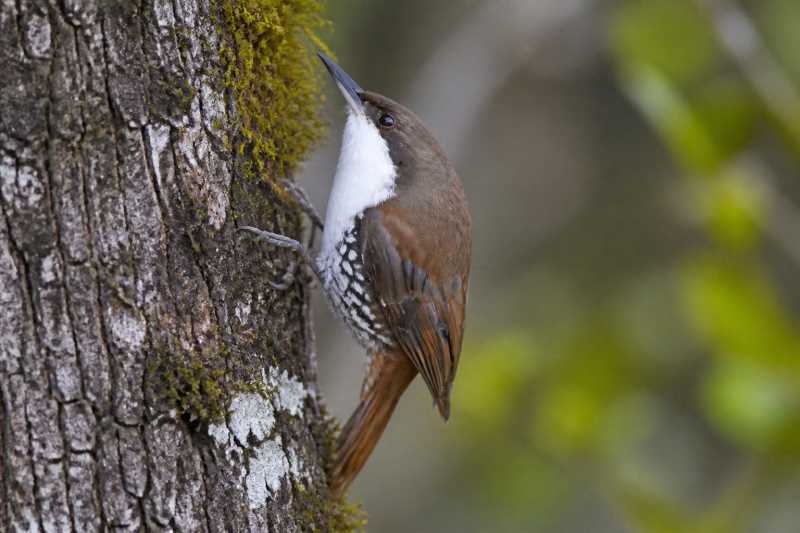
The White-throated Treerunner is a small bird, measuring approximately 16 to 17 centimeters in length. It displays a distinctive plumage that aids in identification. The upperparts are primarily dark brown with subtle rufous tones, while the underparts are lighter, often displaying a buff or grayish hue. The most striking feature is the white throat and upper breast, which contrast sharply with the rest of the body.
This bird possesses a slender, slightly curved bill and strong claws, adaptations that facilitate its arboreal lifestyle. The bill is particularly useful for foraging in the bark and crevices of trees, a behavior that will be discussed later in this article.
Behavior and Ecology
White-throated Treerunners are primarily arboreal, spending most of their time climbing tree trunks and branches in search of food. They exhibit a behavior known as ‘creeping,’ similar to that of nuthatches and treecreepers in other parts of the world. This involves moving in a spiraling pattern around tree trunks, using their strong claws and tail for support.
Their diet consists mainly of insects and other small invertebrates, which they extract from the bark of trees using their specialized bills. This foraging method is highly effective in their native temperate forests, where bark-dwelling insects are abundant.
Treerunners are known to be monogamous, forming pairs that remain together throughout the breeding season. Their nests are typically constructed in tree cavities, which provide protection from predators and environmental elements. Both parents share the responsibility of incubating the eggs and feeding the chicks.
Habitat and Distribution
The natural habitat of the White-throated Treerunner is the temperate forests of southern South America. These forests are characterized by a mix of deciduous and evergreen trees, providing an ideal environment for their foraging habits. The species is predominantly found in the Andes mountain range, ranging from central Chile and Argentina southwards to Tierra del Fuego.
These birds are well-adapted to the cool, moist conditions of their habitat, and their range is largely confined to areas that support these environmental conditions. However, they can also be found in secondary forests and areas of forest regeneration, demonstrating some level of adaptability to habitat changes.
Conservation Status and Threats
The White-throated Treerunner is currently listed as a species of Least Concern by the International Union for Conservation of Nature (IUCN). This classification indicates that the species is not presently at significant risk of extinction across its range. However, like many wildlife species, it faces potential threats from habitat loss and fragmentation due to logging, agriculture, and urban development.
Conservation efforts for this species focus on the preservation and restoration of its native forest habitat. Protected areas and national parks in Chile and Argentina play a crucial role in safeguarding these environments, ensuring that the White-throated Treerunner and other native species can continue to thrive.
Conclusion
The White-throated Treerunner is a remarkable bird that exemplifies the unique biodiversity of South America’s temperate forests. Its specialized adaptations and behaviors highlight the intricate connections between species and their habitats. While currently not at immediate risk of extinction, ongoing conservation efforts are essential to protect this species and its environment for future generations.
As we continue to study and appreciate the White-throated Treerunner, it serves as a reminder of the importance of biodiversity and the delicate balance that sustains ecosystems around the world.
References
- BirdLife International. (2023). Species factsheet: Pygarrhichas albogularis. Retrieved from BirdLife International
- Remsen, J. V., & Schulenberg, T. S. (2023). White-throated Treerunner (Pygarrhichas albogularis). In Birds of the World. Cornell Lab of Ornithology.
- IUCN. (2023). The IUCN Red List of Threatened Species. Version 2023-2.
Related posts