The Graceful White-throated Swallow: A Bird of Elegance and Agility
The White-throated Swallow, scientifically known as Hirundo albigularis, is a remarkable avian species that captivates bird enthusiasts and ornithologists alike. Renowned for its distinctive appearance and agile flight, this swallow is a common sight across the southern regions of the African continent. In this article, we delve into the intriguing world of the White-throated Swallow, exploring its habitat, behavior, and the ecological role it plays.
Habitat and Distribution
The White-throated Swallow is predominantly found in sub-Saharan Africa, with a distribution range extending from the southern regions of the Democratic Republic of the Congo and Tanzania down to South Africa. These swallows are particularly abundant in areas with access to water bodies such as rivers, lakes, and wetlands, as they rely heavily on these ecosystems for nesting and feeding.
Their preference for open landscapes, often interspersed with trees or shrubs, makes them a common sight in savannas, farmlands, and grasslands. During the breeding season, these swallows are frequently observed near human settlements where they find suitable structures for nesting.
Physical Characteristics
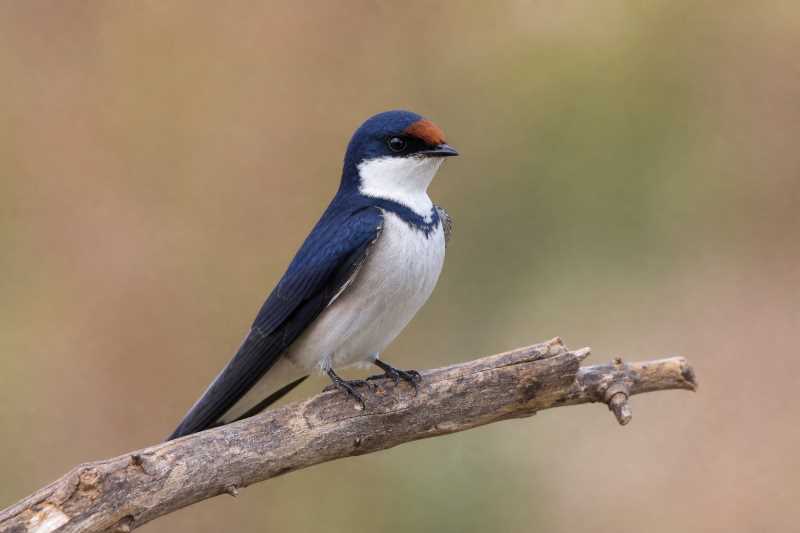
The White-throated Swallow is a medium-sized bird, measuring approximately 14 to 17 centimeters in length with a wingspan of about 32 centimeters. True to its name, this swallow is easily recognizable by its pure white throat and underparts. The upperparts, including the head and back, are a glossy blue-black, providing a striking contrast to its white plumage.
A notable feature of the White-throated Swallow is its deeply forked tail, which adds to its aerodynamic prowess in the sky. The tail feathers, or rectrices, are long and narrow, contributing to its agile flight and maneuverability.
Behavior and Diet
White-throated Swallows are social birds, often seen in small flocks, particularly outside the breeding season. Their flight is characterized by swift and acrobatic movements, as they dart and swoop in pursuit of flying insects, which make up the majority of their diet. These swallows are adept at catching insects mid-air, showcasing their impressive aerial skills.
In addition to insects, the White-throated Swallow also consumes spiders and other small invertebrates, which they forage from the ground or vegetation. Their feeding habits play a crucial role in controlling insect populations, thereby maintaining ecological balance in their habitats.
Reproduction and Nesting
The breeding season for the White-throated Swallow varies depending on the geographic location but generally occurs during the wet season when food availability is at its peak. These birds exhibit monogamous pair bonds, often returning to the same nesting sites year after year.
White-throated Swallows typically build their nests in natural or man-made structures, such as cliffs, bridges, and buildings. The nests are cup-shaped and constructed using mud and plant fibers, skillfully glued together with the birds’ saliva. The female lays between two to four eggs, which are incubated for approximately 14 to 16 days.
Both parents are actively involved in feeding the chicks, which fledge about three weeks after hatching. The young swallows remain with their parents for several weeks, honing their flying and foraging skills before becoming independent.
Conservation Status
Currently, the White-throated Swallow is classified as a species of least concern by the International Union for Conservation of Nature (IUCN). Despite facing threats such as habitat loss and environmental pollution, their population remains stable across most of their range.
Conservation efforts focused on preserving wetland habitats and reducing pesticide use in agriculture can contribute significantly to ensuring the long-term survival of this species. By maintaining healthy ecosystems, we can support not only the White-throated Swallow but also a diverse array of wildlife that shares its habitat.
Ecological Importance
As insectivores, White-throated Swallows play a vital role in controlling insect populations, thus benefiting both natural ecosystems and agricultural areas. Their predation on insects helps in reducing the spread of pest species, contributing to crop protection and reducing the need for chemical pesticides.
Moreover, their presence indicates healthy ecosystems, as they are sensitive to changes in their environment. Monitoring swallow populations can provide valuable insights into the health of wetland and grassland ecosystems, serving as an early warning system for environmental changes.
Conclusion
The White-throated Swallow, with its elegant appearance and remarkable flying capabilities, continues to be a source of fascination and admiration. Its role in maintaining ecological balance and its adaptability to varied environments highlight the interconnectivity of species within ecosystems.
By understanding and appreciating the White-throated Swallow, we can foster a greater awareness of the importance of conservation efforts aimed at preserving the diverse avian life that enriches our planet.
Related posts