Introduction
The White-tailed Nightjar (Hydropsalis cayennensis) is a nocturnal member of the nightjar family, Caprimulgidae. It occurs in open and semi-open habitats from Central America through northern South America and parts of the Caribbean. Like other nightjars, it is most often detected by its calls or brief, low flight rather than by prolonged daytime views.
Physical Description
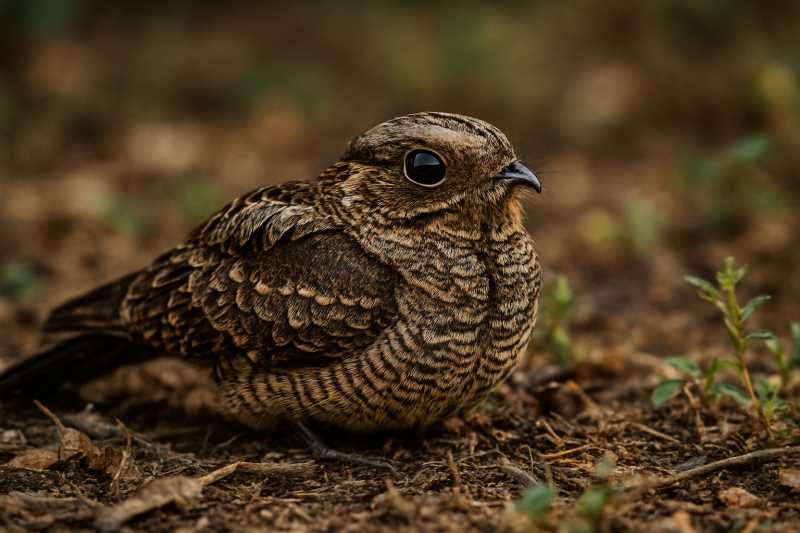
The White-tailed Nightjar is a medium-sized nightjar, measuring approximately 20–23 cm in length. Its upperparts are mottled greyish brown, buff and darker brown, providing effective camouflage when it rests on the ground during daylight. A warm buff collar, pale facial markings and patterned underparts are characteristic of the species.
Adult males usually show conspicuous white markings on the wings and outer tail feathers. The tail may appear slightly forked, with the white outer feathers especially noticeable in flight. Females are generally darker and browner, with less or no white on the wings and tail. Plumage varies geographically, and recognised forms differ in the intensity of their buff, brown and white markings.
Range and Habitat
The species has a broad but discontinuous distribution extending from Costa Rica and Panama through Colombia, Venezuela, the Guianas and northern Brazil. It also occurs on several Caribbean islands, including Trinidad and Tobago, the ABC Islands and Martinique. It is generally regarded as resident rather than a long-distance migrant, although local movements may occur.
White-tailed Nightjars favour open landscapes with patches of low vegetation. Typical habitats include savannas, pastures, open grassland, scrub, hillsides with scattered bushes, forest edges and lightly wooded areas. They may also use modified landscapes where suitable open ground and cover remain available. The species is usually associated with lowland and foothill environments, but precise elevation limits vary across its range.
Behaviour and Diet
The White-tailed Nightjar is primarily nocturnal. It becomes active around dusk and may continue calling and feeding through the night. It often forages by making short sallies from the ground or a low perch, but it can also hawk insects in low flight over grassland and other open areas.
Its diet consists of flying insects, although the relative importance of particular prey groups is not well documented. Moths, beetles and other nocturnal insects are likely to form part of the diet. During the day, the bird usually roosts on the ground beneath sparse vegetation, relying on its cryptic plumage to avoid detection.
Breeding seasons vary geographically and are not fully defined throughout the range. The eggs are laid directly on the ground, without a constructed nest, and a typical clutch consists of two eggs. The eggs and incubating bird are well camouflaged. Males may perform wing-clapping displays during courtship or territorial interactions. Available accounts indicate that the female undertakes incubation, while parental care continues after hatching.
The song is a high, thin, drawn-out whistle, often beginning with a short introductory note. Other reported sounds include a scratchy call associated with flight and short ticking notes when the bird is flushed. Vocal activity is particularly useful for locating the species after dark.
Identification Tips
- Look for a compact, cryptically patterned nightjar in open grassland, savanna, scrub or lightly wooded habitat.
- In flight, the white outer tail feathers and pale wing markings can be conspicuous, especially in males.
- The bird often flies low and briefly before returning to the ground or a low perch.
- At rest, its mottled grey-brown and buff plumage can make it almost invisible against leaf litter, bare soil and sparse grass.
- Listen after dusk for the characteristic thin, high whistle, particularly during the breeding season.
- The Common Pauraque (Nyctidromus albicollis) is a genuinely similar nightjar in parts of the range, but it is generally larger and has different wing, tail and throat markings. The related Ladder-tailed Nightjar (Hydropsalis climacocerca) may also occur in northern South America, but it has a distinctly longer tail and is more closely associated with riverine habitats.
Conservation Status
The White-tailed Nightjar is currently assessed as Least Concern globally. Its broad distribution and apparently large population reduce its immediate global extinction risk, although the population trend is considered to be decreasing. Habitat loss and fragmentation caused by agricultural expansion, deforestation and other land-use changes may reduce local populations, particularly where open habitats are converted or intensively managed.
The species is more vulnerable in some island populations. On Martinique, habitat destruction and introduced predators have been identified as significant concerns, and the island population has received regional conservation attention. Maintaining connected areas of suitable savanna, scrub and open woodland, protecting nesting habitat and monitoring local populations are important conservation measures.
Frequently Asked Questions
Where does the White-tailed Nightjar live?
It occurs in Central America, northern South America and parts of the Caribbean. It is usually found in savannas, pastures, open grasslands, scrub, forest edges and lightly wooded areas.
Is the White-tailed Nightjar migratory?
It is generally considered a resident species rather than a long-distance migrant. Local movements may occur, but regular large-scale migration has not been established as a defining feature of the species.
What does the White-tailed Nightjar eat?
It eats insects caught during nocturnal foraging flights. The diet is not documented in detail, but flying insects such as moths and beetles are likely to be important prey.
When is the White-tailed Nightjar active?
It is active mainly from dusk through the night, when it feeds, calls and performs courtship or territorial displays. During daylight it usually rests on the ground beneath vegetation.
How does the White-tailed Nightjar nest?
The female lays two eggs directly on the ground, with no substantial nest structure. The eggs and adult are camouflaged against the surrounding substrate, and the female is reported to undertake incubation.
What does the White-tailed Nightjar sound like?
Its principal song is a thin, high whistle with a long-drawn-out second note. Other calls include a scratchy sound in flight and short ticking notes when the bird is disturbed.
References
- BirdLife International. n.d. White-tailed Nightjar Hydropsalis cayennensis Species Factsheet. BirdLife DataZone. Accessed 8 September 2026. https://datazone.birdlife.org/species/factsheet/white-tailed-nightjar-hydropsalis-cayennensis
- Ferraro, M. M. L. 2020. White-tailed Nightjar (Hydropsalis cayennensis), version 1.0. In Birds of the World, edited by T. S. Schulenberg. Cornell Lab of Ornithology, Ithaca, New York. https://doi.org/10.2173/bow.whtnig1.01
- Gill, F., D. Donsker and P. Rasmussen, editors. 2026. IOC World Bird List, version 15.2. International Ornithologists’ Union. Accessed 8 September 2026. https://www.worldbirdnames.org/
- U.S. Fish and Wildlife Service. n.d. White-tailed Nightjar, Hydropsalis cayennensis. Species profile. Accessed 8 September 2026. https://www.fws.gov/species/white-tailed-nightjar-hydropsalis-cayennensis
- American Ornithologists’ Union. 1998. Check-list of North American Birds, 7th edition. American Ornithologists’ Union, Washington, DC.
- Piacentini, V. Q., et al. 2015. Annotated checklist of the birds of Brazil by the Brazilian Ornithological Records Committee of the Brazilian Ornithological Society. Revista Brasileira de Ornitologia 23(2): 91–298. https://piacentinilab.com/publication/piacentinietal2015/Piacentinietal2015.pdf
- Dutch Caribbean Species Register. n.d. White-tailed Nightjar Hydropsalis cayennensis. Accessed 8 September 2026. https://www.dutchcaribbeanspecies.org/linnaeus_ng/app/views/species/nsr_taxon.php?cat=CTAB_NAMES&id=189052
Related posts