Introduction
The White Eared Pheasant, Crossoptilon crossoptilon, is a large, ground-dwelling pheasant endemic to the high mountains of south-western China. It belongs to the pheasant family, Phasianidae, and is also known as the Szechuan White Eared Pheasant or Dolan’s Eared Pheasant. Despite its association with the Himalayas, its confirmed distribution is concentrated in China, particularly the eastern Tibetan region, western Sichuan, north-western Yunnan and parts of southern Qinghai. (journal.hep.com.cn)
Physical Description
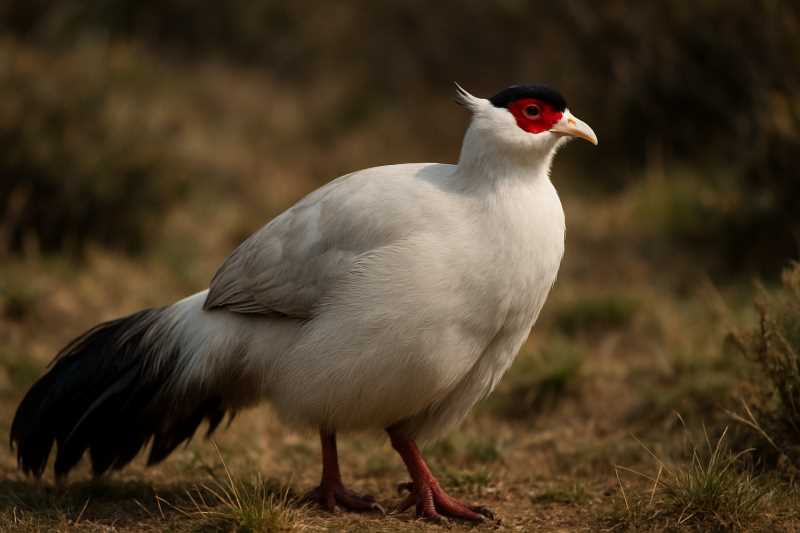
The White Eared Pheasant is approximately 85–96 centimetres long, including its long tail. Males are generally larger than females, but the sexes are broadly similar in colour and pattern. Adult birds have mainly white or pale grey-white body plumage, grey-brown flight feathers, a dark crown and a long tail that becomes darker and more metallic towards the tip.
Distinctive white ear tufts project from the sides of the head. The bare facial skin is bright red, while the bill and legs are also pinkish or red. Adult males possess a spur, whereas the female’s spur is absent or greatly reduced. Juveniles are less distinctive and generally have duller plumage than adults. (yllhj.beijing.gov.cn)
Range and Habitat
The species is endemic to China. Its range includes western Sichuan, north-western Yunnan, eastern Qinghai and eastern Tibet. It occupies high-elevation landscapes, usually between about 3,000 and 4,500 metres, although the precise elevation varies with locality and season. In parts of western Sichuan, breeding birds have been recorded in subalpine coniferous forest at approximately 3,300–4,050 metres, with some birds moving to lower elevations during winter. (journal.hep.com.cn)
Suitable habitat includes mixed deciduous and coniferous forest, subalpine coniferous forest, alpine shrubland, shrub meadow and forest edges. Winter habitat studies indicate that the species is associated with tree and shrub cover, nearby permanent water and vegetation that provides both food and protection from predators. It is a resident species, but local seasonal movements to lower elevations may occur. (cambridge.org)
Behaviour and Diet
White Eared Pheasants are mainly terrestrial and usually forage by walking and scratching among leaf litter, soil and low vegetation. Their diet consists largely of plant material, including roots, bulbs or tubers, seeds, leaves and other vegetation. They may also take small invertebrates, particularly when feeding young, although detailed information about the species’ diet remains limited.
The birds are generally gregarious outside the breeding season and may form sizeable groups. During the breeding period, pairs become more closely associated. The species is capable of short, powerful flights but normally spends most of its time on the ground in forest, shrubland and rocky mountain habitats.
Breeding generally takes place from spring into early summer. The nest is a concealed ground scrape or shallow nest placed beneath shrubs, trees, fallen trunks, rock walls or other cover. Studies in western Sichuan recorded clutches of approximately 5–11 eggs, with an average of about seven eggs in one study. Other field observations recorded typical clutches of 6–9 yellow-brown eggs. The female incubates alone for about 28–29 days. Chicks are precocial and leave the nest soon after hatching, remaining with the female and later rejoining the species’ social groups. (journal.hep.com.cn)
Identification Tips
Look for the following combination of features:
- A large, long-tailed pheasant with mainly white or pale grey-white plumage.
- Bright red bare facial skin and red or pinkish legs.
- Short white ear tufts projecting from the sides of the head.
- A dark crown and darker, often metallic-looking tail feathers.
- A preference for walking in groups through high-elevation forest, shrubland and forest edges rather than remaining in trees.
The Blue Eared Pheasant, Crossoptilon auritum, is a possible comparison where the ranges approach one another. It is generally darker grey-blue overall, whereas the White Eared Pheasant is principally white or pale grey-white. The Brown Eared Pheasant, Crossoptilon mantchuricum, is substantially darker brown and occurs farther north and east in China.
Conservation Status
The White Eared Pheasant is listed as Near Threatened on the IUCN Red List. The species is not classified as Vulnerable, Endangered or Critically Endangered, but its restricted range and dependence on high-elevation forest and shrub habitats warrant continued monitoring. (nc.iucnredlist.org)
Important pressures include habitat degradation, selective logging, fuelwood collection, disturbance, grazing and the loss or fragmentation of suitable forest and shrubland. Hunting may also affect local populations. Research in south-western China has highlighted the importance of retaining tree and shrub cover, protecting nesting habitat and reducing pressure from logging and fuelwood use. The species is protected in China and occurs in protected areas within its range, but effective management and reliable population monitoring remain important conservation priorities. (cambridge.org)
Frequently Asked Questions
Where does the White Eared Pheasant live?
It is endemic to China, where it occurs in high mountain areas of western Sichuan, north-western Yunnan, eastern Qinghai and eastern Tibet. It uses subalpine forest, alpine shrubland, shrub meadow and forest edges.
How high in the mountains does it occur?
The species is usually found at elevations of about 3,000–4,500 metres. Local records vary, and some populations move to lower elevations during winter.
What does the White Eared Pheasant eat?
It feeds mainly on plant material, including roots, bulbs or tubers, seeds and leaves. Small invertebrates may also be taken, particularly during the breeding season.
Are male and female White Eared Pheasants different in colour?
The sexes are broadly alike. Males are generally larger and have a well-developed spur, while females are slightly smaller and have a reduced or absent spur.
Where does the White Eared Pheasant build its nest?
It nests on the ground, usually beneath shrubs, trees, fallen trunks, rock walls or other dense cover. Concealment is important because the eggs and chicks are vulnerable to predators.
Is the White Eared Pheasant endangered?
The species is currently classified as Near Threatened by the IUCN. Its restricted mountain range and continuing habitat pressures mean that protection of forest, shrubland and nesting areas remains important.
References
- BirdLife International. 2024. Crossoptilon crossoptilon assessment and taxonomy resources. BirdLife DataZone. Available from: https://datazone.birdlife.org/ . Accessed 8 September 2026.
- International Union for Conservation of Nature. 2024. IUCN Red List of Threatened Species, version 2024-2: Table 7, taxonomic changes and status information. IUCN, Gland, Switzerland and Cambridge, UK. Available from: https://nc.iucnredlist.org/redlist/content/attachment_files/2024-2_RL_Table_7.pdf. Accessed 8 September 2026.
- IOC World Bird List. 2026. IOC World Bird List, version 15.2. Edited by Frank Gill, David Donsker and Pamela Rasmussen. Available from: https://www.worldbirdnames.org/new/ . Accessed 8 September 2026.
- Jia, F., Wang, N. and Zheng, G.-M. 2005. Winter habitat requirements of White Eared-pheasant Crossoptilon crossoptilon and Blood Pheasant Ithaginis cruentus in south-west China. Bird Conservation International, 15(3), 303–312. https://doi.org/10.1017/S095927090500047X.
- Wang, N., Jia, F. and Zheng, G.-M. 2006. Nest-site selection of the White Eared pheasant in southwestern Sichuan Province, China. Frontiers of Biology in China, 1, 66–70. https://doi.org/10.1007/s11515-005-0016-1.
- Wu, Y. and Peng, J.-T. 1996. Breeding ecology of the White Eared-Pheasant (Crossoptilon crossoptilon) in western Sichuan, China. Journal of the Yamashina Institute for Ornithology, 28(2), 98–102. Available from: https://www.jstage.jst.go.jp/article/jyio1952/28/2/28_2_98/_pdf. Accessed 8 September 2026.
- Beijing Municipal Forestry and Parks Bureau. 2005. Tibetan Eared Pheasant, Crossoptilon crossoptilon. Government of Beijing. Available from: https://yllhj.beijing.gov.cn/ztxx/ysdw/zygk/nlzy/201510/t20151013_120756.shtml. Accessed 8 September 2026.
- Li, X., Huang, Y. and Lei, F. 2024. High-quality genome assembly of a C. crossoptilon and related functional and genetics data resources. GigaScience, 13. Available from: https://pmc.ncbi.nlm.nih.gov/articles/PMC10899641/. Accessed 8 September 2026.
Related posts