
The Enigmatic White-bellied Kingfisher: A Jewel of Nature’s Avian Collection
The White-bellied Kingfisher (Corythornis leucogaster) is a remarkable member of the Alcedinidae family, captivating bird enthusiasts and ornithologists alike with its vibrant plumage and elusive nature. Native to the dense forests of West and Central Africa, this avian marvel remains a symbol of the rich biodiversity found within these regions. Despite its allure, the White-bellied Kingfisher is shrouded in mystery, largely due to its elusive habits and the challenging environments it inhabits.
Habitat and Distribution
The White-bellied Kingfisher is predominantly found in lowland tropical forests, thriving in moist and dense environments that offer both cover and sustenance. Its range extends from Sierra Leone in West Africa, through countries like Ghana and Nigeria, reaching as far east as the Democratic Republic of Congo in Central Africa. This bird’s preference for secluded, dense forested areas makes it particularly difficult to observe in the wild, contributing to the limited data available on its population and behaviors.
Physical Characteristics
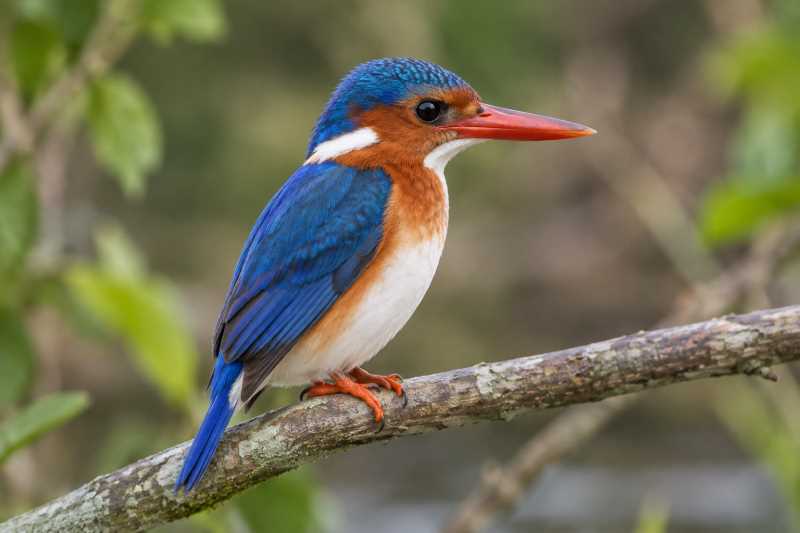
Measuring approximately 15 cm in length, the White-bellied Kingfisher is relatively small compared to other kingfisher species. Its most striking feature is undoubtedly its iridescent blue and green plumage, which contrasts beautifully with its white underparts – a characteristic trait that gives the bird its name. The bird’s compact build, coupled with its short tail and legs, allows it to maneuver effortlessly through the dense foliage of its habitat.
The White-bellied Kingfisher’s beak is a bright orange-red, perfectly adapted for its diet and feeding habits. Its eyes are positioned to provide excellent binocular vision, crucial for hunting and navigation through its forested environment.
Diet and Feeding Habits
As a carnivorous bird, the White-bellied Kingfisher primarily feeds on insects, small crustaceans, and occasionally small fish and amphibians. It employs a sit-and-wait strategy, perching quietly until prey approaches, after which it swiftly launches to capture its meal. This method of feeding is both energy-efficient and effective, allowing the bird to thrive in its resource-rich yet competitive environment.
Reproduction and Lifespan
The breeding habits of the White-bellied Kingfisher are not extensively documented, largely due to the difficulty in observing these birds in their natural habitat. However, like many kingfisher species, they are believed to be monogamous, forming pairs that work collaboratively to raise their young. Nesting usually occurs in burrows excavated in riverbanks or within decaying wood, providing a safe haven for their eggs and chicks.
Chicks are typically altricial, meaning they are born relatively undeveloped and require significant parental care before they are ready to fledge. This care includes feeding, protection, and teaching the young to hunt effectively.
Conservation Status
The International Union for Conservation of Nature (IUCN) currently lists the White-bellied Kingfisher as Least Concern, indicating that it does not face any immediate threat of extinction. However, ongoing deforestation and habitat loss in its native regions pose significant long-term threats to its population. Conservation efforts are crucial to ensure the preservation of the lush forest environments that these birds and countless other species call home.
Cultural Significance and Human Interaction
In many African cultures, birds hold symbolic meanings and are often featured in folklore and traditional stories. The White-bellied Kingfisher, with its striking appearance, is no exception. It is often seen as a symbol of beauty and dexterity, admired for its agility and the vibrant splash of colors it brings to its forested realm.
Human interaction with the White-bellied Kingfisher is limited, primarily due to its elusive nature. Birdwatchers and researchers who venture into its habitat are often rewarded with a rare glimpse of this avian gem, a sighting that is both a privilege and a testament to the rich biodiversity that still thrives in these rapidly changing ecosystems.
Conclusion
The White-bellied Kingfisher stands as a testament to the wonders of avian diversity, showcasing the intricate balance of form and function that evolution has crafted over millennia. Its vibrant appearance and elusive nature make it a treasured subject of study and admiration. As we continue to unravel the mysteries of this enigmatic bird, it serves as a reminder of the delicate ecosystems that require our attention and conservation efforts. Protecting the habitats of such species is not just about preserving individual birds, but about safeguarding the entirety of the vibrant ecosystems they inhabit.
Related posts


