Introduction
The Tepui Swift (Streptoprocne phelpsi) is a specialised swift of the Pantepui region, where Venezuela, western Guyana and northern Brazil meet. It is closely associated with tepui landscapes, including cliffs, rocky gorges, waterfalls, montane forests and open grasslands. Although much remains unknown about its biology, the species is regularly recorded in suitable parts of its restricted range.
Physical Description
The Tepui Swift is a medium-sized swift, measuring about 16.5 centimetres in length. It has a streamlined body, long pointed wings and a distinctly forked tail, all of which support fast, manoeuvrable flight.
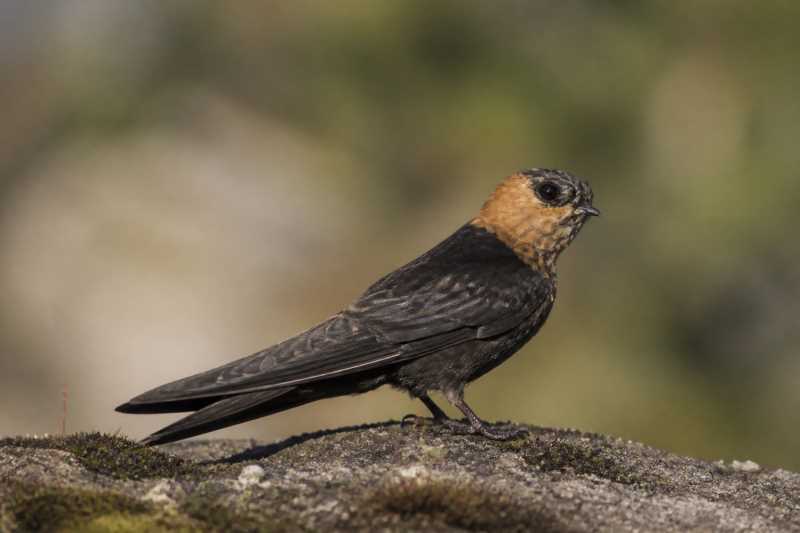
Adults are mainly sooty black. The most distinctive feature is the broad orange-chestnut collar, which extends around the neck and includes the throat, chin, upper breast and much of the face. Females resemble males but may have a paler, less richly coloured collar. Immature birds generally show paler greyish edges to the feathers of the underparts, giving them a slightly scaled or fringed appearance.
The species is best identified by the combination of its dark body, warm orange-chestnut head and throat markings, deeply forked tail and association with tepui country. Plumage can appear less colourful in poor light or when birds are seen at a distance.
Range and Habitat
The Tepui Swift occurs in the Pantepui region of southeastern Venezuela, western Guyana and far northern Brazil. Its distribution is closely linked to the isolated sandstone plateaux and surrounding highlands known as tepuis, although birds also forage over nearby forest, savannah and river valleys.
It uses humid montane forest, lowland evergreen forest, seasonally wet grassland, cliffs, rocky canyons, caves and waterfall gorges. Many observations come from birds flying over open areas or along escarpments rather than from birds perched in vegetation.
Most records come from roughly 400 to 1,400 metres above sea level, but the species can occur higher. A documented nest on Mount Roraima was found at 2,630 metres, demonstrating that it can use high-elevation cliff and cave habitat.
The Tepui Swift is generally regarded as resident within the Pantepui region, although occasional movements or wandering beyond its usual range have been suggested. It is a restricted-range species rather than a long-distance migrant in the usual sense.
Where to See This Species
Canaima National Park, Bolívar, Venezuela
Canaima National Park contains extensive tepui terrain and is one of the most realistic places to look for the Tepui Swift. The species has been documented in the park, including around the Mount Roraima sector. Look above cliffs, waterfalls, forest edges, savannah and open valleys, particularly during periods of active aerial feeding.
Nearby accommodation: Canaima village is the main practical gateway, with local lodges, guest houses and other visitor accommodation. Access to remote tepui areas normally requires local guides and organised transport.
Mount Roraima, Bolívar, Venezuela, and adjoining border region
Mount Roraima has produced repeated records of Tepui Swifts, including observations of large flocks and a documented breeding record from a cave entrance on the summit. The species may be seen flying over the approach trails, summit plateau, cliffs and surrounding savannah. Visits are generally made on guided multi-day treks, and weather can change rapidly at high elevation.
Nearby accommodation: Santa Elena de Uairén is the principal Venezuelan gateway, with guest houses, small hotels, campsites and trekking services. Overnight camping is normally required during the ascent.
Estância Ecológica Sesc Tepequém, Roraima, Brazil
The Estância Ecológica Sesc Tepequém is a recognised wildlife-viewing venue in the Serra do Tepequém, a highland area of northern Brazil. Tepui Swifts have been recorded in the wider Tepequém area, and the combination of rocky slopes, forest, waterfalls and open highland habitat provides suitable conditions for searching the sky above the escarpments.
Nearby accommodation: Vila do Paiva and the Tepequém area offer guest houses, small lodges, campsites and self-catering accommodation. The ecological estate itself also provides visitor accommodation.
Behaviour and Diet
The Tepui Swift is diurnal and spends most of its time in flight. It is an aerial insectivore that catches flying invertebrates above forest, grassland, rivers, cliffs and open valleys. The precise composition of its diet is poorly documented, but it is likely to include a variety of small flying insects.
It may occur alone or in groups, and flocks of 10 to 20 birds or more have been recorded. Mixed flocks with White-collared Swifts (Streptoprocne zonaris) can occur, although the two species should be separated by their different collar colours and overall appearance.
Breeding biology remains incompletely known. Nests have been found on cliffs, rocky ledges and inside caves or grottoes. A documented nest consisted of plant material, including rootlets and moss, placed on a rock shelf. The species may nest colonially, and breeding activity appears to occur during the wetter part of the year in at least some areas, but the timing may vary geographically.
Identification Tips
- Look for a dark swift with a clearly forked tail and a warm orange-chestnut collar around the throat and upper breast.
- Watch cliffs, waterfalls, rocky gorges, tepui escarpments and open savannah near forest.
- The species is often identified in flight, so binocular views may be brief. Focus first on the collar colour and deeply forked tail.
- Females may show a paler collar, while immature birds can have pale feather edges on the underparts.
- Do not confuse it with the White-collared Swift, which has a conspicuous white collar and is generally larger. The Chestnut-collared Swift is a closer comparison, but it is smaller and has a less deeply forked tail.
Conservation Status
The Tepui Swift is currently assessed as Least Concern. Its global population size has not been reliably quantified, and some assessments indicate that the population may be decreasing.
The species occupies a restricted mountain region containing many isolated habitats. Potential long-term pressures include deforestation in surrounding lowlands, mining, disturbance of cliff and cave sites, changing rainfall patterns and climate-driven changes to high-elevation ecosystems. The severity of these pressures for the Tepui Swift itself remains poorly understood.
Protecting the tepui landscape, maintaining forest and river corridors, limiting damaging mining activity and safeguarding caves, cliffs and waterfall gorges are important conservation measures. Further field research is also needed to clarify population size, movements, breeding success and habitat requirements.
Frequently Asked Questions
Where does the Tepui Swift live?
The Tepui Swift lives mainly in the Pantepui region of southeastern Venezuela, western Guyana and northern Brazil. It is associated with tepuis, surrounding highlands, montane forest, lowland forest, grassland, cliffs and rocky gorges.
What does the Tepui Swift look like?
It is a dark, medium-sized swift with a deeply forked tail and a broad orange-chestnut collar around the throat, face and upper breast. Females may have a paler collar, and immature birds often show pale feather edges below.
What does the Tepui Swift eat?
It feeds on flying invertebrates caught in the air. The exact diet has not been studied in detail, but it is an aerial insectivore that forages over forests, grasslands, rivers, cliffs and open valleys.
Is the Tepui Swift migratory?
The species is generally considered resident within the Pantepui region. Occasional wandering or movements outside the usual range have been suggested, but it is not regarded as a regular long-distance migrant.
Where is the best place to see a Tepui Swift?
Canaima National Park and Mount Roraima in Venezuela are among the best-documented places to look. The wider Serra do Tepequém area in northern Brazil is another possible location. Local guides are important because many suitable sites are remote and difficult to access.
Is the Tepui Swift endangered?
No. The species is currently classified as Least Concern, although its population may be decreasing and its restricted tepui habitat could be vulnerable to deforestation, mining, climate change and disturbance.
References
- BirdLife International
- IUCN Red List of Threatened Species
- The Wilson Journal of Ornithology
Related posts