Introduction
The Sunda Teal, Anas gibberifrons, is a small to medium-sized dabbling duck in the family Anatidae. It occurs mainly in Indonesia and Timor-Leste, where it uses a broad range of freshwater, brackish and coastal wetlands. The species was formerly treated more broadly in some taxonomies, but the Sunda Teal is now generally recognised as a separate species from the Grey Teal and Andaman Teal.
Physical Description
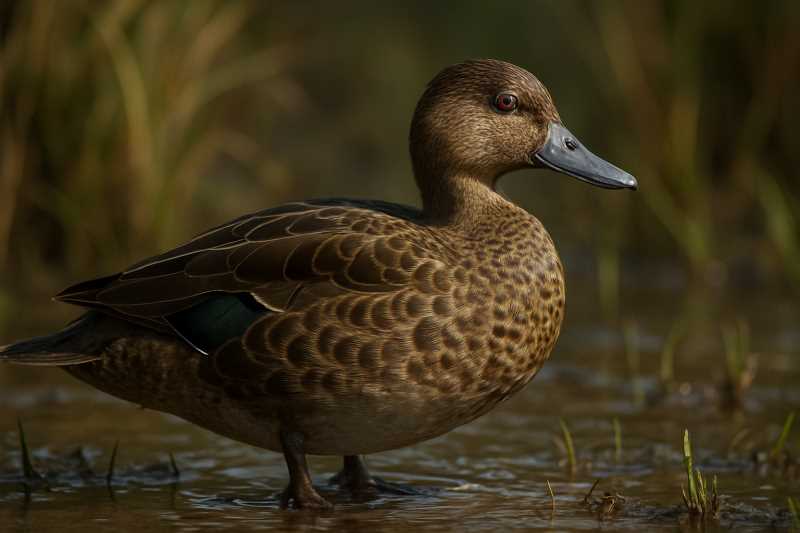
The Sunda Teal measures approximately 37–47 cm in length, with a wingspan of about 60–67 cm. Adults have predominantly mottled grey-brown plumage, a darker crown and upperparts, and paler throat and cheek areas. The wings show a conspicuous white band and a dark speculum with a greenish gloss, features that are particularly useful in flight. The iris is reddish, while the bill, legs and feet are generally grey.
Males and females are broadly similar in colour, although adult males may show a more noticeable bulging forehead. Juveniles are generally paler, especially on the head, and lack some of the stronger adult contrasts. The bill is grey rather than blue, as sometimes stated in less reliable descriptions.
Range and Habitat
The Sunda Teal is distributed across parts of Indonesia, including Sumatra, Java, Bali, Sulawesi and the Lesser Sunda Islands, extending eastwards to Timor and nearby islands. It is also recorded in Timor-Leste. Records from Borneo exist, but the species’ status and distribution there require careful interpretation because of identification and taxonomic issues.
It occupies open wetlands and wetland margins, including shallow freshwater lakes, marshes, swamps, rice fields, mangrove edges, estuaries, tidal creeks and brackish fishponds. It may occur from sea level to inland areas at moderate elevations. The species is generally resident, although local or seasonal movements between wetlands and islands may occur.
Behaviour and Diet
Sunda Teals are usually seen singly, in pairs or in small groups, although larger gatherings may form where suitable food and shallow water are available. They are active during the day but can also be vocal and mobile at night. The male’s call has been described as a soft whistle or peep, while the female gives a louder, more typical duck-like call.
Like other dabbling ducks, the Sunda Teal feeds in shallow water by tipping forward, dabbling and filtering food from mud and water. Its diet includes seeds and vegetative parts of aquatic and shoreline plants, grasses, sedges, aquatic insects and larvae, molluscs and small crustaceans. Small fish should not be regarded as a characteristic or well-established part of its diet.
Breeding timing varies geographically. In Java, breeding has been reported mainly from April to August, with some additional records in November, while breeding-condition birds and young have been recorded at other times in the Lesser Sundas and Sulawesi. Nests are usually concealed close to water in dense vegetation, although tree holes and other sheltered cavities have also been reported. Clutches commonly contain about seven to nine eggs, and incubation has been reported to last approximately 24–26 days. Ducklings are precocial and leave the nest soon after hatching under the care of the female.
Identification Tips
- Look for a compact, brown-grey duck with a dark crown, pale throat and cheeks, and a reddish eye.
- In flight, check for the broad white wing bar, dark glossy speculum and pale axillaries.
- The species is usually less strongly patterned than many brightly coloured tropical ducks, so the head profile and wing pattern are important.
- The slightly swollen or bulbous forehead can help identify an adult male.
- The Sunda Teal may resemble the female Chestnut Teal, Anas castanea. The Sunda Teal is generally paler around the face and neck and has a more noticeable forehead profile, while the Chestnut Teal has stronger regional sexual differences in plumage.
- Do not confuse the Sunda Teal with the Grey Teal, Anas gracilis, where the two occur near one another. Identification may require close attention to head shape, facial tones, wing pattern and local distribution.
Conservation Status
The Sunda Teal is currently listed as Least Concern on the IUCN Red List. The species nevertheless depends on wetlands that are vulnerable to drainage, conversion, pollution, aquaculture development, settlement and other forms of habitat modification. Hunting is also a documented local concern in parts of Indonesia.
The available evidence does not support presenting a single global population estimate here. Conservation priorities include protecting shallow freshwater and coastal wetlands, maintaining mangrove and marsh habitat, managing disturbance and hunting, and improving monitoring in areas where the species is uncommon or difficult to distinguish from related teals.
Frequently Asked Questions
Where does the Sunda Teal live?
The Sunda Teal occurs mainly in Indonesia and Timor-Leste. It uses freshwater lakes, marshes, swamps, rice fields, mangrove margins, estuaries, tidal creeks and other shallow wetlands.
Is the Sunda Teal migratory?
It is generally considered resident rather than a long-distance migrant. Local and seasonal movements between wetlands or islands may occur in response to rainfall, water levels and food availability.
What does the Sunda Teal eat?
Its diet consists mainly of aquatic and shoreline vegetation, seeds, grasses, sedges, aquatic insects and larvae, molluscs and small crustaceans. It usually feeds by dabbling in shallow water.
How can the Sunda Teal be identified?
Look for a mottled grey-brown duck with a dark crown, pale throat and cheeks, reddish eyes, a grey bill and a distinctive white-and-dark wing pattern. Adult males may have a more pronounced bulging forehead.
Does the Sunda Teal have a blue bill?
No. The bill is generally grey, although lighting and individual variation can affect its appearance. Descriptions of a blue bill are not reliable for this species.
What is the conservation status of the Sunda Teal?
The Sunda Teal is currently classified as Least Concern. Its wetlands remain vulnerable to habitat loss, degradation, disturbance and local hunting, so regional conservation and monitoring are still important.
References
- BirdLife International. 2026. Sunda Teal Anas gibberifrons Species Factsheet. BirdLife DataZone. Available at: https://datazone.birdlife.org/species/factsheet/sunda-teal-anas-gibberifrons. Accessed 8 September 2026.
- Gill, F., Donsker, D. and Rasmussen, P., eds. 2026. IOC World Bird List, version 15.2. International Ornithologists’ Union. Available at: https://www.worldbirdnames.org/. Accessed 8 September 2026.
- International Union for Conservation of Nature. 2025. Table 7: Species changing IUCN Red List Status, 2024–2025. IUCN Red List of Threatened Species. Available at: https://nc.iucnredlist.org/redlist/content/attachment_files/2025-2_RL_Table7.pdf. Accessed 8 September 2026.
- Carboneras, C., Christie, D. A. and Kirwan, G. M. 2020. Sunda Teal, Anas gibberifrons. In del Hoyo, J., Elliott, A., Sargatal, J., Christie, D. A. and de Juana, E., eds, Birds of the World. Cornell Lab of Ornithology. https://doi.org/10.2173/bow.suntea1.01.
- Gonzalez, J., Düttmann, H. and Wink, M. 2009. Phylogenetic relationships based on two mitochondrial genes and hybridisation patterns in Anatidae. Journal of Zoology, 279(3), 310–318. https://doi.org/10.1111/j.1469-7998.2009.00622.x.
- Wibowo, A., Basukriadi, A., Nurdin, E. and Nasution, N. S. 2022. Habitat suitability spatial model of Near Threatened Sunda Teal Anas gibberifrons in Muara Angke Wetlands, Jakarta, Indonesia. Treubia, 49(1), 1–14. https://doi.org/10.14203/treubia.v49i1.4364.
- Iqbal, M. 2016. Status of Sunda Teal Anas gibberifrons in South Sumatra. Kukila, 19, 31–36. Available at: https://www.researchgate.net/publication/316075498_Status_of_Sunda_Teal_Anas_gibberifrons_in_South_Sumatra. Accessed 8 September 2026.
Related posts