Streak-headed Mannikin: Nature’s Intricate Artisan
In the lush, biodiverse forests of New Guinea and its surrounding islands, the Streak-headed Mannikin (Mayrimunia tristissima) thrives as a vibrant testament to the intricate beauty of avian life. This small bird, belonging to the family Estrildidae, captivates bird enthusiasts and researchers alike with its striking plumage and complex social behaviors.
Taxonomy and Classification
The Streak-headed Mannikin is a member of the Estrildidae family, commonly known as waxbills, which encompasses a wide range of small passerine birds. The genus Mayrimunia, to which this species belongs, is closely related to other mannikins and munias. The species name, ‘tristissima,’ aptly translates to ‘saddest,’ possibly referring to its subdued yet sophisticated coloration.
Physical Description
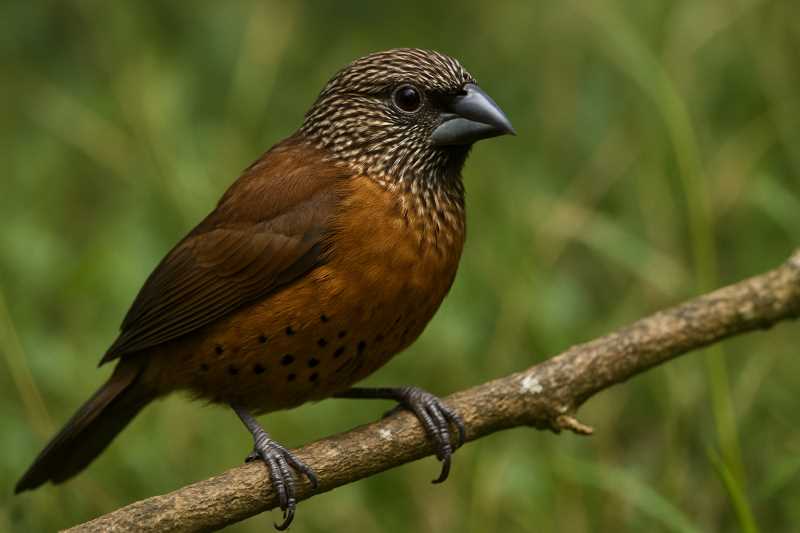
The Streak-headed Mannikin is characterized by its small size, measuring approximately 10-12 cm in length, and weighing around 10-15 grams. Its plumage is a melange of earthy tones, predominantly featuring streaks of brown and black across the head, which gives the bird its common name. The body exhibits a subtle gradation from olive-brown to a lighter, buff underbelly. The eyes are dark, adding a sharp contrast to the bird’s overall muted palette, and the beak is stout and conical, perfectly adapted for its granivorous diet.
Habitat and Distribution
This species is endemic to New Guinea and nearby islands, including the Aru Islands and parts of the Maluku Islands in Indonesia. It thrives in lowland to montane forests, often favoring edges and clearings where food sources are abundant. The Streak-headed Mannikin is particularly adaptable and can sometimes be found in human-altered landscapes such as gardens and plantations, provided that the vegetation is sufficiently dense.
Diet and Foraging Behavior
Primarily granivorous, the Streak-headed Mannikin feeds on a variety of seeds, grasses, and grains. Its strong, conical beak is an efficient tool for cracking open seeds. In the wild, these birds are often observed foraging in flocks, which allows them to efficiently exploit food resources while also providing protection against predators. Occasionally, they supplement their diet with small insects and larvae, especially during the breeding season when the demand for protein is higher.
Breeding and Reproduction
The breeding season for the Streak-headed Mannikin typically coincides with the rainy season, when food is plentiful. These birds are monogamous, forming strong pair bonds that often last several breeding seasons. Courtship involves a series of intricate displays, including bowing, wing flicking, and vocalizations.
Nests are constructed by both sexes and are typically spherical structures made from grass, leaves, and feathers. These nests are usually situated in dense foliage to provide concealment from predators. The female lays a clutch of 3-6 eggs, which are incubated by both parents for about two weeks. After hatching, the chicks are altricial, requiring extensive parental care. Both parents partake in feeding the young, regurgitating partially digested seeds and insects to meet the chicks’ nutritional needs.
Social Structure and Behavior
Streak-headed Mannikins are highly social, often forming large flocks that can number in the hundreds outside of the breeding season. This gregarious nature is a crucial survival strategy, as it reduces the risk of predation and enhances foraging efficiency. Within these flocks, complex social hierarchies are observed, with dominant individuals often securing better access to resources.
Conservation Status
Currently, the Streak-headed Mannikin is listed as Least Concern by the IUCN Red List. This status reflects its wide distribution and relatively stable population numbers. However, habitat loss due to deforestation and changes in land use pose potential threats. Conservation efforts focus on preserving natural habitats and promoting sustainable land use practices to ensure the species’ continued survival.
Conclusion
The Streak-headed Mannikin is a remarkable species that exemplifies the rich biodiversity of New Guinea’s avian fauna. Its intricate social structures, adaptive foraging strategies, and striking appearance make it a subject of interest for ornithologists and bird watchers. As with many wildlife species, continued conservation efforts are essential to maintain its habitat and ensure that future generations can appreciate this fascinating bird in its natural environment.
Related posts