Introduction
The Plumed Whistling Duck (Dendrocygna eytoni) is a long-necked Australian waterfowl species in the family Anatidae. It is best known for its pale brown plumage, conspicuous flank plumes, pink-and-dark bill, pink legs and loud whistling calls. Although associated with wetlands, it often feeds on nearby grasslands and may gather in flocks ranging from a few birds to many thousands.
Physical Description
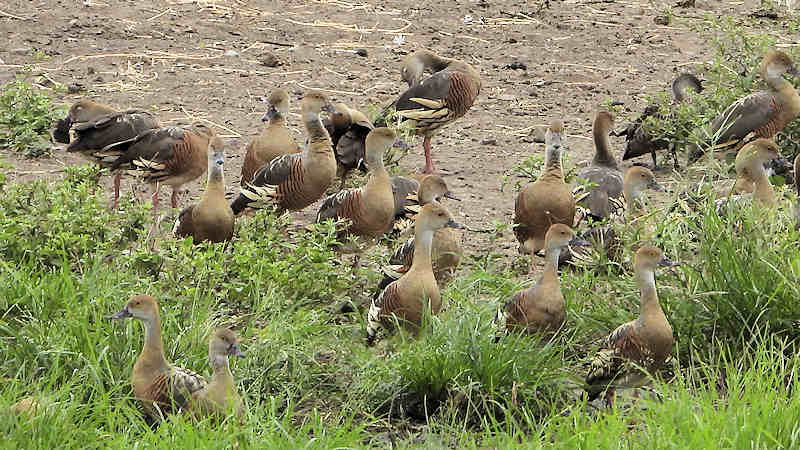
The Plumed Whistling Duck is a medium-sized, upright duck measuring approximately 41–62 cm in length. It has a honey-brown head and neck, a pale chestnut breast with fine dark barring, and yellowish-brown upperparts. The most distinctive feature is the set of long, pale yellow to off-white lanceolate feathers on the flanks. These plumes have dark edges and project upwards towards the folded wings.
The bill is pink or pinkish-grey with dark markings, while the legs and feet are pale pink. The sexes are very similar in colour and pattern, although males may have slightly longer flank plumes. Juveniles are generally duller and paler, with less strongly marked flanks and shorter flank feathers.
Range and Habitat
The Plumed Whistling Duck is native to Australia. Its main range extends across northern Australia, through Queensland and into northern and eastern New South Wales, with records reaching the Murray, Murrumbidgee and upper Darling catchments. Occasional birds have also been recorded outside the usual range, including in New Zealand, but these records do not represent an established breeding population.
It inhabits freshwater wetlands, floodplains, lagoons, swamps, shallow marshes and the grasslands surrounding them. It may also use artificial waterbodies, pasture and other open agricultural landscapes where suitable feeding and roosting conditions remain. During dry periods, birds commonly congregate beside permanent water. Following seasonal rain, they may disperse to temporary wetlands and flooded grasslands.
Behaviour and Diet
Plumed Whistling Ducks are highly social and commonly form large feeding and roosting flocks. During the day, they usually rest, preen and sleep on the margins of lagoons, swamps or other waterbodies. They often leave the water at dusk or during the night to feed on nearby grasslands, sometimes travelling considerable distances between roosting and feeding sites.
The species is primarily herbivorous. It grazes on short grasses and other terrestrial plants, often feeding in a goose-like manner, and may also dabble in shallow water for aquatic vegetation and seeds. Flocks are vocal, producing high-pitched whistles and constant twittering, while the wingbeats can also create a characteristic whistling sound.
Breeding generally begins during the tropical wet season, when food and cover are more readily available. Pairs are thought to form long-term bonds, but the birds continue to live within larger flocks. The nest is a shallow depression on the ground, usually placed in long grass or other vegetation and generally away from the immediate edge of open water. A clutch usually contains 8–14 whitish eggs. Both adults incubate the eggs for about 28 days and guard the ducklings after hatching. Young birds are precocial and remain with the adults until they become independent and develop their flight feathers.
Identification Tips
Look for a tall, upright duck with a long neck, pale brown plumage and pink legs. The most reliable field mark is the group of long, pale, black-edged flank plumes that extend upwards over the sides of the back.
Other useful identification features include:
- A pink bill with dark freckles or mottling.
- A pale face and foreneck, contrasting with a darker crown and hind neck.
- A pale chestnut breast finely barred with dark brown.
- A loud, high-pitched whistling call, especially when birds are flying or gathered in flocks.
- A preference for grazing on land near wetlands rather than remaining constantly on open water.
The species most likely to cause confusion in Australia is the Wandering Whistling Duck (Dendrocygna arcuata). The Plumed Whistling Duck is generally paler and has much more prominent pale flank plumes, whereas the Wandering Whistling Duck usually has a darker back, crown and legs.
Conservation Status
The Plumed Whistling Duck is currently listed as Least Concern on the IUCN Red List. It has a broad Australian distribution and is locally common, sometimes occurring in very large flocks. A precise current population estimate and definitive long-term population trend should not be inferred from local observations alone.
The species depends on functioning wetlands, seasonal flooding and suitable surrounding grasslands. Potential pressures include drainage or degradation of wetlands, altered water regimes, intensive development of floodplains, water pollution and loss of feeding habitat. Maintaining permanent wetland refuges, protecting seasonal wetlands and managing water and agricultural landscapes sustainably are important conservation measures.
Frequently Asked Questions
Where does the Plumed Whistling Duck live?
It is native to Australia and occurs mainly across northern Australia, Queensland and parts of New South Wales. It uses freshwater wetlands, floodplains, lagoons, swamps and nearby grasslands.
Is the Plumed Whistling Duck migratory?
It is not regarded as a long-distance migrant. Instead, it makes seasonal movements between permanent water and temporary wetlands in response to rainfall, flooding and food availability.
What does the Plumed Whistling Duck eat?
It feeds mainly on grasses and other plant material. It also takes seeds and aquatic vegetation by grazing on land and dabbling in shallow water.
How can the species be identified?
The combination of a long neck, pale brown plumage, pink-and-dark bill, pink legs and long pale flank plumes is distinctive. Its loud whistling calls are also useful for locating flocks.
Where does it build its nest?
The nest is a shallow ground depression, usually hidden in long grass or other vegetation. It is commonly placed away from the immediate water margin, where it is less exposed to rising water.
Is the Plumed Whistling Duck threatened?
The species is currently classified as Least Concern globally. Nevertheless, wetland drainage, altered flooding patterns, pollution and loss of adjacent grassland can reduce the quality of habitat available to local populations.
References
- BirdLife International. n.d. “Plumed Whistling-duck Dendrocygna eytoni Species Factsheet.” BirdLife DataZone. https://datazone.birdlife.org/species/factsheet/plumed-whistling-duck-dendrocygna-eytoni. Accessed 8 September 2026.
- BirdLife Australia. 2026. “Plumed Whistling-Duck.” BirdLife Australia Bird Profiles. https://birdlife.org.au/bird-profiles/plumed-whistling-duck/. Accessed 8 September 2026.
- International Ornithologists’ Union. 2025. “IOC World Bird List, Version 15.2.” World Bird Names. https://www.worldbirdnames.org/. Accessed 8 September 2026.
- McKay, L. 2013. “Dendrocygna eytoni, Plumed Whistling Duck.” Museums Victoria Collections. https://collections.museumsvictoria.com.au/species/5728. Accessed 8 September 2026.
- Marchant, S. and Higgins, P. J., eds. 1990. Handbook of Australian, New Zealand and Antarctic Birds. Volume 1: Ratites to Ducks. Oxford University Press, Melbourne.
- Williams, M. J. 2013, updated 2025. “Plumed Whistling Duck.” In C. M. Miskelly, ed., New Zealand Birds Online. https://www.nzbirdsonline.org.nz/species/plumed-whistling-duck. Accessed 8 September 2026.
Related posts